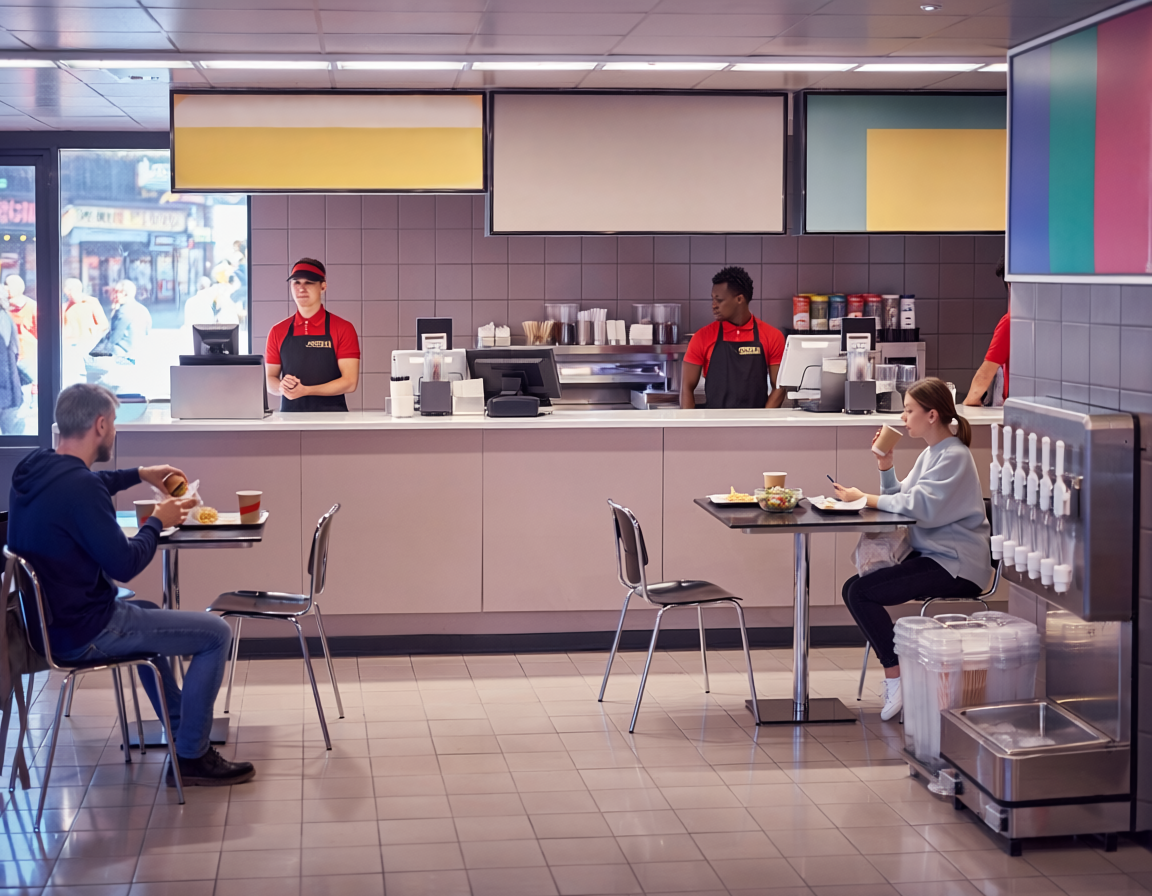
There is a particular kind of economic early warning signal that arrives not in the data releases of central banks or the quarterly reports of energy companies, but in the quarterly calls of fast food chains. McDonald’s — with its 40,000 restaurants in over 100 countries, its $6.5 billion quarterly revenue, and its customer base weighted heavily toward the lower half of the income distribution — functions as one of the most sensitive barometers of consumer financial health available to anyone paying attention. When McDonald’s CEO says something is getting worse, it is worth listening. Not because McDonald’s is struggling — it largely is not — but because the pressure it is describing is reaching the specific segment of the American and global consumer economy that feels economic stress first and most acutely.
On Thursday, May 7, Chris Kempczinski said something was getting worse. The Iran war’s effect on fuel prices, he told analysts on McDonald’s first-quarter earnings call, is “disproportionately hurting low-income consumers.” He described the start of the second quarter as weak. He said comparable sales had turned “slightly negative” in April. And then, with the careful qualifications of a CEO who does not want to alarm investors more than necessary, he said: “I think probably it’s fair to say that it’s certainly not improving, and it may be getting a little bit worse.”
That sequence — a beat on Q1 numbers, followed by a warning about what Q2 is already showing, followed by a candid admission that consumer conditions may be deteriorating — is the earnings call equivalent of an amber light changing to red.
The Q1 Numbers: Genuinely Good, With a Caveat
McDonald’s first-quarter results, taken in isolation, were stronger than most analysts had predicted. Total revenue of $6.52 billion beat the LSEG consensus estimate of $6.47 billion. Adjusted earnings per share of $2.83 beat expectations of $2.74. Global comparable sales rose 3.8% — missing the consensus estimate of 3.95% by a narrow margin, but representing a dramatic reversal from the 1% decline reported in the same quarter a year earlier. The company reaffirmed its full-year capital expenditure forecast of between $3.7 billion and $3.9 billion and maintained its plan to open approximately 2,600 new restaurants globally in 2026. Shares initially rose more than 3% in premarket trading on the results.
The caveat is in the US same-store sales figure. American comparable sales grew 3.9% in Q1, missing the analyst expectation of 4.2% — a small miss in percentage terms but one that reflects an underlying story about traffic that is more nuanced than the headline suggests. McDonald’s customer count — the number of people actually visiting its restaurants — remains under pressure at the lower-income end of its customer base. Kempczinski acknowledged that low-income traffic is still declining, though at a slower rate than the high single-digit drops seen a year ago. The 3.9% US same-store sales growth is being driven by higher average spend per visit, not by more people walking through the door.
Put differently: the customers who kept coming are spending slightly more, but the customers McDonald’s has been trying to win back with its value menu — the below-$5 meals, the McDouble bundles, the limited-time promotions — are not yet returning in the volumes the company needs.
“Elevated Gas Prices Are the Core Issue”
Kempczinski was specific about the mechanism connecting the Iran war to McDonald’s business in a way that most corporate CEOs avoid in earnings calls, preferring the vaguer formulation of “macroeconomic headwinds.” His directness is analytically useful. “Elevated gas prices are the core issue we’re seeing right now,” he said plainly.
The logic is straightforward and documented. Lower-income households in the United States spend a disproportionately large share of their income on transportation and fuel relative to their total earnings. When gasoline prices rise significantly — US national average prices climbed above $4 per gallon following the Iran conflict’s onset in late February — the portion of a low-income household’s discretionary budget available for food away from home contracts immediately and substantially. The effect is not gradual or lagged. It happens the week gasoline prices move.
McDonald’s customer base, which skews toward households earning below $45,000 annually according to company segmentation data, is precisely the group most exposed to that effect. These are not customers who absorb a $20 per month increase in fuel costs as a minor inconvenience. For many of them, that $20 represents a meaningful reduction in the budget available for discretionary spending — including restaurant visits. And McDonald’s, for all its value positioning and meal bundle promotions, is a discretionary expense. Cooking at home costs less. When fuel prices bite, the calculus shifts.
CFO Ian Borden’s comments on the call were even more specific about what April has already shown. Sales turned slightly negative in April. That is a single month’s data point, and one month does not make a trend — but it is the first month of the second quarter, and it arrived after a first quarter that was already missing the traffic targets McDonald’s had set for itself.
The Franchisee Squeeze: A Problem Inside the Problem
The Iran war’s impact on McDonald’s is not limited to the customer traffic question. It is also compressing the operating economics of the franchisees who operate the vast majority of McDonald’s restaurants — a less visible but structurally important dimension of the earnings story.
McDonald’s franchise model, which accounts for approximately 95% of its global restaurant count, means the company’s direct financial exposure to restaurant-level cost inflation is limited. When food costs rise, when energy costs rise, when packaging costs rise — the primary financial impact falls on the franchisee, not on McDonald’s corporate entity, which earns its revenue primarily from royalties and rent rather than from restaurant operations directly. In a normal inflationary environment, this structure insulates McDonald’s corporate financial results from cost shocks that damage franchisee profitability.
The current environment is not normal. The Iran war has driven simultaneous inflation in food inputs, paper and packaging (petrochemical derivatives), energy costs for restaurant operations, and fuel costs for distribution and delivery. Borden flagged margin pressure at US franchisees from inflation across food, paper, and energy inputs, as well as higher operating costs that franchisees cannot fully offset through pricing. US company-owned and operated restaurant margins slipped 25% to $59 million — a number that, while small in absolute terms relative to McDonald’s total revenue, signals the direction of pressure that its franchisees are absorbing at much greater scale.
When franchisee cash flows deteriorate, the consequences eventually flow back to McDonald’s corporate in the form of reduced franchisee investment in restaurant upgrades, reduced capacity for new openings, and potential franchise relationship stress. The company said it would review its franchisee network in response — language that rarely means anything encouraging for the franchisees under review.
The Value Strategy That Is Not Working Fast Enough
McDonald’s response to the low-income consumer pressure has been a doubling-down on value: sub-$5 meal deals, McDouble promotions, and the under-$3 menu designed specifically to retain the customers most sensitive to price. The strategy is conceptually sound — McDonald’s is a value brand by heritage and by positioning, and its scale gives it the ability to offer price points that most restaurant competitors cannot match.
The problem, as the Q1 data illustrates, is that value promotions are not restoring traffic at the rate McDonald’s needs. The Big Arch burger — a 1,020-calorie behemoth that launched in March and became briefly viral after Kempczinski posted a video of himself taking a tentative nibble from one — generated social media attention but did not translate into the foot traffic recovery the company is targeting. When customers are cutting restaurant visits because fuel is consuming a larger share of their income, no individual menu promotion fully offsets that budgetary constraint. The visit simply does not happen, regardless of how attractive the deal.
McDonald’s executives expressed confidence that the second half of 2026 would be better, citing promotional catalysts being planned for Q3 and Q4. That confidence may be justified — if the Iran ceasefire produces a sustained decline in oil prices, the fuel cost pressure on low-income consumers would ease naturally, restoring some of the discretionary budget that has been absorbed by the pump. But as of May 7, Brent crude remains above $100 per barrel, the ceasefire remains unresolved, and the peace talks in Islamabad continue to produce more uncertainty than resolution.
The $5 meal is doing its job. The $100 oil is undoing it.
Written by Shalin Soni, CMA specializing in financial analysis, global markets, and corporate strategy, with hands-on experience in financial planning and analytical decision-making.
ALSO READ
• Stocks vs Mutual Funds: Which Investment Path Is Right for You?
• Apple’s AI Strategy in 2026: Reinvention or Evolution?
• Swiss National Bank Defends Investment Strategy Amid Calls to Drop Palantir Stake
Source: Based on Reuters and publicly available financial information.