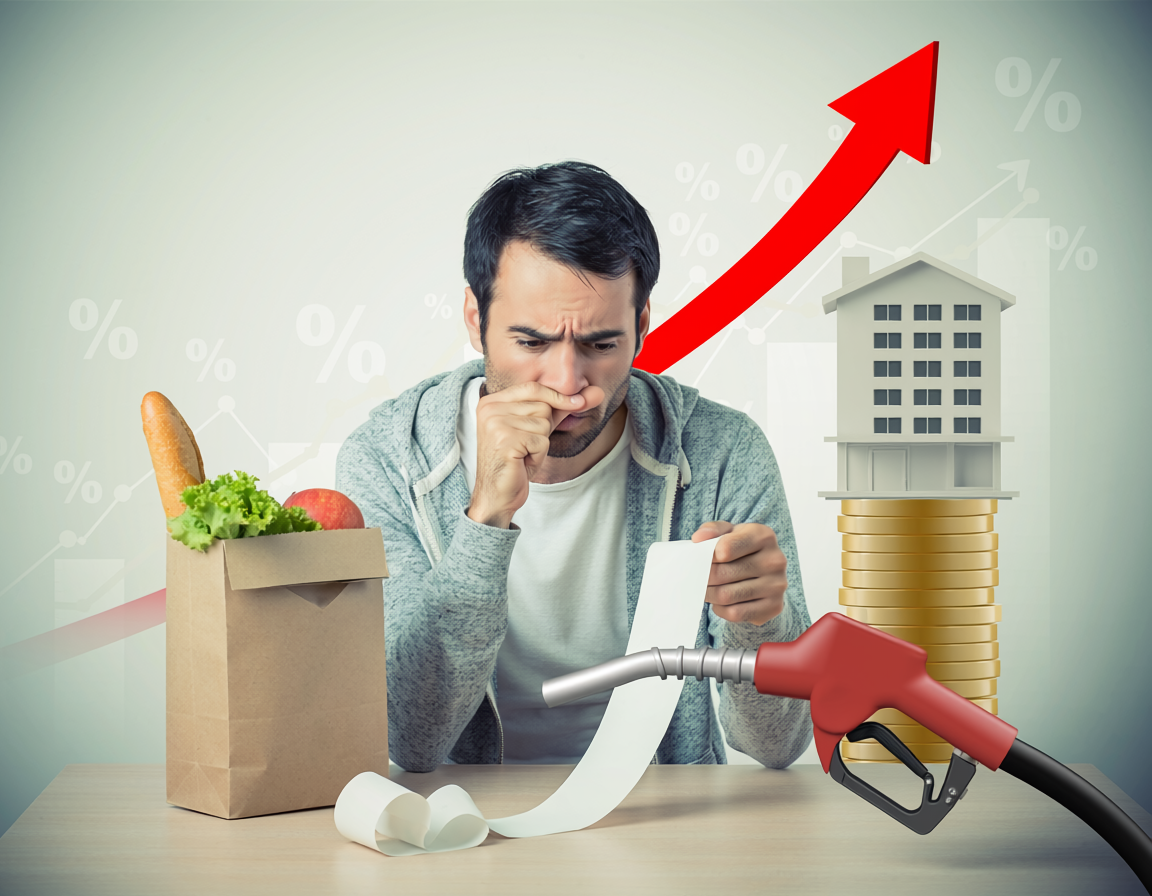
When Donald Trump won re-election in November 2024, inflation was the issue. Not foreign policy, not immigration, not the deficit — inflation. American voters had spent two years being ground down by the highest sustained price increases in four decades, and they chose, by a clear margin, the candidate who promised to bring those prices down. “On day one,” Trump said repeatedly during the campaign, “prices are going to drop.”
On Tuesday, May 12, the Bureau of Labor Statistics released the April Consumer Price Index report. Inflation rose 3.8% in the twelve months through April — the largest annual increase since September 2023, well above the 3.3% recorded in March, and nearly double the Federal Reserve’s 2% target. The month-on-month increase was 0.6%, following an even sharper 0.9% jump from February to March — the largest monthly increase since June 2022. On a twelve-month basis, the trend is accelerating, not decelerating.
The cause is not mysterious. It is the Iran war, and more specifically the $100-per-barrel oil price that the closure of the Strait of Hormuz has produced — and the gasoline, diesel, and jet fuel prices that oil at $100 translates into at the pump, at the grocery distribution centre, and at the airport.
The Gasoline Transmission: From Hormuz to the Highway
The mechanics of how a war in the Middle East produces higher prices in an American supermarket are worth understanding in detail, because they are more pervasive than most people initially appreciate.
The direct effect is gasoline. The Strait of Hormuz, through which approximately 20% of the world’s seaborne oil normally flows, has been effectively closed since early March 2026. Oil prices jumped 15% to $83 per barrel within the first week of the conflict. By the time the ceasefire was announced in early April, Brent crude had exceeded $105. As of this week, it remains above $100. The US national average gasoline price, which stood below $3.20 per gallon before the war began on February 28, climbed above $4 per gallon — the highest since late 2023 — and has not meaningfully retreated despite the April 7 ceasefire, because the ceasefire has not produced a durable reopening of the strait.
Gasoline prices accounted for most of the CPI increase in both March and April. That is the direct, visible effect that every American driving a car or paying for delivery services experiences immediately and personally.
But the second-round effects are where inflation becomes genuinely difficult to contain. Every gallon of diesel that moves a truck from a distribution centre to a supermarket costs more. Every tank of jet fuel burned by an aircraft carrying freight from a port to a destination costs more. Every batch of fertiliser derived from natural gas — of which Qatar, whose LNG facilities sustained damage in March when Iranian forces hit the Ras Laffan complex, is a major global supplier — costs more. The Dallas Federal Reserve’s research, published in April, modelled a 15% global oil supply shortfall scenario and found it would add 0.6 percentage points to headline PCE inflation by the fourth quarter of 2026, with core PCE inflation rising 0.2 percentage points — and that the effects are materially larger if the Strait remains closed for two or three quarters rather than one.
The Core Inflation Puzzle and the Shelter Adjustment
The April report includes a technical complication that the Federal Reserve is watching carefully: a one-time adjustment to shelter costs — rents and owners’ equivalent of rent — that is expected to inflate the April core CPI reading above what the underlying trend would otherwise show.
The Bureau of Labor Statistics surveys rent prices across six rotating panels of respondents, each sampled every six months. In October 2025, during the 43-day government shutdown, one of those panels was not surveyed. The BLS used a carry-forward imputation — essentially repeating the prior period’s reading — for that panel, which artificially suppressed the shelter index in subsequent months. The April report restores actual data for that panel, producing what Wrightson ICAP’s chief economist Lou Crandall described as a “significant catch-up effect” of roughly 0.1 percentage point on the core reading.
In other words, part of the April core CPI increase is a statistical artefact correcting a prior distortion — not genuine underlying inflation pressure. The Fed is aware of this and will discount it accordingly. The problem is that the remaining core inflation, stripped of the shelter adjustment, is still running hotter than the Fed’s comfort zone, because the second-round effects of the energy shock are beginning to bleed into the services and goods categories that core inflation measures.
Food prices — which were unusually flat in March — are now accelerating. Economists expect further food price increases in the coming months as higher energy costs in distribution and manufacturing, plus fertiliser shortages from the Strait of Hormuz disruption, feed through to grocery shelves. This is the pathway that makes oil-shock inflation particularly stubborn: it begins at the pump, moves into freight and distribution, then into food manufacturing, then into restaurant prices, and eventually into wage expectations as workers demand compensation for the erosion of their purchasing power.
The Fed’s Impossible Position
The April inflation data crystallises the Federal Reserve’s most difficult policy predicament since 2022. The central bank’s mandate requires it to keep inflation near 2% and to maintain maximum employment. Those two objectives are, in the current environment, in direct tension.
The inflation case for raising interest rates is straightforward: at 3.8% year-on-year and accelerating, inflation is running nearly twice the Fed’s target. Historically, allowing above-target inflation to persist raises the risk that it becomes embedded in wage-setting and price-setting behaviour — what economists call second-round effects — making it significantly harder to bring back down without a recession.
The employment case for not raising rates is equally straightforward. The Iran war’s energy shock is not a demand-driven inflation of the kind that interest rates effectively address. It is a supply shock — prices are rising not because Americans are spending too freely, but because a war has disrupted the supply of a critical input commodity. Raising interest rates does not produce more oil. It does not reopen the Strait of Hormuz. What it does is raise the cost of mortgages, business loans, and consumer credit — potentially tipping an economy already stressed by $4 gasoline into a recession.
Financial markets have drawn the same conclusion. CME FedWatch data shows markets pricing a 78% probability of no rate change through the remainder of 2026, with the first cut not expected until 2027. The Fed, under its new chair appointed after Jerome Powell’s departure, is expected to hold rates in the 3.50% to 3.75% range and hope that the energy shock fades as the Strait of Hormuz situation resolves — rather than fighting supply-driven inflation with demand-crushing interest rate increases that would add economic pain without addressing the underlying cause.
The Political Cost That Cannot Be Managed Away
The economic pain and the political pain are not the same thing, but they are moving in the same direction.
Trump won the 2024 election, in significant part, on the argument that the Biden administration’s economic management had produced the inflation that was destroying household purchasing power, and that he would fix it. The April CPI report — 3.8% annual inflation, nearly double the Fed’s target, driven by a war that the United States initiated and that has been ongoing for eleven weeks — is being absorbed by an American public that was promised lower prices and is receiving higher ones.
Sung Won Sohn, a finance and economics professor at Loyola Marymount University, captured the lived experience precisely: “The problem is that the average person, the working people, they don’t live in core CPI. They live in higher gasoline prices, they live in higher grocery prices, and they are getting hurt.”
Brian Bethune, a Boston College economics professor, was blunter: “People are now realising that the pitch they got about lowering the cost of goods and services is a fairy tale. They were basically treading water with their nose just above the surface. Now they are being pulled down below the surface. There is no air to breathe.”
The White House pushed back, with spokesperson Kush Desai noting that the March jobs report showed robust private sector job growth and that the president’s economic agenda had produced positive results. The statement is accurate on employment. It does not address the gasoline pump.
Mark Zandi, chief economist at Moody’s Analytics, offered the clearest assessment of the structural damage: “I think the damage has already been done, in part because there’s no going back on oil prices, at least not any time in the near future.” Economists across Wall Street agree: even if a peace deal is reached and the Strait reopens, the supply chain disruptions, the LNG infrastructure damage in Qatar, and the inventory drawdowns that have accumulated over eleven weeks mean that price normalisation will take months, not days.
The April CPI report is not the peak. It is the milestone on a road that still has distance to run.
Written by Shalin Soni, CMA specializing in financial analysis, global markets, and corporate strategy, with hands-on experience in financial planning and analytical decision-making.
ALSO READ
• Swatch Shareholder Vote Puts Hayek Family Control Under Pressure
• US Companies Signal Resilience as Iran War Risks Continue to Rise
• Apple CEO John Ternus Faces China Challenges Despite Business Rebound
Source: Based on Bloomberg and publicly available financial information.