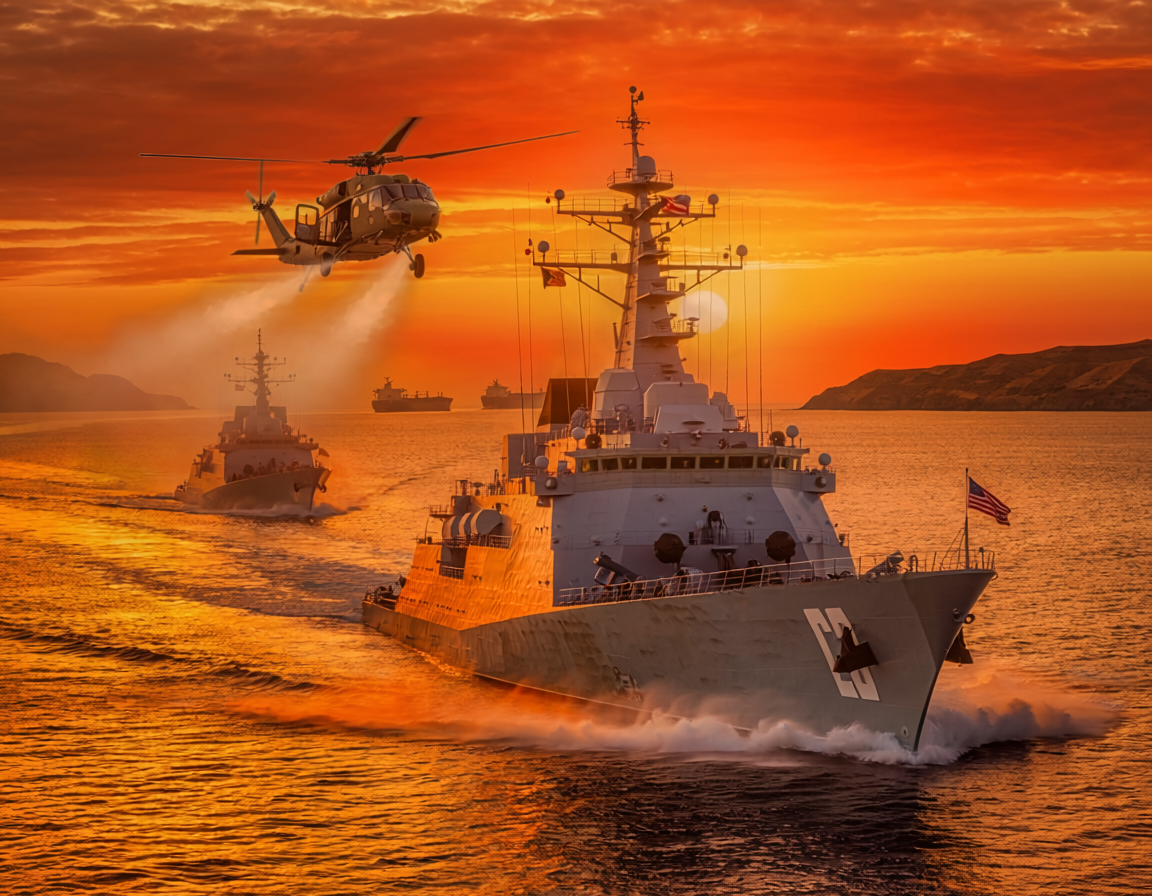
The ceasefire in Islamabad barely had time to dry before the U.S. Navy made its most provocative move since the war began. On Saturday, two American guided-missile destroyers — the USS Frank E. Peterson and the USS Michael Murphy — navigated through the Strait of Hormuz without coordinating with Iran, becoming the first U.S. warships to attempt the passage in the six weeks since hostilities erupted.
The message was unmistakable. Even as diplomats were trading proposals in Islamabad’s fortified hotel conference rooms, the U.S. military was making clear that it had no intention of waiting for Iranian permission to sail through one of the world’s most critical waterways.
And according to energy security experts, that dual-track approach — negotiate while building military leverage — may be exactly the strategy Washington needs if it wants to walk away from this conflict having actually won.
A Deliberate Signal, Not an Accident
The transit wasn’t just operationally significant — the manner in which it was carried out made a point of its own. The USS Michael Murphy activated its Automatic Identification System (AIS) as it crossed through the strait — an unusual move for a Navy vessel, which typically keeps its AIS turned off for tactical concealment.
Campbell University professor Salvatore Mercogliano, who specialises in military and maritime history, was clear about the meaning of that choice. “You just don’t throw AIS on by accident on a Navy ship. This is purposeful. They wanted to turn this on on the far side of the Strait of Hormuz to demonstrate that they have sailed through.”
U.S. Central Command confirmed that the two destroyers had transited the strait and begun setting conditions for clearing the mines placed by Iran’s Islamic Revolutionary Guard Corps. Underwater drones are set to join the effort in the coming days. Admiral Brad Cooper, CENTCOM commander, announced: “Today, we began the process of establishing a new passage and we will share this safe pathway with the maritime industry soon to encourage the free flow of commerce.”
President Trump reinforced the move on Truth Social, posting that the U.S. is “starting the process of clearing out the Strait of Hormuz.”
Iran’s response was swift and confrontational. The IRGC declared the transit a ceasefire violation, and a source told Bloomberg that the destroyers were forced to turn back after Iran launched a drone in their direction. A radio exchange captured by a civilian vessel and reported by the Wall Street Journal captured the moment in real time. “This is the last warning. This is the last warning,” the IRGC transmitted. The U.S. ship replied: “Passage in accordance with international law. No challenge is intended to you, and I intend to abide by rules of our government’s ceasefire.”
The Whack-a-Mole Problem and Why It Matters
To understand why the U.S. Navy’s actions carry such weight, you need to understand what Iran’s control of the Strait of Hormuz actually means — and how difficult it is to dislodge.
The strait is the world’s most important oil chokepoint. Roughly 20% of the world’s oil and liquefied natural gas normally passes through it. Since Iran effectively closed the waterway in the early days of the conflict, the consequences have cascaded globally. Oil prices have spiked sharply, with some European and Asian refiners paying close to $150 a barrel for certain crude grades. Over 230 loaded oil tankers have been trapped inside the Gulf, waiting for safe passage. Fertiliser shipments have been disrupted, food insecurity concerns are mounting, and aluminium and helium markets have been severely rattled.
The head of the International Energy Agency has described the blockade as more consequential than the disruptions of 1973, 1979, and 2022 combined.
Iran uses multiple overlapping methods to enforce its grip on the strait: attacks from fast-attack boats, missiles and drones; hidden sea mines; satellite spoofing and GPS jamming that makes navigation treacherous. The combination dramatically raises insurance costs for any shipowner considering a transit, keeping the waterway effectively closed even without a formal declaration of blockade.
Bob McNally, founder of Rapidan Energy and a former White House energy advisor to President George W. Bush, described what the U.S. military is now doing in a candid interview with CNBC: “I think we’re kind of getting ready for round 2.” He compared the task of weakening Iran’s naval threats to a game of whack-a-mole, listing anti-ship missile launchers, small fast-attack boats, drones, submarines, and long-range artillery as the targets. “It may not be widely reported, but I believe the U.S. military in the last week or so has been focusing on whacking those moles, degrading Iran’s ability.”
On the mines specifically, McNally noted that the U.S. has already been systematically reducing Iran’s stockpile of underwater explosives — a quieter but crucial part of the operation that has received less media attention than the diplomatic drama in Islamabad.
His broader assessment was measured but pointed: “As we work on Iran’s ability to disrupt Hormuz, which we unfortunately started way too late but we’re doing that now, Iran’s leverage starts to erode. And I think the conditions for a real ceasefire and a reopening of the Strait of Hormuz — a full reopening — will be stronger later this month than they are right now.”
Military Buildup Behind the Diplomatic Curtain
The numbers tell their own story. While talks were proceeding in Pakistan, the U.S. was simultaneously pouring more combat power into the region. A third aircraft carrier, along with thousands of Marines and paratroopers, is expected to arrive in the Middle East later this month. Long-range cruise missiles are also flowing to the theatre in increased quantities.
Secretary of State Marco Rubio has been explicit about U.S. objectives in Operation Epic Fury — the military campaign that began on February 28 when joint U.S.-Israeli strikes hit Iranian military and government sites. He outlined four goals: destruction of Iran’s air force, its navy, severe reduction of its missile-launching capabilities, and dismantling of its defence manufacturing capacity. On the strait specifically, Rubio drew a firm red line: “The Iranians are threatening that they are going to set up some permanent system in the Straits of Hormuz where they get to decide who goes through international waterways. That will never be allowed to happen.”
Iran’s current negotiating position in the ceasefire talks included a demand to formalise control of the strait — effectively turning it into a toll booth, charging transit fees of over $1 million per ship. Trump has even mused publicly about entering into a joint venture with Iran to collect transit revenues, though that suggestion has been met with alarm by Gulf states, which export their oil and gas through the waterway and have made clear they will not tolerate Iranian dominance over it. Wall Street analysts have separately warned that institutionalised Iranian control of Hormuz would threaten U.S. dollar dominance in global trade by giving Tehran a stranglehold over the oil markets that underpin the petrodollar system.
The Strategic Logic Behind “Round 2”
McNally’s framing of a coming “round 2” reflects a strategic reality that the failed Islamabad talks have now made explicit: the two sides are nowhere near a comprehensive deal, and the ceasefire itself remains under severe strain.
With Vance departing Pakistan without an agreement, and Iran’s state media insisting that “excessive American demands” scuttled the talks, the diplomatic pathway has narrowed considerably — at least in the short term. Iran’s foreign ministry has left the door open to future negotiations, noting that “diplomacy never comes to an end.” But Tehran has also made clear it expects the U.S. to retreat from its core demands around nuclear weapons and Hormuz control before substantive progress is possible.
That leaves the military dimension as the primary lever available to Washington in the near term. The logic is straightforward: the more the U.S. degrades Iran’s capacity to enforce the blockade — through mine-clearing, anti-ship missile strikes, neutralising IRGC fast boats — the weaker Tehran’s negotiating position becomes. A partially open strait, where Iranian threats exist but can be managed, is a fundamentally different situation from a fully closed one.
As McNally put it, the goal is to reduce Iran’s leverage to “a manageable level” — not necessarily to eliminate it entirely, but to erode it enough that a permanent reopening becomes the rational choice for Tehran.
Whether that calculation works depends on Iran’s willingness to accept reduced leverage in exchange for economic relief — and on whether the ceasefire, already fraying, holds long enough for the military degradation to take meaningful effect.
For now, the strait sits at the centre of everything: the peace talks, the oil markets, the nuclear question, and the prospect of a second, potentially fiercer round of conflict. The Navy’s Saturday transit was a message. The question is whether Tehran will read it the way Washington intended.
Written by Shalin Soni, CMA specializing in financial analysis, global markets, and corporate strategy, with hands-on experience in financial planning and analytical decision-making.
ALSO READ
• Sodexo Shares Tumble After Earnings Miss and Outlook Cut — What It Means for Investors
• China Considers Financial Aid for Airlines as Jet Fuel Costs Surge
• Navy Exchange Competes with Walmart and Amazon to Fund Military Programs
Source: Based on Fortune and publicly available information.