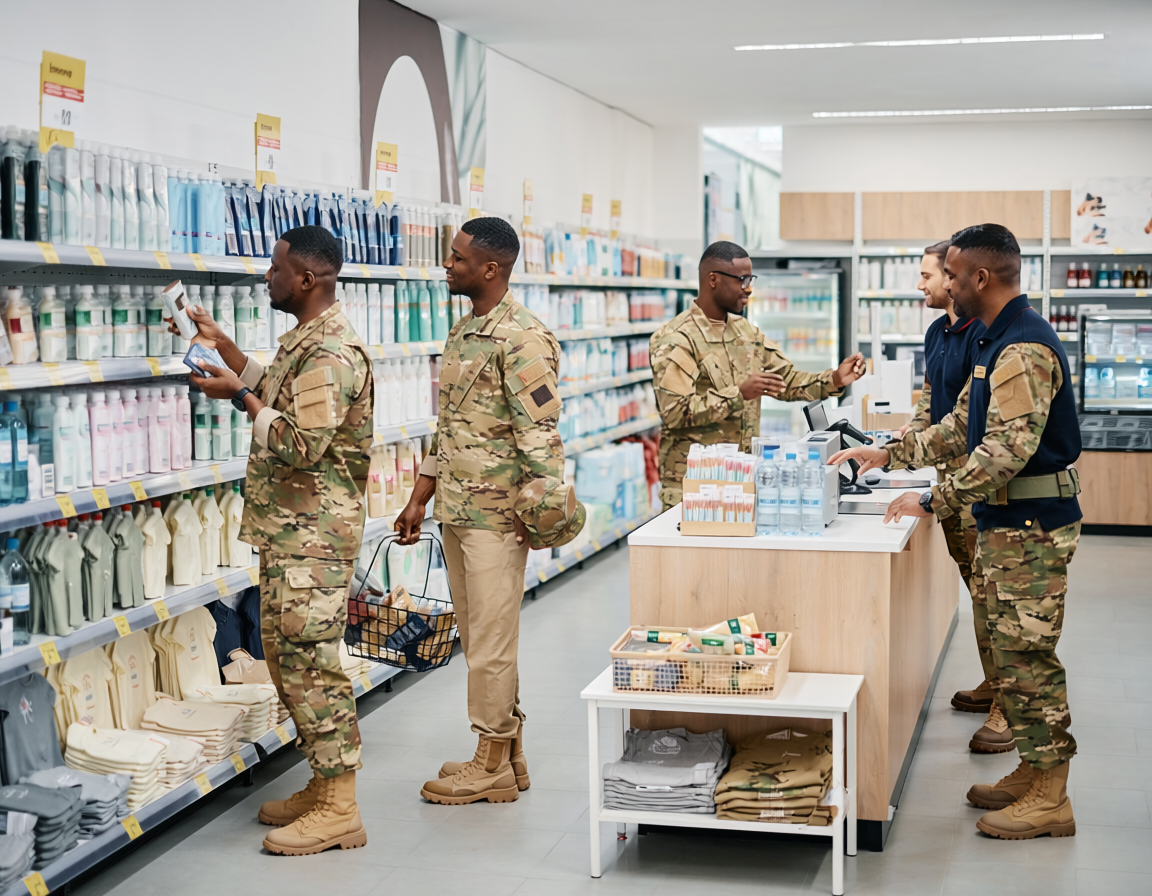
In the rural plains of northern Poland, at a remote military base surrounded by farmland and pine forest, roughly 150 US Navy sailors have access to a small slice of home through the Navy Exchange Mini Mart — a compact store stocked with familiar snack brands, hygiene products, and the household staples many of them grew up with. The store does not turn much profit. In commercial terms, it barely registers. But it is part of something much larger especially a global retail network that has quietly served as one of the Navy’s most important quality-of-life instruments for nearly a century — and one that is now in a fight for its financial survival against Walmart, Amazon, and Target.
That fight has a name, a budget, and a CEO who understands both the commercial stakes and the human ones.
The Mission Behind the Merchandise
The Navy Exchange Service Command — known as Nexcom — is not a typical retailer. Founded in the 1940s with roots stretching back to the 1800s, it operates as a $2.5 billion government-owned enterprise that provides active duty military members, veterans, and their families with access to discounted, tax-free products at bases and outposts around the world. Unlike most military programs, Nexcom is not primarily funded by federal appropriations. It funds itself through retail sales — and then gives every dollar of profit back to the Navy’s Morale, Welfare and Recreation (MWR) programs, which in turn fund day cares, gyms, counselling services, community events, and support networks for sailors and military families.
Since 1946, Nexcom has contributed more than $3.7 billion to Navy MWR programs. That figure represents something harder to quantify: the childcare that made it possible for a deployed sailor’s spouse to work; the gym that kept a young enlisted member healthy and motivated; the community centre that gave isolated military families a connection to something larger than their base. “The spouses a lot of times are left behind and they’re looking for connections and wanting to establish those relationships with folks that they can lean on while their husband or wife is out to sea for months at a time,” said Nexcom CEO Robert Bianchi, a retired rear admiral who spent nearly 30 years as a sailor before taking over a business with a Harvard MBA and intimate knowledge of what these programs mean to the people they serve.
A Virtuous Cycle Under Threat
Nexcom’s business model is what Bianchi calls a “virtuous cycle.” Larger department stores near major bases in California, Florida, and Virginia generate the profits that cross-subsidise smaller, less commercially viable outposts like the mini mart in Redzikowo, Poland. Every transaction at a busy stateside exchange helps keep a remote foreign post open. Every dollar of profit flows back into programs that keep sailors and their families connected, supported, and — critically — retained in the Navy.
But the cycle is under strain. Over the past decade, Nexcom’s sales have declined at a time when overall US retail sales have grown — a pattern that unmistakably signals market share loss rather than macro headwinds. The numbers are clear: dividends paid to MWR programs fell 43% between fiscal 2013 and fiscal 2024, dropping from $51.9 million to $29.8 million. The services those dividends fund have not become less needed in that time. If anything, the demands on military families have increased.
The cause of the decline is structural. Nexcom’s stores have become dated. Its e-commerce capability has fallen behind. And while the Navy Exchange still offers genuine advantages — tax-free pricing, military-exclusive access, and a brand assortment spanning Tempur-Pedic mattresses to Estée Lauder fragrances to a diamond solitaire ring that sold for over $90,000 last year — it has been competing on price alone rather than offering the kind of experience that keeps customers loyal.
“Even though we’re within the military, we compete for people’s share of wallet,” Bianchi told CNBC. “They can just as easily stop at a Target, they could stop at a Walmart, but we want them to shop here. It is a constant challenge to stay relevant.”
The Turnaround: $100 Million and a Consultant Named Melissa
In 2020, Nexcom hired retail consultant Melissa Gonzalez and began what has grown into a multi-year, $100 million store renovation and modernisation plan. The turnaround is now five years in the making — and it will take at least three more years and additional funding to complete.
Gonzalez has been working department by department, rethinking how stores are formatted, how signage communicates value, and how merchandising can be tailored to the demographics surrounding each individual base. It is not a small task. Nexcom’s larger stores carry a range of goods that would challenge any visual merchandiser: from 40-cent note cards at overseas outposts to mattresses, major appliances, beauty counters, and fine jewellery in stateside flagships.
“How do we merchandise it? It is challenging, which is why we don’t try to be Costco and bulk things out, or we don’t try to be Amazon and carry everything,” said Richard Honiball, Nexcom’s chief merchandising and marketing officer. The positioning is intentionally distinct: Nexcom is not trying to win on breadth or sheer logistical scale. It is trying to win on relevance — knowing its customer, reflecting their specific lifestyle, and delivering the kind of curated, community-adjacent shopping experience that neither Amazon’s algorithm nor Walmart’s price leadership can easily replicate on a military installation.
The Stakes Beyond the Sales Floor
The commercial stakes are real, but the broader ones are more consequential. Nexcom is not simply a retail chain that needs to modernise — it is an instrument of US military readiness. The Navy has long understood that retention depends not just on salary and career opportunity, but on quality of life: whether families feel supported, whether remote postings feel bearable, whether the invisible infrastructure of welfare programs is adequately funded.
“What is at risk is potentially the degradation of this benefit for all those military members and their families around the world,” Bianchi said. “If we made less money, [MWR] may have to reprioritise some things within their budget.” That is the soft underbelly of a retail problem: as Nexcom loses market share to Walmart and Amazon, the programmes that support sailors’ spouses, children, and mental health face creeping budget pressure. The pressure is invisible until it isn’t.
Bianchi, who experienced MWR programs personally during his own Navy career, understands the human dimension with unusual clarity. “You know you were going to be in a group of folks that were kind of going through the same thing that you were,” he said of those programs. “It was almost like a support group.” The fact that those support structures are funded by a retail enterprise competing with the world’s most sophisticated commercial operators is an unusual arrangement. But it is the arrangement that exists — and it is the one Nexcom must make work.
Can It Win?
The honest answer is that the turnaround faces a genuinely difficult competitive environment. Walmart and Amazon have advantages in scale, logistics, technology, and capital that no government-owned retail chain can match in a conventional sense. Prime membership, same-day delivery, algorithmic personalisation, and perpetually low prices are a formidable combination — and sailors living near large commercial centres have full access to all of it.
What Nexcom has, and its competitors do not, is a captive community with specific needs, a tax-free pricing advantage, and a mission that resonates with its customer base in a way that no commercial retailer can replicate. A sailor shopping at the Navy Exchange is not just buying a mattress or a razor. They are contributing to a system that funds their community’s well-being.
The renovation investment, the store reformatting, the e-commerce modernisation — all of these are necessary conditions for survival. Whether they are sufficient will depend on whether Nexcom can remind its customer base, clearly and consistently, why shopping at the Exchange matters beyond the price tag. The mini mart in Redzikowo and the diamond counter in Virginia Beach are both, in their own way, staking a claim on the same answer.
Written by Shalin Soni, CMA specializing in financial analysis, global markets, and corporate strategy, with hands-on experience in financial planning and analytical decision-making.
ALSO READ
• ASML Shares Fall as U.S. Pushes New China Chip Export Restrictions
• India Refiners Delay Maintenance to Stabilize Fuel Supply Amid Iran War Disruptions
• OPEC+ Debates Output Hike as Iran War Disrupts Global Oil Supply
Source: Based on CNBC and publicly available information.
Disclaimer
This article is based on publicly available information, market developments, and credible media reports. The content is intended for informational and analytical purposes only and should not be considered financial, investment, or legal advice.