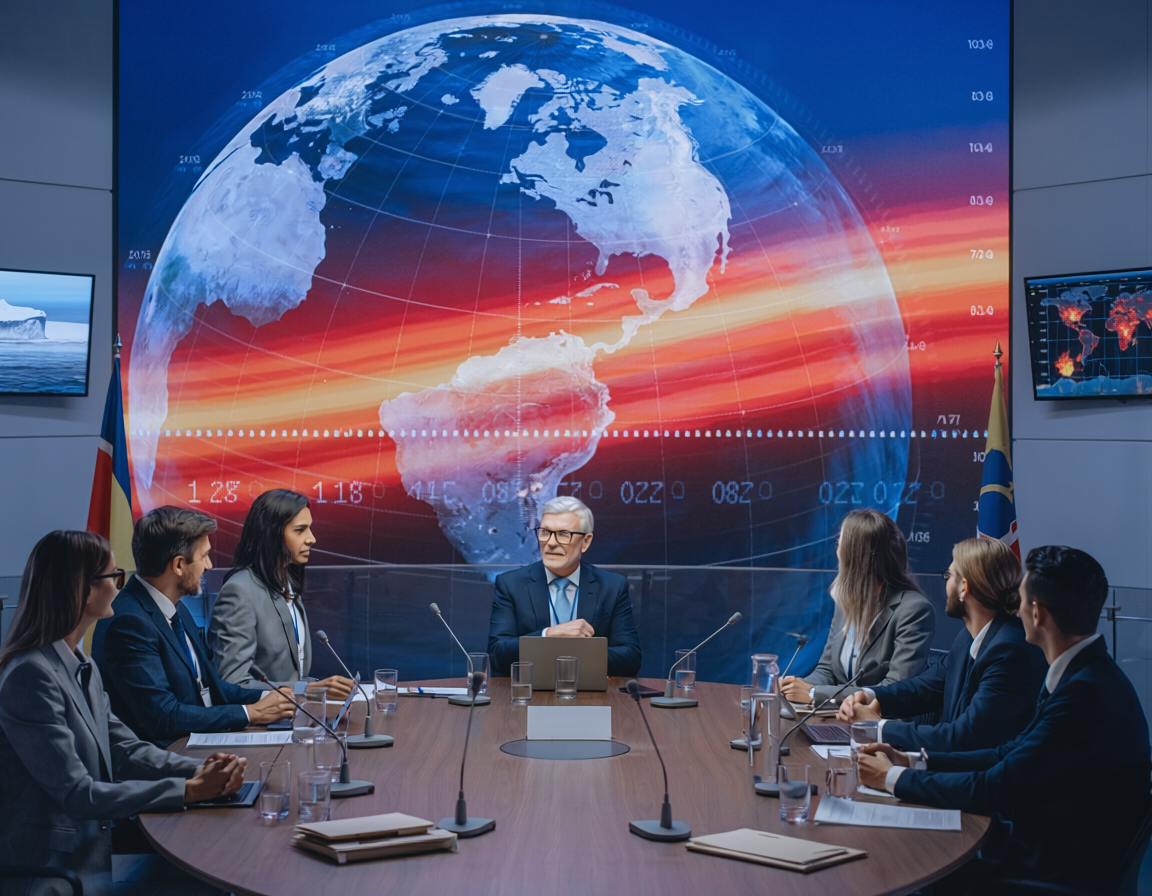
For more than three decades, the world’s annual climate summits have served as the centerpiece of international efforts to combat global warming.
As reported by Reuters, world leaders gather, negotiators debate emissions targets, activists demand urgency, and governments announce new commitments intended to keep the planet on a safer climate path.
Yet despite years of increasingly ambitious rhetoric, global emissions remain stubbornly high, fossil fuel consumption continues at massive scale, and extreme weather events are becoming more frequent across continents.
Now even some of the strongest supporters of the United Nations climate process are openly questioning whether the system is delivering what science demands.
That reality was underscored this week when European Union climate commissioner Wopke Hoekstra acknowledged that many recent COP climate summits have fallen well short of the action required to address the climate crisis effectively. Speaking in Brussels, Hoekstra described the outcomes of recent negotiations as “underwhelming” compared with the scale of action scientists say is necessary.
His remarks reflect a growing frustration spreading through climate policy circles worldwide.
The question is no longer whether climate summits are producing agreements, but the question is whether those agreements are producing meaningful results.
The Gap Between Climate Science and Climate Politics
The central problem facing global climate diplomacy is increasingly obvious. Climate science is moving faster than political consensus.
Researchers have repeatedly warned that greenhouse gas emissions must decline sharply during this decade if the world hopes to limit warming near the Paris Agreement target of 1.5 degrees Celsius above pre-industrial levels. Yet global emissions remain near record highs, while many countries continue expanding fossil fuel production and consumption.
That disconnect has become the defining challenge of modern climate negotiations.
At nearly every major climate summit, countries announce new targets, financing commitments, or policy frameworks. However, implementation often moves far more slowly than the science requires.
The result is a recurring cycle: ambitious declarations followed by limited execution.
Hoekstra’s criticism is particularly significant because it comes from one of the world’s most climate-focused political blocs. The European Union has traditionally positioned itself as a global leader on emissions reductions, renewable energy expansion, and climate regulation. Yet even European officials increasingly acknowledge that international negotiations are struggling to translate commitments into measurable global progress.
Why COP Summits Keep Falling Short
The structure of the climate negotiation process itself may be part of the problem.
Nearly 200 countries participate in COP negotiations, and decisions generally require broad consensus. While that framework ensures global participation, it also creates enormous challenges when countries possess vastly different economic priorities, energy needs, and political systems.
Major fossil fuel exporters often resist aggressive language on oil and gas phaseouts.
Developing nations frequently argue that wealthy countries, which generated most historical emissions, should bear greater financial responsibility for climate adaptation and clean-energy transitions.
Meanwhile, advanced economies struggle to balance climate goals with economic competitiveness and domestic political pressures.
Those competing interests frequently dilute final agreements.
The outcome is often compromise language that satisfies diplomatic requirements but falls short of the transformative action climate scientists recommend. As we can see that recent summits illustrate that pattern clearly.
COP30 in Brazil produced agreements on climate finance but failed to secure stronger global commitments on fossil fuel reductions after resistance from oil-producing countries. Similar disputes have repeatedly emerged across previous climate negotiations.
The challenge is not merely technical, however it is geopolitical.
Climate Policy Is Colliding With Economic Reality
One reason climate negotiations have become more difficult is that governments are increasingly prioritizing economic resilience, industrial policy, and energy security.
Over the past several years, global crises have repeatedly disrupted climate momentum.
Russia’s invasion of Ukraine triggered energy shocks across Europe. Inflation forced governments to focus on household affordability. Rising geopolitical tensions between major powers redirected political attention toward defense spending, supply-chain security, and industrial competitiveness.
As a result, climate policy no longer operates in isolation but It now competes directly with other strategic priorities.
European leaders themselves increasingly emphasize competitiveness alongside decarbonization. European Commission President Ursula von der Leyen has argued that simplifying regulations and strengthening economic performance are necessary for Europe to compete with the United States and China.
That balancing act is becoming politically unavoidable.
Governments face growing pressure to maintain economic growth while simultaneously reducing emissions — a combination that is often more difficult in practice than in policy announcements.
The Climate Crisis Is Becoming More Visible
The frustration surrounding climate summits is also growing because the consequences of global warming are becoming harder to ignore.
Across Europe, Asia, North America, and Africa, extreme weather events are becoming increasingly costly and disruptive.
Recent heatwaves across Europe shattered seasonal temperature records and triggered warnings from climate scientists that the effects of global warming are accelerating. United Nations officials described the events as a stark reminder of the worsening climate crisis.
Meanwhile, flooding risks continue increasing across major regions, including parts of China entering another severe flood season amid concerns over extreme rainfall and rising temperatures. With this, the economic costs are rising rapidly as well.
Within Europe alone, climate-related damage to infrastructure and buildings now reaches approximately €45 billion annually, according to EU data roughly five times higher than levels recorded during the 1980s.
These figures help explain why patience with incremental climate diplomacy is fading.
The impacts are no longer theoretical projections, but they are becoming visible economic realities.
The Rise of Smaller Climate Coalitions
Recognizing the limitations of large-scale negotiations, some policymakers are increasingly exploring alternative approaches.
Hoekstra suggested that alongside formal UN negotiations, smaller groups of countries willing to move faster should cooperate more aggressively on emissions reductions and clean-energy deployment. This reflects a growing strategic shift in climate policy.
Instead of waiting for unanimous global agreement, governments may increasingly pursue targeted alliances focused on specific goals such as renewable energy expansion, methane reductions, carbon markets, green hydrogen, or industrial decarbonization.
In practice, much of the world’s climate progress already operates this way.
Regional agreements, bilateral partnerships, private-sector investments, and technology alliances often move faster than large international negotiations especially the challenge is scale.
Smaller coalitions can accelerate progress, but they cannot fully replace global coordination when emissions remain a worldwide problem.
Technology Is Providing Hope and New Risks
Ironically, some of the strongest climate optimism today comes not from diplomacy but from technology.
Renewable energy costs have fallen dramatically over the past decade. Electric vehicle adoption continues expanding. Battery technologies are improving. Clean-energy investment is growing worldwide.
At the same time, however, new technologies are creating fresh challenges.
Artificial intelligence, cloud computing, and hyperscale data centers are dramatically increasing electricity demand globally. Some analysts warn that surging power consumption could temporarily increase fossil fuel use if renewable deployment fails to keep pace.
This illustrates a broader reality of the energy transition.
Technological progress alone cannot solve climate change without parallel policy coordination, infrastructure investment, and international cooperation.
The Bigger Problem: Trust
Ultimately, the greatest obstacle facing climate diplomacy may be trust. Developing nations often argue that wealthy countries have failed to deliver promised climate financing. Advanced economies worry about competitiveness if rivals adopt weaker environmental standards.
Major emitters frequently accuse one another of insufficient action. These tensions have repeatedly undermined negotiations.
The result is a cycle where countries hesitate to make stronger commitments because they doubt others will do the same.
That trust deficit has become one of the most persistent barriers to meaningful climate progress.
What Happens Next?
Despite the criticism, few policymakers believe climate summits will disappear. Even Hoekstra emphasized the importance of continuing negotiations because global coordination remains essential for addressing a challenge that crosses national borders.
But the tone surrounding climate diplomacy is clearly changing. The conversation is shifting from celebration of commitments toward scrutiny of outcomes.
Investors, scientists, businesses, and policymakers increasingly want measurable progress rather than ambitious declarations alone.
Since the world has now spent decades negotiating climate goals, the next phase may depend less on announcing new targets and more on proving that existing promises can actually be delivered.
In a nutshell, it’s only the challenge confronting governments today. And as extreme weather intensifies, economic losses rise, and global temperatures continue climbing, the political space for underwhelming outcomes may be shrinking faster than climate negotiators realize.
Written by Shalin Soni, CMA specializing in financial analysis, global markets, and corporate strategy, with hands-on experience in financial planning and analytical decision-making.
ALSO READ
• Where to Invest $1 Million in 2026: AI, Emerging Markets and Defense Stocks
• US Inflation Speeds Up in April as Gas, Food and Housing Costs Climb
• McDonald’s Sees Weak Q2 Start as Fuel Costs Weigh on Consumer Sentiment