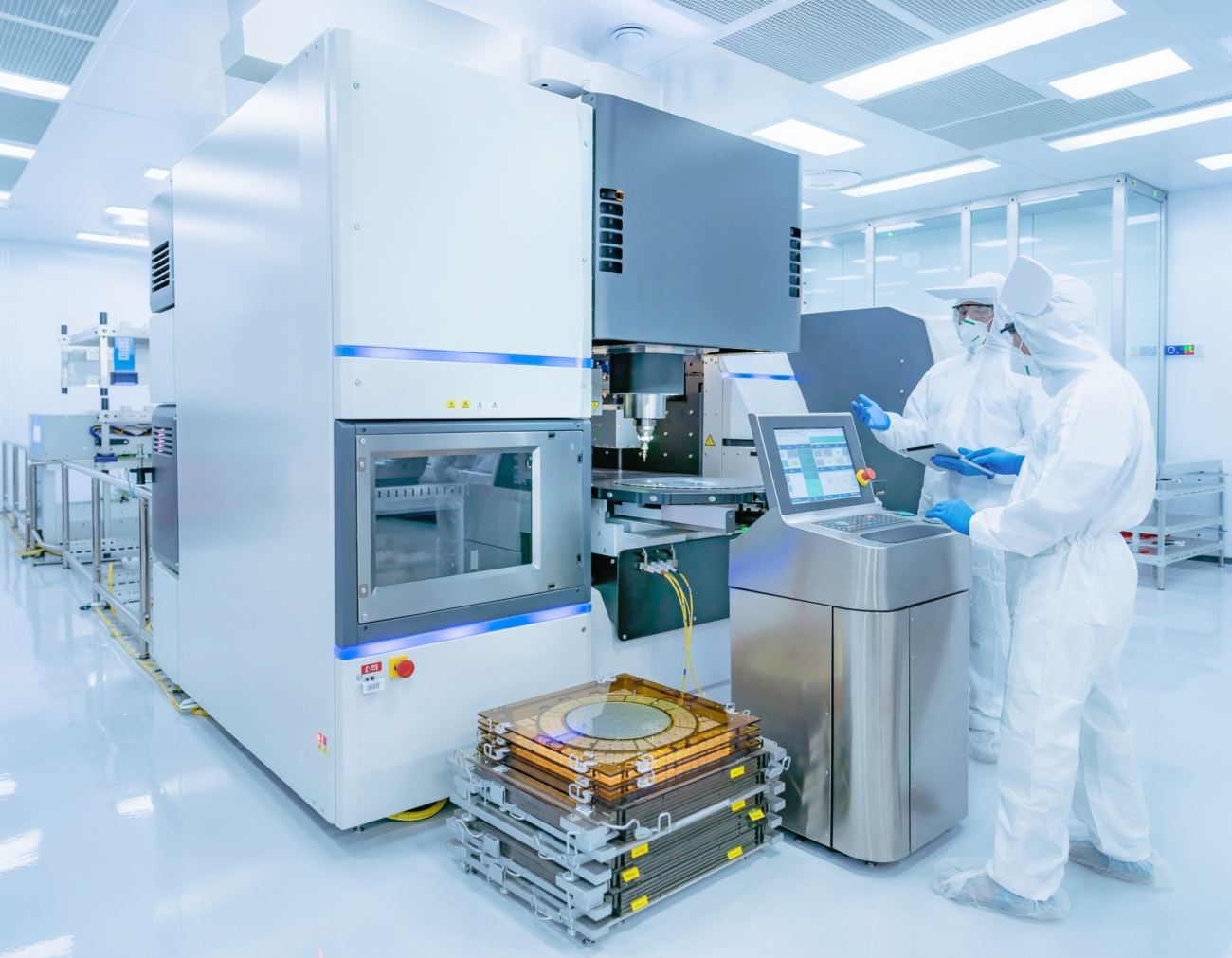
ASML is a Dutch company that makes machines in the Netherlands, employs largely European engineers, and sells its products to chip manufacturers across the world. But on April 7, it was a bill introduced in the United States Congress — thousands of miles away — that sent its stock sliding by as much as 4.7% in Amsterdam trading. By mid-morning, shares had recovered slightly to trade 4.1% lower at 1,114 euros. The Dutch government, when asked for comment, said it was “not up to the Netherlands to comment on proposals by the U.S.”
The proposal in question is the Multilateral Alignment of Technology Controls on Hardware Act — the MATCH Act — introduced by a bipartisan group of senators on April 2, including Jim Risch (R-Idaho), Pete Ricketts (R-Nebraska), Andy Kim (D-New Jersey), and Chuck Schumer (D-New York), with companion House legislation from Representative Michael Baumgartner. The bill would do something that no previous US export control measure had accomplished: close the last remaining significant loophole in the Western technology embargo against China’s semiconductor industry.
Until now, that loophole was ASML’s Deep Ultraviolet, or DUV, lithography machines.
The Gap the MATCH Act Is Designed to Close
Understanding why this matters requires a brief primer on how semiconductor restrictions have evolved. Since 2019, the United States has imposed escalating export controls on China’s chip industry, targeting both the chips themselves and the equipment needed to make them. The most advanced restriction was on ASML’s Extreme Ultraviolet, or EUV, machines — the tools required to manufacture chips at the cutting edge of performance, used by Nvidia, Apple, and the AI data centres that are reshaping the global economy. ASML has never sold a single EUV machine to China. The Dutch government, coordinating with Washington, blocked all such exports.
But DUV lithography — the older, less advanced technology — remained partially available. Chinese chipmakers SMIC and Hua Hong, among others, have continued to purchase certain ASML DUV tools to manufacture less-advanced chips: the memory chips inside laptops and phones, the processors in automotive systems, and — through sophisticated manufacturing techniques called multiple-patterning — chips approaching 7-nanometre performance levels that power Huawei’s domestic AI hardware.
The MATCH Act targets this remaining access directly. It would impose a blanket prohibition on the sale and servicing of DUV immersion lithography tools to any facility in China, naming SMIC, Hua Hong, Huawei, ChangXin Memory Technologies (CXMT), and Yangtze Memory Technologies Corp (YMTC) as covered facilities subject to Entity List-equivalent restrictions. Critically, it also targets servicing — not just new sales. ASML and Japan’s Tokyo Electron have continued to maintain and service semiconductor equipment already installed in Chinese factories while US companies were barred from doing the same. Experts say this ongoing servicing has allowed Chinese chip factories to repair broken machines, upgrade existing tools, and sustain manufacturing processes that would otherwise degrade. Blocking servicing would effectively put Chinese fabs operating on restricted equipment into what one Chinese semiconductor analyst called “chronic death.”
The bill gives US allies 150 days to implement equivalent controls. If they fail to demonstrate sufficient progress within that deadline, the US Department of Commerce would be authorised to implement controls unilaterally — applying the Foreign Direct Product Rule to compel compliance from companies, including ASML, that use US technology in their manufacturing processes.
What This Means for ASML
The financial impact is contested but meaningful. ASML had already been managing a declining China business well before the MATCH Act arrived. In January 2026, the company said it expected China to account for approximately 20% of total sales in 2026, down from 33% in 2025, reflecting previous export restrictions and a normalisation of demand following the front-loading of orders that occurred before earlier restrictions took effect.
The MATCH Act, if passed, would accelerate and deepen that decline. Analyst estimates vary. Michael Roeg of Degroof Petercam put the impact at a “single digit” percentage of total ASML sales. JPMorgan analyst Sandeep Deshpande was more specific, estimating that ASML’s earnings per share could be reduced by up to 10%. Ben Barringer of Quilter Cheviot, head of technology research, offered a granular breakdown: the legislation targets the older DUV tools that represent 10% to 15% of ASML’s overall sales, within which China accounts for roughly 50%, implying “a fairly big hit of around 5%, but one that would likely depreciate over time” as the China business naturally shrinks anyway.
Citi analysts summarised the market’s view: “We view this prospect negatively.”
There is a partial offset. JPMorgan’s Deshpande noted that ASML’s sales to other regions would “increase considerably, though not offsetting the lost China revenue,” as non-Chinese chipmakers accelerate their own capacity expansions to compensate for constrained Chinese production. The current shortage of chips in multiple markets would worsen significantly under the MATCH Act, he warned: “The current tight capacity for chips in multiple markets would get much worse with these restrictions.”
ASML’s Q1 2026 earnings, released on April 15, showed a company still performing strongly — net sales of 8.8 billion euros against 8.5 billion expected, with gross margins of 66.2% beating consensus. The company raised its 2026 revenue forecast to a range of 36 billion to 40 billion euros, up from 34 billion to 39 billion previously. CEO Christophe Fouquet pointed to “AI-related infrastructure investments” as the core demand driver, with customers “accelerating their capacity expansion plans for 2026 and beyond.” But the stock still fell 6% on results day, reflecting investor concern that China restrictions would erode a revenue stream the market had previously been willing to overlook.
The Broader Significance: From Executive Action to Congress
One of the MATCH Act’s most important features is structural rather than specific: it originates from Congress, not the executive branch. Every previous major semiconductor export control directed at China has been driven by executive authority under the Trump and Biden administrations. Congressional action is different in character — it signals a broader, bipartisan political consensus that has proven harder to reverse or waive through diplomatic negotiation. Companies and governments can lobby the White House for carve-outs and waivers; statutory law is harder to undo.
Senator Kim’s statement on introducing the bill made the ambition explicit: “This legislation can send a clear message to the world that our export controls are enduring and our bipartisan commitment to safeguarding America’s competitive edge in innovation is strong.”
The bill also addresses the long-standing frustration among US policymakers about allied companies — ASML chief among them — continuing to service and sell equipment that American firms are prohibited from providing. The 150-day ally compliance deadline, backed by the Foreign Direct Product Rule as a lever, is designed to close that gap and ensure that the competitive disadvantage does not fall entirely on US firms.
The Accelerating Paradox
There is a recurring irony in the history of Western semiconductor export controls. Successive rounds of restrictions have been designed to slow China’s chip industry down. They have unquestionably imposed costs and delays. They have also, each time, intensified China’s investment in domestic alternatives. China spent $41 billion on wafer fabrication equipment in 2024, accounting for roughly 40% of global purchases. Its semiconductor equipment self-sufficiency rate has risen to 13.6%, with domestic suppliers like SMEE developing DUV tools that, while not yet competitive with ASML’s NXT series, are progressing. China has set a target of 80% chip self-sufficiency by 2030.
The MATCH Act would represent the most significant single step in the technology embargo since EUV was blocked — closing the last commercially significant opening in the DUV market. Whether it ultimately slows China’s semiconductor development or merely accelerates its determination to build domestic alternatives faster remains the central, unresolved question. The bill is still in its early stages and must work through the US legislative process before any of its provisions take effect.
But for ASML — a Dutch company caught between an American Congress determined to win the AI chip race and a Chinese market that once accounted for a third of its sales — the direction of travel is unmistakable. And the Amsterdam stock exchange reflected that reality on April 7, even before a single piece of legislation had been signed.
Written by Shalin Soni, CMA specializing in financial analysis, global markets, and corporate strategy, with hands-on experience in financial planning and analytical decision-making.
ALSO READ
• Tesla Targets Japan’s Top Imported Car Spot with Aggressive EV Expansion
• Starbucks Expands Tipping and Introduces Bonuses to Boost Barista Pay
• Netflix Shifts to Original Franchises After Missing $72 Billion Harry Potter Deal
Source: Based on Reuters and publicly available information.
Disclaimer
This article is based on publicly available information, market developments, and credible media reports. The content is intended for informational and analytical purposes only and should not be considered financial, investment, or legal advice.