In December 2021, Charles Lieber sat in a federal courtroom in Boston and was found guilty on six counts — making false statements to federal authorities, making false statements to Department of Defense investigators, two counts of making and subscribing false tax returns, and two counts of failing to file reports of foreign bank accounts. The jury deliberated for less than three hours. Lieber, then 63 years old and one of the most decorated chemists in the United States, had lied about his participation in China’s Thousand Talents Programme, about payments he had received from a Chinese university totalling approximately $1.5 million in salary and living expenses, and about the offshore bank accounts those payments had funded.
His sentence, pronounced in January 2023, was: two days in prison, already served during processing. Six months of home confinement. A fine of $33,600. Two years of probation.
By April 2025 — approximately 28 months after that sentence — Lieber arrived in Shenzhen, China, with what he described at a Shenzhen government conference in December as “a dream and not much more, maybe a couple bags of clothes.” Today, at 67, he is the founding director of i-BRAIN — the Institute for Brain Research, Advanced Interfaces and Neurotechnologies — a state-funded laboratory operating inside the Shenzhen Medical Academy of Research and Translation, with resources that were not available to him during his entire tenure at Harvard.
The Reuters investigation that revealed this story on April 30 is not merely a narrative about one scientist’s extraordinary personal journey. It is a case study in what American deterrence actually achieves — and does not achieve — in the global competition for strategically critical technology.
What i-BRAIN Gives Lieber That Harvard Could Not
The practical dimensions of Lieber’s new laboratory are worth examining carefully, because they illuminate why Shenzhen was able to make an offer that no American institution could match.
At i-BRAIN, Lieber has access to a deep ultraviolet lithography system — advanced semiconductor manufacturing equipment essential for producing the nanoscale electronic probes that brain-computer interface research requires. He has access to a primate research facility with 2,000 cages. Harvard, for context, wound down its New England Primate Research Center by 2015 — a decision that significantly reduced domestic capacity for the large-scale primate work that is considered essential for advancing invasive brain-computer interfaces toward human trials. Lieber himself noted the appeal explicitly: “With so many hassles with non-human primate research here, to have somebody give you all this support, access to technology, a concentrated center, a national initiative — those are things that are very attractive.”
The institution housing i-BRAIN, SMART, operates with a 2026 budget of approximately $153 million — up nearly 18% from the prior year — funded entirely by Shenzhen’s city government. It sits alongside the Shenzhen Bay Laboratory, which launched in 2019 with a five-year government budget of approximately $2 billion. The signs at SMART’s entrance carry the slogan: “Innovate with the Party.” The framing is unapologetic. This is a state science project with explicit strategic objectives, not a research institution incidentally located in China.
The resources Lieber now commands — the lithography equipment, the primate facilities, the dedicated nanofabrication tools, the institutional backing of a national strategic initiative — represent the kind of infrastructure that American academic research, with its fragmented grant funding, regulatory constraints on primate research, and no coherent national BCI programme, has been unable to assemble at equivalent scale. Lieber did not move to China despite the loss of his Harvard position. He moved partly because of what China could offer that Harvard could not.
Why Brain-Computer Interfaces Are the Prize
Brain-computer interfaces — systems that establish direct communication channels between the human brain and external devices — are not a peripheral technology. They are, as China’s National Development and Reform Commission head Zheng Shanjie stated in October, equivalent to “creating another Chinese high-tech sector in the next 10 years.” China named BCI technology a national growth priority in its new five-year plan in March 2026.
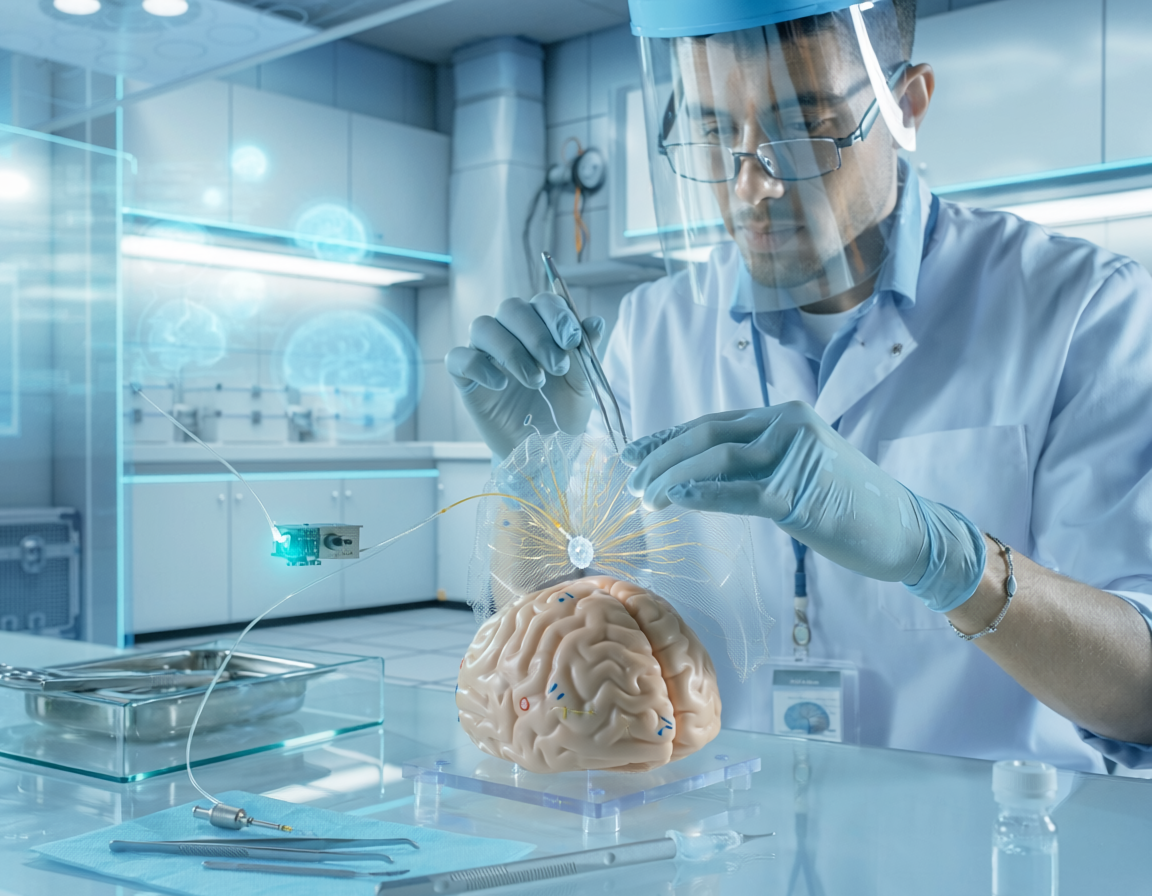
The technology exists on a dual-use spectrum that makes its strategic significance particularly acute. On the civilian side, BCIs offer transformative potential for treating neurological conditions including paralysis, ALS, Parkinson’s disease, and treatment-resistant depression. The electronic scaffolds that Lieber’s laboratory specialises in — syringe-injectable mesh electronics capable of monitoring electrical signals from individual neurons without causing cellular damage — represent a specific approach to invasive BCI that could theoretically allow damaged neural circuits to reconnect and rewire themselves over time. The medical applications are profound.
On the military side, the US Defence Advanced Research Projects Agency is investing in BCIs for drone and cyber defence applications. Military analysts have noted that researchers affiliated with the People’s Liberation Army have published studies exploring BCIs to enhance soldiers’ cognitive performance and reaction capabilities. The same technology that might allow a paralysed patient to control a prosthetic limb could theoretically allow a soldier to operate multiple autonomous systems simultaneously through direct neural control.
It is this dual-use character that makes Lieber’s presence at i-BRAIN consequential beyond the scientific questions his research addresses. His expertise in nanoscale electronic fabrication — the specific technical domain that determines whether BCI devices can be manufactured with the precision required to function reliably inside the human brain — is directly applicable to both the medical and the military dimensions of the technology. And it is now being applied inside a Chinese state institution whose budget is approved by the Shenzhen city government and whose slogan explicitly invokes the Communist Party.
The Deterrence Failure That Analysts Are Naming
The legal and national security implications of Lieber’s Shenzhen appointment have not escaped attention in Washington’s policy community. As Eva Daily reported, some analysts are calling Lieber “Exhibit A” for how US legal tools have struggled to deter the transfer of talent and know-how to China in strategically sensitive fields.
The critique is specific and documented. Lieber received federal court authorisation to travel to China for approved purposes while under supervised release — multiple travel requests were reportedly authorised by judges in 2024, even as critics warned that such permissions undercut the deterrent effect of the conviction. The sentence itself — two days of time served, six months of home confinement, a $33,600 fine — was, by any comparative measure, modest for conduct that prosecutors framed as a deliberate deception of federal investigators designed to conceal a significant foreign intelligence recruitment relationship.
The Thousand Talents Programme, under which Lieber received his payments, was identified by the FBI and the Department of Justice as a systematic effort by the Chinese government to recruit American scientists to transfer technology and expertise to China. The China Initiative — the DOJ programme established to prosecute Thousand Talents cases — generated significant controversy, with critics arguing it led to selective prosecution of Chinese-American researchers and chilled legitimate scientific collaboration. The Initiative was formally ended in 2022. Lieber arrived in Shenzhen in 2025.
Whether the combination of a criminal conviction, modest sentence, and supervised release travel permissions constituted meaningful deterrence — or whether it constituted, as at least some analysts now argue, a sequence of legal actions that produced a criminal record without preventing the outcome those actions were designed to prevent — is the uncomfortable policy question that Reuters’ investigation forces into the open.
The Broader Pattern: Six Others, the Same Trajectory
Lieber is not alone at SMART. Reuters reported that at least six other researchers have moved to the institution from US institutions, though all of them are Chinese-born scientists returning to China rather than American citizens choosing to relocate. The distinction matters politically but may matter less strategically: the expertise that travels with researchers, regardless of their nationality, is the variable that competition policy is designed to influence.
SMART was established in 2023 under founding president Nieng Yan, a structural biologist whose return to China after five years at Princeton University was celebrated in Chinese domestic media as the homecoming of a “goddess scientist.” The institution’s recruitment model — targeting researchers with access to advanced technology and offering them state funding, equipment, and research conditions that no Western academic institution can easily match — is a systematic expression of China’s broader approach to technology competition: identify the fields that matter, fund them at state level, and recruit the talent that makes them advance.
In brain-computer interfaces, that approach has now brought to Shenzhen one of the world’s leading researchers in syringe-injectable mesh electronics — a man convicted by an American federal jury of concealing his relationship with exactly the programme that recruited him, who subsequently served two days in prison, and who now directs a Chinese national-priority research institution with equipment and facilities superior to what Harvard provided.
Whatever conclusions American policymakers draw from that sequence, the empirical outcome is not ambiguous. The talent is in Shenzhen. The equipment is in Shenzhen. The five-year plan is in Beijing. And the entrance to the building reads: “Innovate with the Party.”
Written by Shalin Soni, CMA specializing in financial analysis, global markets, and corporate strategy, with hands-on experience in financial planning and analytical decision-making.
ALSO READ
• Coca-Cola Shrugs Off Oil Shock, Lifts Profit Outlook on Strong Demand
• Meta Strikes Multi-Billion Dollar Deal With Amazon AWS to Use AI CPU Chips
• Nomura Posts Record Profit, Sees Limited Impact From Iran War
Source: Based on Reuters and publicly available financial information.