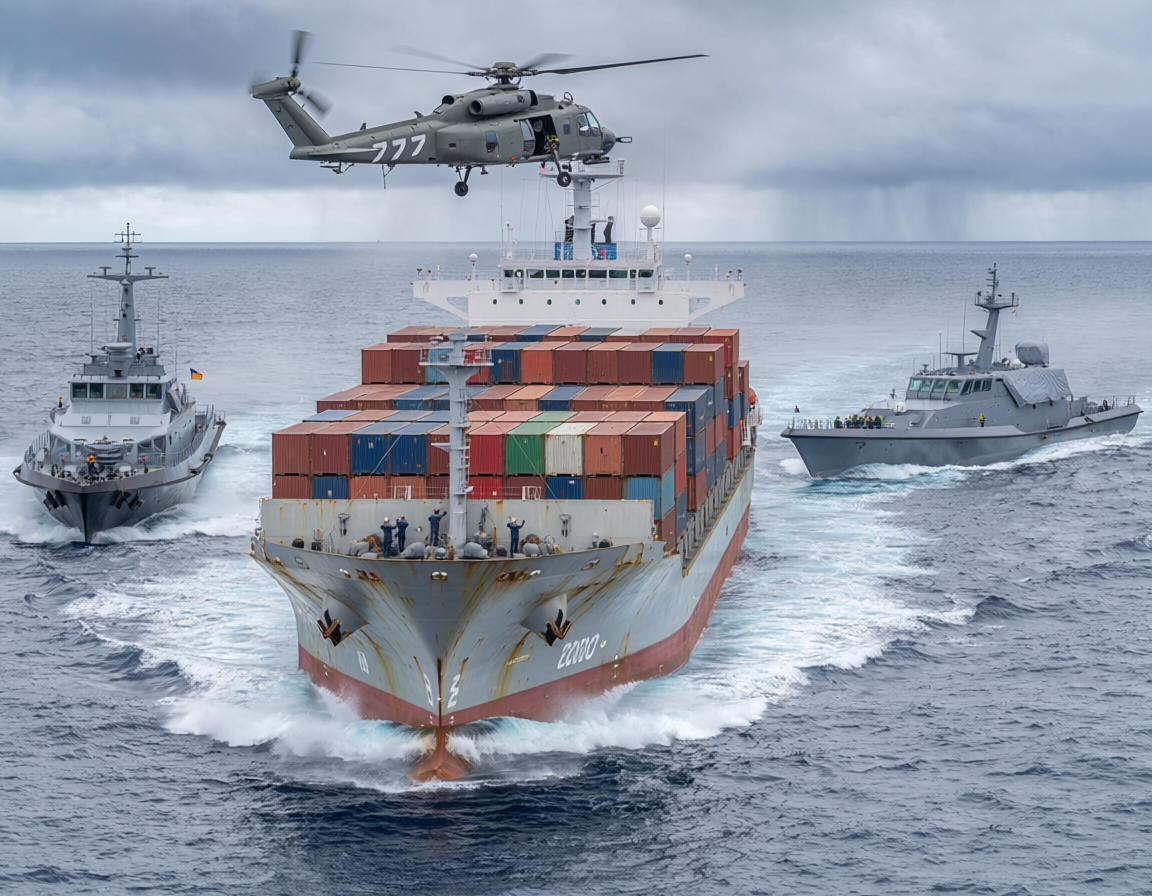
On Sunday, April 19, a nearly 900-foot Iranian-flagged cargo ship named the Touska left the North Arabian Sea and headed toward the Iranian port of Bandar Abbas. Over the next six hours, the USS Spruance — a US Navy guided-missile destroyer — issued repeated warnings to the vessel’s crew to comply with the American naval blockade. The crew refused. At the end of those six hours, the USS Spruance fired several rounds into the Touska’s engine room, disabling it. US Marines from the 31st Marine Expeditionary Unit descended by ropes from a helicopter onto the vessel’s deck. The Touska, under US Treasury sanctions for a prior history of illegal activity, was now in American hands.
That sequence of events — documented in video footage released by US Central Command and announced by President Trump on Truth Social — changed the diplomatic landscape of the Iran war in a matter of hours. What had appeared, just 48 hours earlier, to be a fragile but functioning ceasefire with possible peace talks on the horizon became, by Sunday evening, a situation in which Tehran was threatening retaliation for what it called “maritime highway robbery,” no tankers were passing through the Strait of Hormuz, and Iran’s Foreign Ministry had publicly stated it had “no plan for a second round of negotiations” with the United States.
A Weekend of Escalation
The Touska seizure did not happen in isolation. The days preceding it had already seen a reversal of the cautious optimism that had gripped markets when Iran briefly declared the strait “completely open” on April 17. That declaration proved short-lived. By Saturday, April 18, Iran had re-imposed its control over the Strait of Hormuz, citing what Tehran called American “breaches of trust.” Iranian forces fired on commercial vessels attempting to transit the strait. The ships turned back. By Sunday, not a single tanker had passed through — one of the quietest days in the channel since the war began on February 28.
Iran’s chief negotiator and parliamentary speaker, Mohammed Bagher Qalibaf, was explicit about Tehran’s position on the closed waterway. “It is impossible for others to pass through the Strait of Hormuz while we cannot,” he said on Iranian state television — a statement that captured the core asymmetry in the two sides’ negotiating positions. The US wants the strait open as a precondition for any agreement. Iran wants its own ports unblockaded before it will allow international traffic through.
Trump, for his part, accused Iran of committing a “total violation” of the ceasefire by firing on ships in the strait on Saturday. “Iran decided to fire bullets yesterday in the Strait of Hormuz — a Total Violation of our Ceasefire Agreement!” he wrote on Truth Social Sunday morning. He followed that with a threat: unless Iran agreed to a deal, the United States would “knock out every single Power Plant, and every single Bridge, in Iran.”
The same morning he announced that US negotiators — Vice President JD Vance, Special Envoy Steve Witkoff, and Jared Kushner — would travel to Pakistan for a second round of talks. Hours later, he announced the Touska seizure. Both declarations on the same day: diplomacy and escalation, simultaneously.
Iran’s Response: Retaliation Pledged, Talks Uncertain
Iran’s military response to the Touska seizure was swift and categorical. “We warn that the Armed Forces of the Islamic Republic of Iran will soon respond and retaliate against this armed piracy by the US military,” an Iranian military spokesperson said through state broadcaster IRIB. The country’s National Security Council issued a statement declaring that Iran was “determined to exercise supervision and control over traffic through the Strait of Hormuz until the war is definitively ended and lasting peace is achieved in the region.”
Diplomatically, the picture was contradictory but not without a signal of continued engagement. Iran’s Foreign Ministry spokesperson stated publicly that there was “no plan for a second round of negotiations.” Yet Iranian sources familiar with the process told CNN that a delegation would likely arrive in Islamabad on Tuesday. Ebrahim Azizi, head of the Iranian Parliament’s National Security Committee, told Al Jazeera that Iran would likely send a team “today or tomorrow.” Security measures were tightened across Islamabad ahead of expected delegations. Traffic in Islamabad’s Red Zone was restricted, with all government officials asked to work from home on April 20.
The gap between Iran’s public posture and its private diplomatic movement reflects the same dynamic that has characterised every stage of this conflict’s negotiations: Tehran needs to project strength domestically while leaving enough space to continue talking. Qalibaf, Iran’s chief negotiator, captured the contradiction precisely when he said: “There is still a big distance between us,” while simultaneously insisting that Iran remained committed to diplomacy.
The Sticking Points That Have Not Moved
Beneath the drama of ship seizures and social media threats, the fundamental obstacles to a deal are the same ones that collapsed the first round of Islamabad talks on April 12 after 21 hours of negotiation.
The nuclear question remains the hardest wall. The US proposed a 20-year pause on Iranian uranium enrichment. Iran, which has consistently insisted its right to enrichment is “indisputable,” reportedly counter-proposed five years. That gap — 20 years versus five — reflects not merely a difference in number but a difference in whether Iran accepts a permanent nuclear constraint or merely a temporary one. Washington’s position, as articulated by Vance after the first round collapsed, requires a “fundamental commitment of will” that Iran not develop nuclear weapons “not just now, not just two years from now, but for the long term.” Iran’s position does not yet offer that commitment.
The Hormuz question has become, if anything, more contentious since the first round of talks. Iran’s National Security Council statement — that it intends to maintain control of the strait until “lasting peace is achieved” — is a direct rejection of the US demand that Hormuz be fully reopened as a precondition of any agreement. The Touska seizure, and the US blockade that preceded it, have made Iran’s leverage over the waterway both more visible and more politically significant for Tehran’s domestic audience.
The Ceasefire Expiry and What Comes Next
The two-week ceasefire brokered by Pakistan on April 7 expires on Wednesday, April 21. As of Monday morning, the two sides had accused each other of violating it. The US cited Iran’s firing on ships in the strait. Iran cited the Touska seizure as proof the US had violated the agreement. Both arguments are being made simultaneously; neither side has formally declared the ceasefire dead.
CENTCOM confirmed that 23 ships had been forced to turn around since the blockade began on April 13. The economic toll of the strait’s continued closure is mounting by the day. Energy analyst Johnston estimated supply disruptions of approximately 13 million barrels of crude, condensates, and natural gas liquids per day, with the cumulative effect already surpassing half a billion barrels. “Even an imminent deal announcement would not immediately unwind the damage,” he warned. Oil prices surged more than 7% on Sunday, with Brent crude rising to $96.88, reversing much of the relief rally that had followed Iran’s brief strait-opening announcement just days earlier.
What comes next depends on whether the Islamabad talks take place at all, and if they do, whether the Touska seizure and the Hormuz re-closure have narrowed or expanded the diplomatic space available to both parties. Alan Eyre, a distinguished diplomatic fellow at the Middle East Institute and former member of the US diplomatic team, offered a frank assessment: “Until, and unless the US negotiating team rids itself of the misconception that military victory equals strategic dominance, we’re not going to get to a solution.”
He added, with the bluntness that the moment warrants: “A resumption of hostilities is unfortunately more likely.”
Written by Shalin Soni, CMA specializing in financial analysis, global markets, and corporate strategy, with hands-on experience in financial planning and analytical decision-making.
ALSO READ
• Rising Jet Fuel Costs Are Forcing Airlines to Cut Routes Worldwide
• Why Silver Beats Gold in Bull Markets: Key Trends Investors Should Watch
• Why Telling Investors About Your Problems Can Help You Get Funded
Source: Based on Bloomberg and publicly available information.