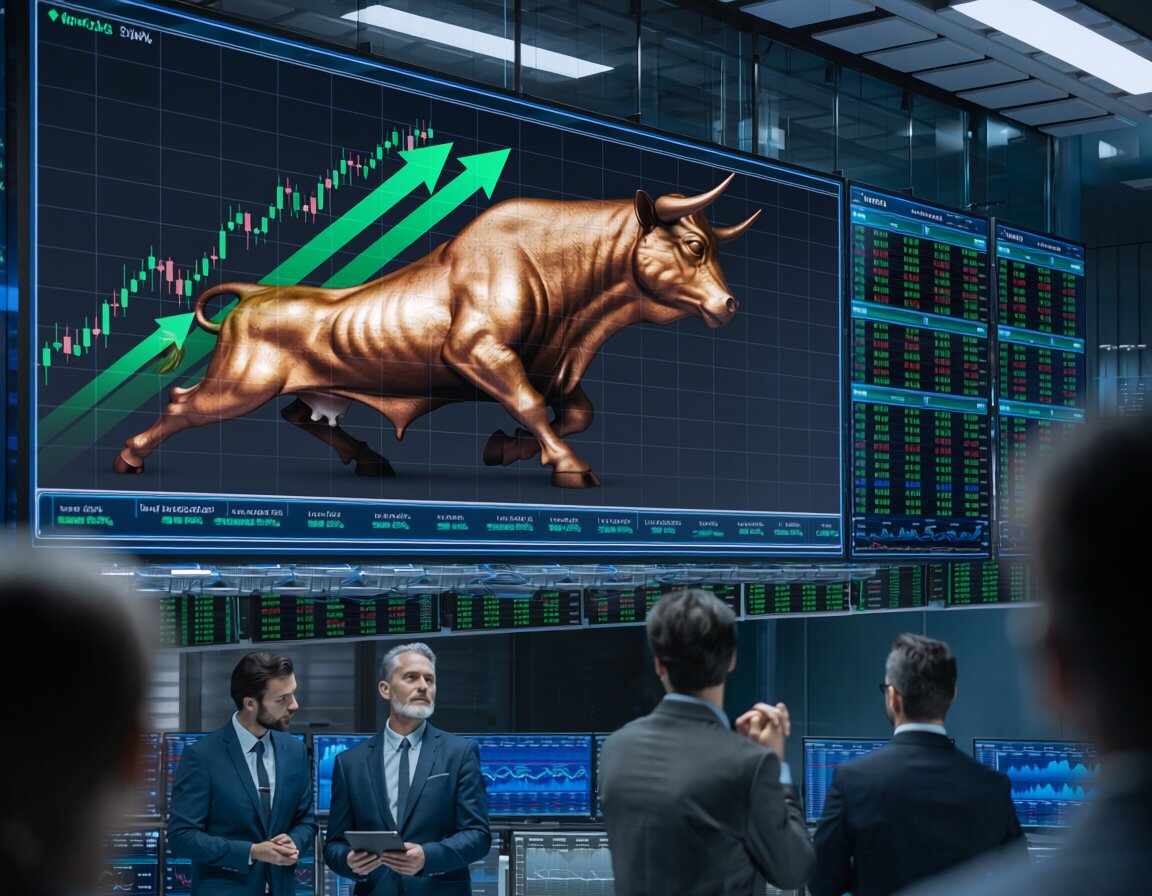
The math of what happened to US financial markets between late March and April 17 is, by any historical standard, remarkable. The S&P 500 hit an all-time high of 7,126 on Friday — its third consecutive record closing high. The Nasdaq Composite notched its 13th straight session of gains, its longest winning streak since 1992. The Dow Jones Industrial Average surged 868 points in a single session to 49,447, its highest close since late February. The US stock market, in aggregate, has gained more than 12% from its late-March low — with roughly half of that coming in just the past week alone.
On April 17, Iran’s Foreign Minister Abbas Araghchi posted on X that passage for all commercial vessels through the Strait of Hormuz was “completely open.” Crude oil immediately plunged more than 10%, with US benchmark WTI settling at $82.59 per barrel — down from peaks above $100 just weeks earlier — and Brent crude dropping to $90.38. The dollar fell against every major peer. Bond yields tumbled as traders repriced the odds of Federal Reserve rate cuts resuming before year’s end. Bitcoin climbed for its fifth straight day. Credit spreads tightened. Gold rose. The VIX, the so-called fear gauge of equity markets, dropped.
In the space of seven weeks, the Iran war nearly tipped global markets into a full-scale crisis. In the space of seven days — catalysed by a ceasefire in Lebanon, the Hormuz reopening, and Trump’s statement that the war “should be ending pretty soon” — Wall Street priced almost all of it out again.
The Rally’s Architecture
To understand the speed and magnitude of what happened, it helps to understand what the market was actually pricing in when it hit its trough on March 30. At that point, oil was trading above $100 a barrel. The Strait of Hormuz — through which roughly 20% of global oil and natural gas flows — had been effectively closed for weeks. Bond yields were spiking on inflation fears. The University of Michigan consumer sentiment index had fallen to a 74-year low. The ISM Services prices index had recorded its largest monthly jump in 14 years. Fed rate cut expectations had been completely priced out and markets had briefly flirted with pricing in rate hikes.
The market’s fear was not irrational. The energy shock was real and documented. Delta Air Lines projected over $2 billion in additional fuel costs through June. WD-40 warned of surging input costs. Constellation Brands withdrew its 2028 outlook. Consumer sentiment — the survey of ordinary Americans, not financial professionals — was at levels not seen since 1952.
And yet. From that trough, the S&P 500 gained more than 12% in less than three weeks. The speed of the reversal is described by Bloomberg as driven by “a combination of hedge unwinding, systematic buying and short covering by hedge funds in macro products.” That language translates as follows: investors who had positioned defensively — buying protection against further declines, reducing equity exposure, shifting into cash — reversed those trades rapidly when the geopolitical signal changed. The unwinding of those hedges is itself a source of buying pressure, amplifying the upside move beyond what fundamentals alone would justify.
The technical dimension was striking. It took the S&P 500 just 11 days to lurch from an oversold reading to overbought territory — a reversal that, according to Bloomberg data, has only been exceeded in speed by a rally in 1982.
What the Market Believes and What It Cannot Know
The Hormuz announcement and the ceasefire between Israel and Lebanon triggered the sharpest single-session moves. Araghchi’s post on X — calling the strait “completely open” as part of the Lebanon ceasefire agreement — was the catalyst for Friday’s surge. But the precise terms of that opening remained contested almost immediately. Trump confirmed the strait was open while indicating the US naval blockade would remain in effect until a formal US-Iran deal was concluded. Araghchi specified that vessels must pass through a “coordinated route” established by Iran — language that implies Iranian authority over the waterway remains intact, not that it has been surrendered.
Crossmark CEO Bob Doll captured the market’s pragmatic reasoning precisely: “The concern about oil putting the world into a slowdown diminishes as it’s onward and upward for a possible final deal. It looks like it’s heading in a direction that’s enough for the market to go up.” The phrase “enough for the market to go up” is the operative one. Markets do not need certainty. They need a change in the probability distribution — specifically, a meaningful shift in the likelihood that the worst-case scenario will not materialise. The Hormuz announcement, even with its ambiguities, accomplished that.
Meanwhile, strong earnings from Wall Street’s biggest banks provided the fundamental underpinning that the geopolitical signal needed. Goldman Sachs, JPMorgan, Bank of America, Morgan Stanley — every major institution reported record or near-record trading revenues and beat analyst expectations on earnings per share. Q1 2026 turned out to be the most profitable quarter in recent Wall Street history, driven partly by the very volatility that the war created. The earnings signal told investors that, whatever the macro uncertainty, the underlying corporate earnings machine was still running.
Winners, Losers, and What Got Priced Out
The sector rotation on Friday was clean and legible. Energy stocks fell sharply — Exxon Mobil dropped 3.6%, Chevron 2.2% — as investors priced in lower oil revenues from a lower crude price environment. Airlines surged: United Airlines jumped 7%, Royal Caribbean 7.3%, Carnival 7%. Consumer discretionary — the sector most sensitive to consumers having more money in their pockets when gasoline is cheaper — was the day’s best performer. A Goldman Sachs basket of middle-income consumer spending companies gained, with Boot Barn, Yeti, and Brinker International all rising sharply on the market’s calculation that falling gas prices act as a consumer tax cut.
The technology sector maintained its momentum, with the Nasdaq’s 13-day winning streak — its longest since 1992 — extending through Friday’s session. Scott Rubner, Citadel Securities head of equity and equity derivatives strategy, noted that the recent pullback had created “a more constructive entry point in equities, particularly across large-cap quality growth.” Tech valuations, despite the rally, remain near their ten-year average on a forward price-to-earnings basis — a data point that gives bulls an argument that the surge is not simply multiple expansion running ahead of fundamentals.
The Risks That Have Not Been Priced Out
What the market has not priced out is the uncertainty that remains embedded in every dimension of the US-Iran situation. The Lebanon ceasefire that triggered Araghchi’s Hormuz announcement is ten days old. The second round of US-Iran talks has not yet been scheduled. The nuclear question — the central sticking point that collapsed the Islamabad negotiations after 21 hours — remains unresolved. US mines sweeping operations in the strait are ongoing, because Iran lost track of some of the mines it placed during hostilities, meaning navigation is not yet fully safe regardless of political announcements.
Some Gulf Arab and European leaders have said a full US-Iran peace deal could take approximately six months to finalise. The ceasefire is a pause, not a settlement. Analysts at Motley Fool noted that “there are other broader market concerns investors need to keep an eye out for, including threats from artificial intelligence, private credit, potential further weakness in the labor market, and persistently elevated inflation.”
The S&P 500’s earnings estimates have been rising in concert with the stock rally, keeping forward price-to-earnings ratios at manageable levels — a positive technical signal. But those estimates were constructed before the war began and have not been comprehensively revised to reflect its secondary effects: the supply chain disruptions, the input cost inflation, the consumer sentiment damage, the credit conditions tightening that six weeks of energy shock produced.
What Wall Street priced out this week was the catastrophic scenario. What it has not fully priced in is the economic afterglow of a shock that, even if it ends diplomatically, has already left its mark on inflation, on consumer confidence, and on the global supply chains that make the earnings growth those forward estimates assume possible in the first place.
Written by Shalin Soni, CMA specializing in financial analysis, global markets, and corporate strategy, with hands-on experience in financial planning and analytical decision-making.
ALSO READ
• ‘AI Is an Excuse’: CEO Criticizes Tech Industry Layoff Trend
• China’s Economy Defies War Pressures With Unexpected 5% Growth
• South Korea’s Richest Just Hit an All-Time High and AI Is Why
Source: Based on Bloomberg and publicly available information.