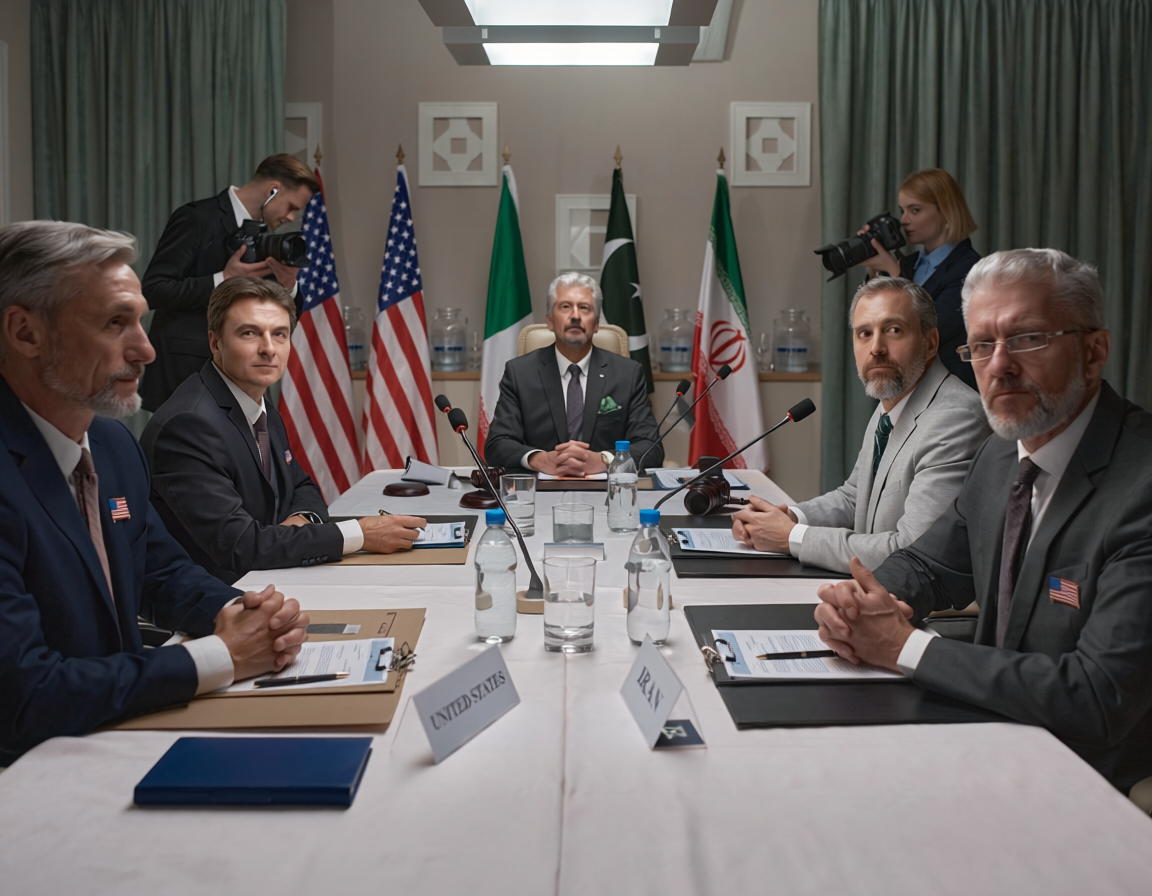
For one extraordinary weekend, the world held its breath as the most consequential diplomatic encounter in decades played out in a heavily fortified Pakistani capital. Roads blocked by shipping containers. Armed soldiers on every corner. Luxury hotels quietly evacuated. Islamabad had been transformed into something it had never quite been before — the nerve centre of global geopolitics.
And when it was all over, after 21 gruelling hours of direct negotiations between American and Iranian officials, Vice President JD Vance walked to a podium, flanked by special envoy Steve Witkoff and Jared Kushner, and delivered the verdict the world was dreading: no deal.
“The bad news is that we have not reached an agreement, and I think that’s bad news for Iran much more than it’s bad news for the United States of America,” Vance told reporters before boarding Air Force Two back to Washington.
The war that has killed thousands, sent oil prices soaring, and rattled global markets had entered its seventh week — and its most uncertain chapter yet.
How We Got Here
The story of the Islamabad talks begins in late February, when President Donald Trump announced “major combat operations” against Iran, triggering massive joint US-Israeli airstrikes on Iranian military and government sites. The stated objectives were clear: stop Iran’s ballistic missile programme and prevent it from developing a nuclear weapon. What followed was weeks of conflict that choked the world’s most critical energy corridor.
Iran responded by blocking the Strait of Hormuz — the narrow waterway through which roughly 20% of global oil and liquefied natural gas shipments flow. The economic consequences rippled outward almost immediately, hitting energy markets, supply chains, and economies across Asia, Europe, and beyond.
A fragile two-week ceasefire was brokered and announced on April 7. Hours before a bombing deadline expired, Trump agreed to pause military action if Iran permitted safe passage through the strait. Iran’s foreign minister signalled cautious compliance, describing passage as possible “via coordination with Iran’s Armed Forces.”
That ceasefire opened the narrow window through which the Islamabad talks were supposed to walk.
Pakistan’s Unexpected Starring Role
Perhaps the most surprising subplot of this entire saga is the nation that hosted it. Pakistan — until recently viewed by Washington as an unreliable partner — emerged as the unlikely mediator of one of the most consequential diplomatic conversations of the 21st century.
“Pakistan is very happy that both Iran and the US have expressed their confidence in Pakistan to facilitate their talks,” Foreign Minister Ishaq Dar said in a televised address as the talks were being arranged. “Pakistan will be honored to host and facilitate meaningful talks between the two sides for a comprehensive settlement of the ongoing conflict.”
Pakistan earned that credibility through weeks of quiet diplomacy, building trust simultaneously with Washington and Tehran — no small feat given the geopolitical minefield involved. Digital billboards across Islamabad branded the event “The Islamabad Talks,” and the Pakistani government spared nothing on security, creating a several-mile-wide security ring around the Serena Hotel where delegations met.
Saudi Arabia, Egypt, and Turkey all backed the talks publicly, lending regional legitimacy to Pakistan’s mediation role. Even Iran’s President Masoud Pezeshkian called Pakistani Prime Minister Shehbaz Sharif to personally express appreciation for Islamabad’s efforts before negotiations began.
Inside the Negotiating Room
The American delegation that landed in Islamabad was a striking one. Vance — a reluctant defender of the Iran war with limited diplomatic experience — was joined by Witkoff and Kushner, both relatively new to international negotiations of this scale. Iran’s delegation, led by Parliament Speaker Mohammad Bagher Qalibaf, arrived dressed in black, mourning for Supreme Leader Ayatollah Ali Khamenei and others killed in the war. They carried with them shoes and bags belonging to students killed during a US bombing of a school near a military compound — a pointed and theatrical statement of grievance before a single word of negotiation had been spoken.
What began as “proximate talks” — where Pakistani mediators would shuttle between the two sides — evolved into something more historically significant. Sources close to the mediation confirmed that the two teams moved into the same room for direct, face-to-face discussions, with Pakistani officials present. These were the first direct US-Iranian talks at this level since Barack Obama called Iranian President Hassan Rouhani in 2013 to discuss nuclear concerns. More significantly, they were the highest-level direct engagement since the 1979 Islamic Revolution.
Iran’s foreign ministry confirmed that negotiations covered the full range of live issues: the Strait of Hormuz, the nuclear programme, war reparations, the lifting of sanctions, and the broader regional conflict — including Israel’s ongoing military campaign against Hezbollah in Lebanon, which had already killed more than 2,000 people and which Iran insisted must be part of any deal.
Where It Broke Down
By the early hours of Sunday morning, 21 hours of intensive negotiation had produced no signed agreement and no clear path forward.
From the American side, the non-negotiable demand was stark: Iran must make a firm, long-term commitment not to develop a nuclear weapon. “The simple fact is we need to see an affirmative commitment that they will not seek a nuclear weapon, and they will not seek the tools that would enable them to quickly achieve a nuclear weapon,” Vance told reporters. “We haven’t seen that yet.”
Iran’s position was equally firm, and framed entirely differently. Iranian state media reported that “excessive demands by America prevented any agreement.” Tehran insisted on its sovereign right to enrich uranium under the Nuclear Non-Proliferation Treaty — a right the US argued Iran forfeited through years of deceiving international inspectors. Tehran also demanded control of Strait of Hormuz transit fees, release of frozen assets held in Qatar and other foreign banks, war reparations, and a regional ceasefire that included Lebanon.
Former State Department Middle East negotiator Aaron David Miller captured the deadlock bluntly. Iran, he said, “hold more cards than the Americans.” He noted that Tehran appeared to be operating on a slower diplomatic timeline. “They are clearly in no hurry to make concessions,” he told CNN. “They still have the highly enriched uranium. They’ve weaponised geography, they control the Strait of Hormuz. The regime has survived.”
What Hangs in the Balance
The breakdown in Islamabad does not automatically mean a return to active warfare — but it puts the fragile two-week ceasefire under serious strain, and no one in Islamabad seemed entirely certain what comes next.
Without a deal to permanently reopen the Strait of Hormuz, global energy markets remain vulnerable. Three supertankers did pass through the strait on Saturday — the first vessels to exit since the ceasefire — but Iran’s Islamic Revolutionary Guard Corps warned that any military vessel attempting transit would be met with “a strong response.” Two US Navy destroyers claimed to have transited the strait to begin clearing mines; Iranian state media denied it happened.
Trump, speaking from the White House lawn, struck his characteristic tone of studied indifference. “Whether we make a deal or not makes no difference to me,” he said, claiming the US had already won militarily. He acknowledged knowing where mines had been placed in the waterway and said minesweepers were already deployed.
Pakistan’s Foreign Minister Dar, to his credit, refused to declare the effort finished. “Pakistan has been and will continue to play its role to facilitate engagement and dialogue,” he posted after the talks ended, urging both sides to preserve the ceasefire’s “positive spirit.”
Iran’s foreign ministry, for its part, kept a door ajar. Spokesman Esmaeil Baghaei acknowledged that “on some topics, US and Iranian negotiators actually reached mutual understanding,” and added with a diplomat’s typical understatement: “Diplomacy never comes to an end.”
Analysis: A Beginning Disguised as a Failure
It would be too simple to call what happened in Islamabad a failure. History rarely moves cleanly. The Islamabad talks were, in fundamental terms, a historic first — the most direct, senior-level engagement between Washington and Tehran in nearly half a century. That alone matters.
The gap between the two sides remains wide: nuclear rights versus nuclear guarantees; Lebanese ceasefire inclusion versus bilateral-only framing; sanctions relief versus preconditions. But the fact that both delegations stayed in that room for 21 consecutive hours suggests that neither side was entirely uninterested in a deal.
The ceasefire holds — for now. The diplomats are home. The mines are still in the water. And the world is watching to see whether Islamabad was the end of negotiations, or merely the end of the beginning.
Written by Shalin Soni, CMA specializing in financial analysis, global markets, and corporate strategy, with hands-on experience in financial planning and analytical decision-making.
ALSO READ
• NASA Revises Moon Strategy, Ties Landing Timeline to SpaceX and Blue Origin
• Markets Surge $1.5 Trillion as Trump-Iran Ceasefire Eases Oil Shock
• Hong Kong Eyes World’s Largest Digital Bond Sale Worth $1.5 Billion
Source: Based on Bloomberg and publicly available information.