There is a particular kind of corporate announcement that demands careful reading — the one where a company reports record results and immediately walks them back with a caution. Foxconn delivered precisely that kind of statement this month, and understanding the tension between those two messages tells you a great deal about where the global tech industry stands right now.
Taiwan’s Hon Hai Precision Industry — known worldwide as Foxconn — posted first-quarter revenue of T$2.13 trillion ($66.60 billion), a 29.7% jump compared to the same period a year ago. March alone was a record month, with revenue rising 45.6% year-on-year to T$803.7 billion. For the world’s largest contract electronics manufacturer, these are genuinely extraordinary numbers, driven by an AI infrastructure boom that shows no sign of losing momentum.
And yet, almost in the same breath, the company warned that “it remains necessary to monitor the impact of the volatile global political and economic situation.” Chairman Young Liu went further, stating plainly that the biggest external challenge for Foxconn in 2026 is the global political environment — with the war in the Middle East sitting at the top of his list of concerns.
Strong numbers. Serious warning. Both deserve attention.
The AI Engine Running at Full Speed
Let’s start with what’s working, because the magnitude of Foxconn’s AI-driven transformation is easy to underestimate.
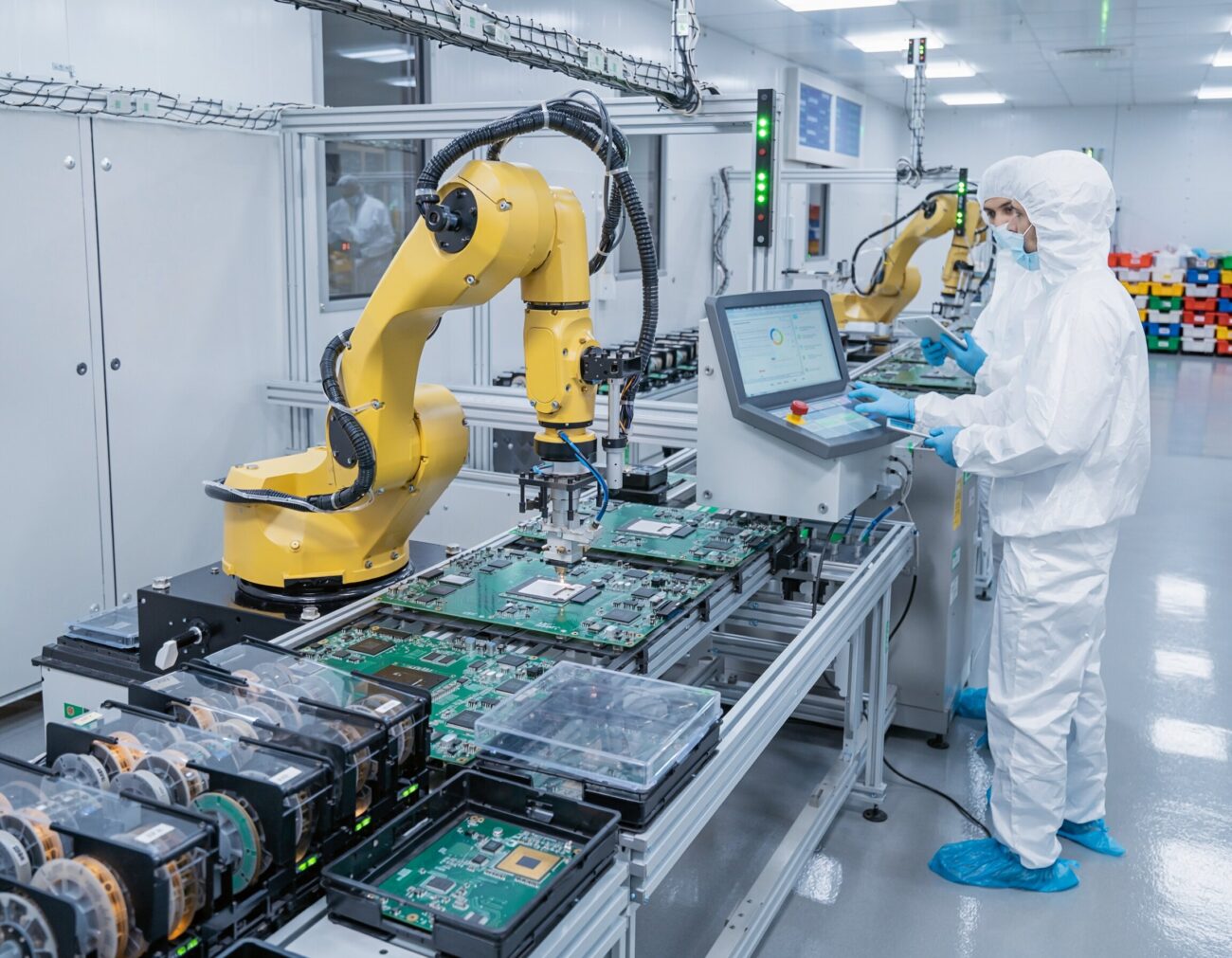
Foxconn is not simply the company that assembles iPhones anymore. That description, while still accurate, misses the more consequential story of what the business has become. The company is now Nvidia’s largest server manufacturer globally, controlling an estimated 40% of the AI server market. Its cloud and networking products division — the segment directly tied to data centre infrastructure and AI computing — accounted for 40% of Foxconn’s total business portfolio in 2025, up from 30% the year before. That shift in revenue composition is a structural transformation, not a temporary bump.
What’s fuelling it is the relentless demand from cloud service providers and hyperscalers pouring capital into AI infrastructure. Every Nvidia GPU architecture requires sophisticated assembly, thermal management, and testing at scale. Foxconn has positioned itself as the primary partner for that work, and the backlog reflects it. The company has guided for AI rack shipments to grow at a high double-digit pace on a sequential basis, and analysts expect AI servers to account for more than half of Foxconn’s total server revenue in 2026.
The company has gone so far as to issue something it has never done before: a full-year forward guidance designation of “strong growth” for 2026 — its highest possible category. That kind of visibility commitment, covering an entire calendar year, signals a level of confidence in AI demand that the company has not publicly expressed before now. Chairman Liu was direct about what that confidence rests on: “Driven by the strong growth of AI servers, I believe 2026 will still be a very good year, and we expect to see robust growth.”
The iPhone business also contributed meaningfully. Smart consumer electronics posted what Foxconn described as “significant” growth in the quarter, supported by strong new product launches. For a company that built its foundations on smartphone assembly, the consumer electronics recovery provides a complementary tailwind alongside the AI surge.
The Shadows Behind the Numbers
Here is where the story becomes more complicated. Strong as those Q1 results were, the stock has not rewarded them in the way the revenue growth might suggest. Foxconn’s shares have fallen roughly 6% so far this year, even as Taiwan’s benchmark index has risen 15%. That gap reflects investor anxiety about precisely the risks that Chairman Liu flagged — and they are not small.
The tariff exposure. Foxconn has substantial manufacturing operations in China and Mexico, both of which are directly in the crosshairs of U.S. trade policy under the Trump administration. The tariff math on consumer electronics assembled in China is brutal: a 145% duty on Chinese-made goods shipped to the United States would be devastating for margin calculations on smartphones, which already operate on razor-thin profitability. Foxconn’s rotating CEO Kathy Yang cautioned that the acceleration of AI server growth required “close attention due to the impact of changes in tariffs and exchange rates.”
The company has been diversifying its manufacturing footprint for several years, expanding into India, Mexico, and Vietnam. But relocating AI server manufacturing is fundamentally different from shifting a smartphone assembly line. AI servers require specialised components, advanced thermal management systems, and proximity to chip packaging facilities that remain concentrated in East Asia. The complexity of that relocation cannot be resolved in a single quarter.
The Middle East war and energy costs. Chairman Liu specifically identified the Middle East conflict as the primary geopolitical concern for 2026. That concern has multiple dimensions. The closure of the Strait of Hormuz has sent global energy prices surging — crude oil has hit $120 a barrel, with some analysts warning of $150 if the disruption extends into mid-May. Rising energy costs feed directly into manufacturing expenses, logistics costs, and the operating expenses of the data centres that Foxconn’s AI servers ultimately power. Persistent Middle East instability poses a threat to logistics networks and insurance costs for global shipping that is difficult to quantify but impossible to ignore.
Capital expenditure commitments at a moment of uncertainty. Foxconn has announced that capital spending will rise more than 20% this year, with investment focused on expanding AI server production capacity in Texas and Wisconsin in the United States. This includes what was intended to be among the world’s largest AI server assembly facilities. These are serious long-term bets made at a moment when the near-term operating environment is unusually uncertain. If AI demand normalises sooner than expected — or if the geopolitical environment disrupts the supply chains feeding these facilities — the capital commitments become harder to justify.
A Company in Strategic Transition, Navigating an Unstable World
What Foxconn’s Q1 results really reveal is a business caught mid-transformation: shedding its identity as a low-margin assembler of consumer gadgets and rebuilding itself as the backbone of the AI infrastructure economy, all while the world around it becomes measurably more volatile.
The AI pivot is unambiguously working. The cloud and networking division is growing. The partnership with Nvidia is deepening. The OpenAI collaboration on next-generation AI infrastructure hardware and the Taiwanese government’s AI factory initiative with Nvidia and Foxconn suggest that the company’s positioning in the AI supply chain is strengthening, not weakening.
But the external environment that Liu is cautioning about is real. “Over the past few months, there have been significant changes in tariffs, geopolitics, and global monetary policy,” he told analysts. That sentence, understated as it was, describes an operating context that would challenge any global manufacturer.
For investors and analysts tracking the company, the fundamental question is whether Foxconn’s AI momentum can withstand the turbulence that its own chairman is warning about. The Q1 numbers argue yes — for now. The guidance for the rest of 2026 argues yes — with caveats. What the market’s muted response to those record results suggests is that the word “volatile,” when used by the world’s largest electronics maker about the global operating environment, carries more weight than any single quarter’s revenue figure.
Foxconn is having its best financial period in its history. It is also operating in one of the most uncertain geopolitical environments it has ever faced. Both of those things are true at the same time, and neither cancels the other out.
Written by Shalin Soni, CMA specializing in financial analysis, global markets, and corporate strategy, with hands-on experience in financial planning and analytical decision-making.
ALSO READ
• How to Profit From Meta’s Smart Glasses Boom Without Owning Meta Stock
• Wealthy Investors Exit Private Credit as $14 Billion Redemption Wave Hits Markets
• Visa Launches AI Tools to Transform Payment Dispute Management
Source: Based on Reuters and publicly available information.
Disclaimer
This article is based on publicly available information, market developments, and credible media reports. The content is intended for informational and analytical purposes only and should not be considered financial, investment, or legal advice.