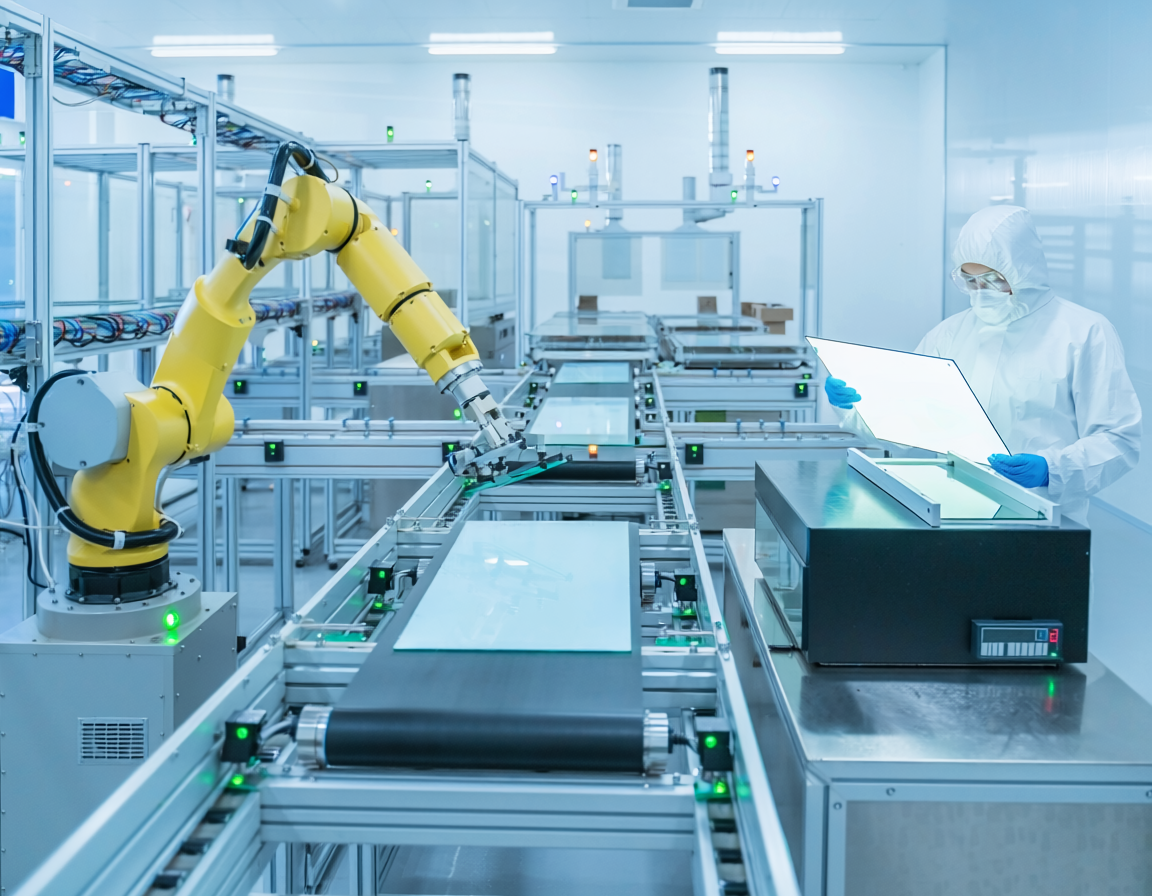
There is an understated confidence in the way LG Display is spending money right now. The South Korean display panel giant, which returned to full-year profitability for the first time since 2020 in 2025, has announced a $745 million investment in OLED display infrastructure — the latest and largest single tranche of a capital deployment programme that reflects a company convinced it has correctly identified where the display industry is going and is now racing to build the physical capacity to lead it there.
The investment, reported by Reuters, targets infrastructure for advanced OLED technologies and forms part of the broader KRW 1.26 trillion (approximately $925 million) investment programme that LG Display’s board approved in June 2025. The funds will be used to build and upgrade production infrastructure — equipment, facilities, and process technologies — at its flagship manufacturing complex in Paju, South Korea, and its module assembly plant in Vietnam. With approximately 55% of the investment directed toward Paju, the programme represents the most significant domestic capital commitment LG Display has made since divesting its LCD plant in Guangzhou, China.
Why Now: The Financial Position That Made This Possible
Understanding the timing of this investment requires understanding where LG Display has come from. The company spent years navigating a difficult transition out of LCD manufacturing — a product category that Chinese rivals, primarily BOE and CSOT, had commoditised through aggressive capacity expansion, relentlessly compressing prices and squeezing margins for companies that lacked low-cost manufacturing advantages. LG Display’s strategy was to accelerate its exit from LCD and concentrate entirely on OLED, a technology where Korean manufacturers held both the technical lead and the production expertise.
That strategy extracted a significant financial cost. From 2021 to 2024, LG Display struggled with losses that accumulated across multiple years, the result of heavy capital investment in OLED capacity during a period when OLED market volumes had not yet reached the scale required to absorb those costs profitably. The company returned to full-year profit in 2025, reporting revenues of $18 billion and net profit of $360 million — modest in absolute terms, but symbolically important as the first full-year profit since 2020. OLED sales accounted for 61% of total revenues in 2025, up from 32% in 2020 and 55% in 2024. The directional shift is complete. The question now is whether the infrastructure investment can translate the strategic position into sustained profitability.
Management’s answer, expressed through the investment announcement, is yes — and that they intend to bet $745 million on that conviction.
What the Money Is Buying
The investment is not a general capacity expansion. It is a targeted upgrade of production technology across several specific categories, each of which addresses a distinct opportunity in the evolving display market.
At the Paju facility, the spending encompasses upgrades to LTPO 3.0 technology — the low-temperature polycrystalline oxide backplane architecture that enables variable refresh rate displays, important for smartphones and IT devices that need to balance performance with battery life. The investment also covers implementation of COE (Colour on Encapsulation) technology, which produces polarizer-free OLED panels that are notably thinner and more power-efficient — a key requirement for the next generation of ultra-thin smartphones, including Apple’s mooted iPhone Air 2, which is reportedly under consideration as the first ultra-thin iPhone model to adopt COE.
Enhancements to the RGB 2-stack tandem AMOLED structure are also included, as are new production chambers capable of manufacturing 4-stack WOLED panels, increasing the capacity of LG Display’s most advanced WOLED generation for premium television applications. In Vietnam, the investment focuses on improving module process efficiency and automation capabilities — the finishing stages of OLED panel production that convert glass substrates into finished display modules ready for integration into consumer devices.
The breadth of the technology upgrades reflects the breadth of the market LG Display is targeting. The company supplies OLED panels for smartphones, tablets, laptops, monitors, televisions, and automotive displays. Its growth in the Apple Watch segment has been particularly notable: following Japan Display’s exit from that market, LG Display has effectively become the sole supplier of Apple Watch OLED panels, with its market share in the smartwatch OLED segment rising to 43.7% in 2025, the highest in its history.
The Market Tailwinds Behind the Investment
The strategic logic underpinning the investment is supported by market data that is broadly favourable. According to market tracker Omdia, the global LCD market — valued at approximately $79 billion — is projected to grow at an average annual rate of just 1% through 2028. The OLED market, by contrast, is expected to grow at around 5% annually over the same period, from $53 billion to nearly $69 billion by 2028. Some estimates project far faster long-term expansion: the global OLED market has been forecast to grow at a compound annual rate of 20.1% through 2033, potentially reaching $192 billion.
The near-term demand signals are also encouraging. OLED tablet panel shipments are expected to grow 39% year-on-year to 15 million units in 2026, as OLED becomes the primary driver of tablet panel growth, overtaking LCD technology in that segment for the first time. LG Display is expected to supply approximately 45.6 million panels for the iPhone 17 series in 2026, a significant increase from its 2024 shipments. Foldable smartphones, which declined slightly in 2025, are forecast to rebound sharply in 2026. The automotive display segment, where LG Display is investing in technologies like its 51-inch pillar-to-pillar OLED panel for in-cabin screens, represents an emerging high-margin vertical that is still in relatively early growth stages.
Against that demand backdrop, analysts at FnGuide project LG Display’s operating profit will reach approximately KRW 1.3 trillion ($852 million) in 2026, a 152% increase from 2024. Samsung Securities has forecast that LG Display will return to profitability across all its OLED divisions — including mobile, television, and IT panels — by 2026. The investment announcement is, in part, a statement that management believes those projections are achievable and that the capacity needs to be in place to meet the demand that would produce them.
The Competition That Sharpens the Stakes
The investment is also, explicitly, a competitive response. Samsung Display — LG’s primary Korean rival — is reportedly preparing to begin mass production on its 8.6-generation IT OLED line as early as May 2026, the first such production line outside China. BOE, the Chinese display giant, has been aggressively expanding its own OLED capacity. In the premium segment, the race between Samsung’s QD-OLED and LG Display’s WOLED for television and monitor panels is intensifying, with each company regularly trading performance claims at industry events including CES 2026, where LG showcased its Primary RGB Tandem 2.0 technology and next-generation products including a 39-inch 5K2K Tandem WOLED monitor panel.
LG Display CFO Kim Seong-hyun has been measured about the pace of expansion, stating during the January earnings call that the company remains cautious about investing in a separate 8.6-generation IT OLED line, citing unclear customer demand and a volatile broader environment. That restraint — spending heavily on upgrading existing infrastructure while holding back on the largest new expansion decisions — reflects a company trying to balance competitive urgency with financial discipline.
The $745 million investment is a significant sum. But it is also a company that generated $18 billion in revenue in 2025 and has now committed to a programme it believes will strengthen its position in a market growing faster than almost any other in consumer electronics. The infrastructure going up in Paju will determine which premium screens the world uses in 2028 and beyond. LG Display is betting that the answer will carry its name.
Written by Shalin Soni, CMA specializing in financial analysis, global markets, and corporate strategy, with hands-on experience in financial planning and analytical decision-making.
ALSO READ
• Mulberry Returns to Sales Growth as Turnaround Strategy Gains Momentum
• Rising Jet Fuel Costs Are Forcing Airlines to Cut Routes Worldwide
• Why Silver Beats Gold in Bull Markets: Key Trends Investors Should Watch
Source: Based on Reuters and publicly available information.