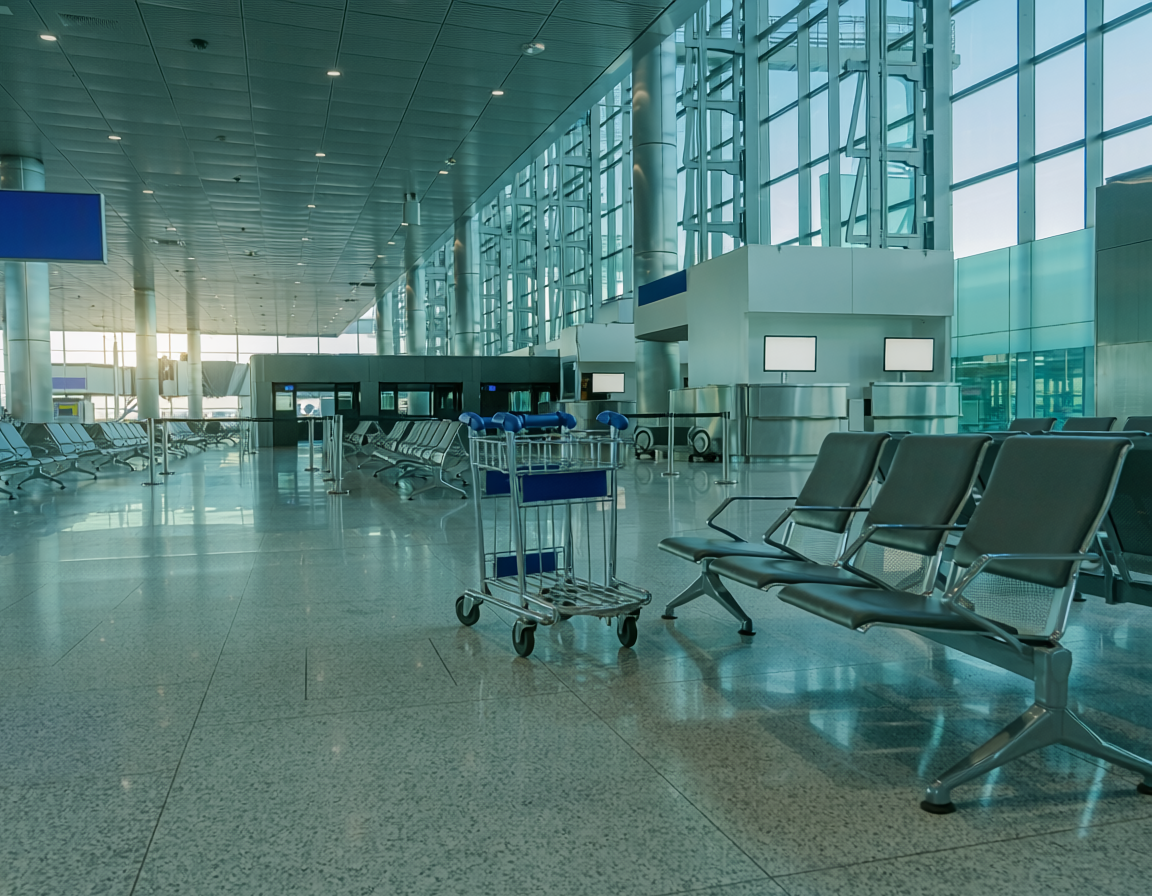
When KLM announced on Thursday that it would cancel 80 return flights out of Amsterdam’s Schiphol Airport over the coming month, the Dutch flag carrier was careful to specify the reason. Not a pilot shortage. Not mechanical issues. Not a scheduling conflict. The reason, stated plainly in KLM’s operational notice, was that a “limited number of flights are no longer financially viable to operate” because of rising kerosene costs.
That single sentence — from one of Europe’s most established airlines — encapsulates what the Iran war has done to global aviation. Jet fuel, which constitutes roughly 30% of an airline’s total operating costs in normal times, has more than doubled in price since the US and Israel launched strikes on Iran on February 28. European jet fuel hit a record $1,838 per tonne in early April, up from approximately $831 before the conflict began. At those prices, routes that were marginally profitable — short European hops, off-peak connections, thin-demand services — are no longer worth operating at all. The planes stay on the ground. The passengers find other ways.
A Global Industry in Self-Preservation Mode
KLM’s announcement was notable not because it was unusual, but because it was unusually direct. Nineteen of the 20 largest airlines in the world have cut capacity for May, according to data compiled by aviation analytics firm Cirium. Global capacity for the month has been reduced by approximately 3 percentage points — a figure that, while modest in aggregate, translates to thousands of cancelled or suspended flights and routes that, in some cases, will not return.
The roll call of affected carriers reads like a cross-section of international aviation. United Airlines has pruned its itineraries. Deutsche Lufthansa — Europe’s largest airline — has taken the most aggressive action on the continent, shutting down its feeder unit CityLine immediately and withdrawing its 27 older, less fuel-efficient aircraft from service ahead of schedule. The shutdown had been planned for next year; the fuel crisis accelerated it. Lufthansa also grounded older widebody jets across the rest of its network. “The package to accelerate fleet and capacity measures is unavoidable given the sharp rise in jet fuel costs and ongoing geopolitical instability,” said group CFO Till Streichert.
The cuts extend well beyond Europe. Qantas Airways has reduced its flights to the United States and is cutting domestic capacity by approximately 5%, estimating an additional A$800 million (roughly $575 million) on its fuel bill in the second half of its fiscal year. Hong Kong’s Cathay Pacific is reducing flight frequencies across the Asia-Pacific region by 2% from mid-May through the end of June, with its budget unit HK Express implementing a steeper 6% pullback following fuel levies of as much as $400 on long-haul round-trip services.
Norse Atlantic, the Norwegian budget carrier, halted all flights to and from Los Angeles. Virgin Atlantic scrapped its London-to-Riyadh service after just one year in operation. British Airways dropped its Jeddah route. Nigerian airlines warned they are “facing existential threats” and may halt flights entirely in coming days unless measures are taken to address fuel prices. Air Canada has suspended its direct Toronto-to-New York JFK service starting June 1.
Chinese airlines, which also lack fuel-hedging protection, have been stepping up daily cancellations. Scores of Chinese travellers have taken to social media to complain about late-notice cancellations ahead of the country’s five-day Golden Week holiday in May.
The Problem Behind the Problem is Supply Itself
The price shock is one dimension of the aviation crisis. The supply dimension may prove more consequential. In an exclusive interview on Thursday, International Energy Agency Director Fatih Birol delivered a warning that went well beyond airline economics: Europe has “maybe six weeks” of jet fuel supplies remaining at current consumption rates, and the global economy faces what he described as its “largest energy crisis.”
The structural reason for Europe’s vulnerability is straightforward. European aviation runs overwhelmingly on kerosene refined from Middle Eastern crude — crude that normally flows through the Strait of Hormuz. With the strait effectively closed since early March, and with the US naval blockade layered on top of that closure since April 13, Europe’s refiners cannot access the feedstock their operations depend on. The United States has been increasing exports to help, but even at full capacity would cover only about half of what Europe typically imports from the region.
Some European countries normally hold several months of jet fuel inventory at a time. That buffer is being drawn down. Ryanair, Virgin Atlantic, and EasyJet have all given outlooks that do not extend beyond mid-summer — an honest acknowledgment that carriers cannot reliably forecast their fuel availability beyond the near term. The International Energy Agency has warned that physical shortages at specific airports could emerge as early as June if Middle Eastern supply chains are not restored. This would represent a qualitatively different problem from the current cost crisis: a situation where airlines cannot buy fuel at any price because there is not enough of it.
EasyJet absorbed an extra £25 million in fuel costs in March alone — and that was with more than three-quarters of its fuel locked in at pre-conflict prices through hedging contracts. As those contracts roll off and airlines must repurchase at spot prices, the cost burden will increase significantly even if crude prices remain at current levels. EasyJet said Thursday it expects a pretax loss of £540 million to £560 million for the first half of its 2026 fiscal year.
The Summer Travel Season in Jeopardy
The timing of this disruption is not incidental. The aviation industry’s financial model is built around the summer travel season. The revenue generated in June, July, and August subsidises the rest of the calendar year. Airlines that survive margin compression in winter by borrowing against summer profitability cannot do so if summer revenues are being eroded simultaneously by higher costs and reduced capacity.
Delta Air Lines CEO Ed Bastian — whose airline faces over $2.5 billion in additional fuel costs this quarter — framed the stakes plainly on an earnings call: “Any flying that we’re doing that’s on the margin, maybe not producing the yields we’d like, is likely going to be reconsidered. This is going to be a test for the industry.”
For passengers, the practical consequences are already visible. Less popular routes — connections to smaller regional airports, services to destinations outside the major hub-and-spoke corridors — are the first to go. They will likely be the last to return. When airlines retrench, they concentrate on the routes that carry the highest yields per seat: long-haul business class, peak-season leisure routes to high-demand destinations, cargo-heavy services. The regional connections, the intra-European hops that LCCs have spent a decade building, the secondary routes that expanded global aviation’s reach — these are the first casualties of a cost shock that leaves no margin for anything that isn’t clearly profitable.
Lufthansa’s Edelweiss unit has already suspended its Denver and Seattle flights. Its Las Vegas frequency has been reduced. Virgin Atlantic’s London-Riyadh route is gone. And Goodbody analyst Dudley Shanley has stated the obvious about where this leads: “If the price of jet fuel remains elevated for an extended period there will be more cancellations.”
A Partial Reprieve
There was, as this article was being written, one piece of genuinely positive news. Iran’s Foreign Minister Abbas Araghchi announced on Friday that the Strait of Hormuz is “completely open” for commercial traffic, following the ceasefire between Israel and Lebanon. Benchmark Brent crude fell as much as 11% on the news. If the opening holds — if the diplomatic arrangements around the strait prove more durable than the fragile ceasefire dynamics of the past two weeks — it would begin unwinding the fuel cost pressure within weeks.
But aviation does not operate in real time. Airlines plan schedules six to twelve months in advance. Summer 2026 itineraries were largely set before the Iran war began. The route cancellations announced this week are not reversible overnight. Even if fuel prices fall back toward pre-war levels — a scenario that remains conditional on a peace deal that does not yet exist — the damage to summer 2026 scheduling is done. The flights that have been cancelled will not be reinstated in time for the passengers who would have boarded them.
The Iran war remapped global energy markets in seven weeks. It will take considerably longer to remap global flight connections back to where they were.
Written by Shalin Soni, CMA specializing in financial analysis, global markets, and corporate strategy, with hands-on experience in financial planning and analytical decision-making.
ALSO READ
• Wall Street Reprices War Risks as Stocks Surge to Record Highs
• Macro Hedge Funds Hit Hard in China as Bridgewater Associates Loses 5.6%
• Asia’s Markets Are Healing: How Taiwan, Singapore, and the AI Trade Are Leading the Regional Recovery
Source: Based on Bloomberg publicly available information.