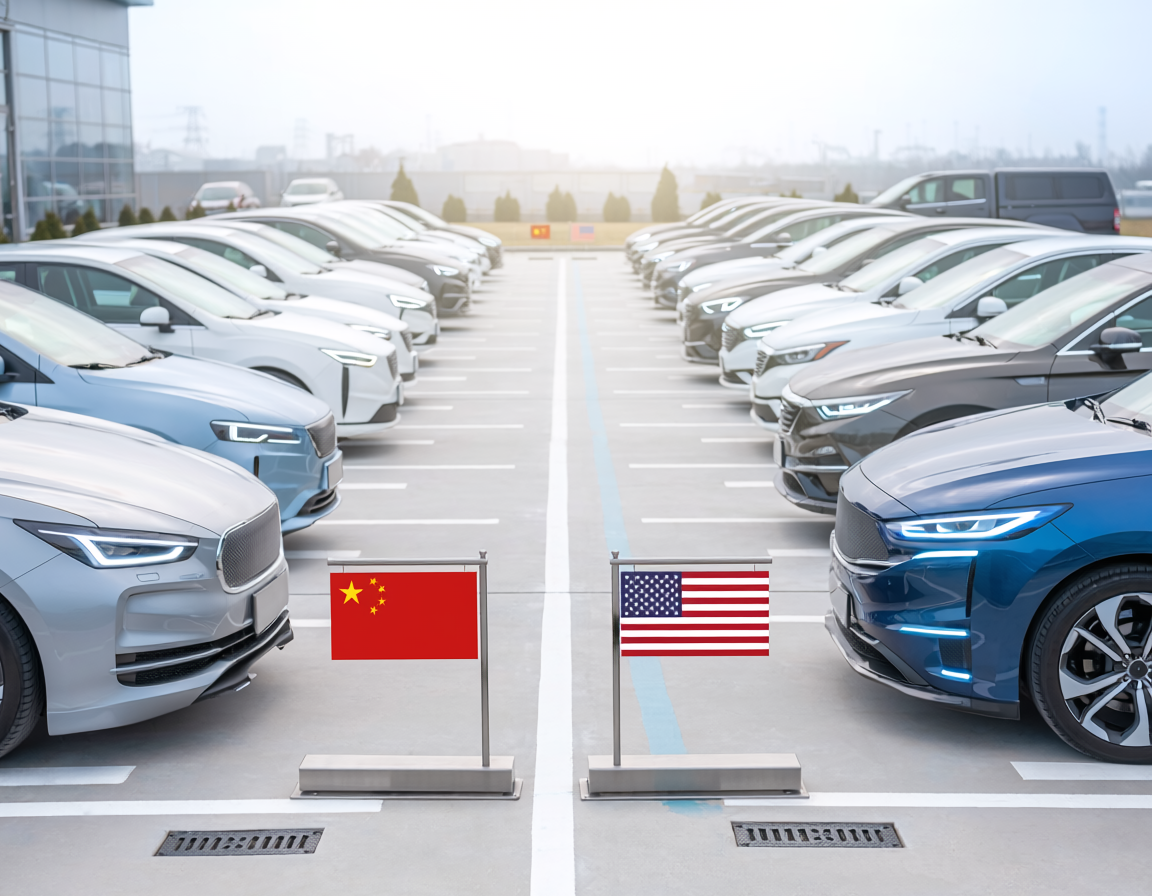
The Beijing Auto Show opened to the public this week, and amid the concept cars and camera crews and the tens of thousands of visitors crowding its exhibition halls, the most significant thing on display was not any individual vehicle. It was a number.
The average new car sold in the United States in March 2026 carried a list price of $51,456, according to Kelley Blue Book. At the Beijing show, Reuters found five of China’s best-selling electric vehicles, all priced under $12,000. Add up the sticker prices of all five. The total comes to less than the price of one average American car. For a little over $51,000, a Chinese consumer could buy a Wuling Hongguang MiniEV, a Wuling Bingo Pro, a BYD Seagull, a BYD Dolphin Mini, and a Geely compact EV — five vehicles, five sets of keys, five battery packs — and still potentially have change.
That arithmetic is not a curiosity or a trick of currency conversion. It is the clearest single illustration of what two and a half decades of Chinese industrial policy, state subsidy, hypercompetitive domestic pricing, and technological investment have produced: an electric vehicle industry capable of delivering mobility at a price point that no Western manufacturer can currently approach, and that is now threatening to permanently reshape the global automotive order.
The Cars Behind the Number
The five vehicles Reuters catalogued using DCar data represent the full spectrum of China’s budget EV market, from the deliberately tiny to the genuinely capable.
At the bottom sits the Wuling Hongguang MiniEV, the car that started the affordable EV conversation in China when it launched in 2020 and became, briefly, the world’s best-selling electric vehicle by volume. The 2026 version has been stretched to accommodate four doors and marginally more rear-seat space for adults, but remains compact by any standard outside of dense Asian cities. Its top speed of 62 miles per hour and a China-rated battery range of 127 miles make it a purpose-built urban commuter. Its price makes it a social statement: here is a country where the barrier to electric mobility has been lowered to the point where it is not a statement about income.
Wuling’s second entry, the Bingo Pro, starts at just over $8,000 and aims for a different customer: the buyer who needs highway capability. The retro-styled subcompact delivers 250 miles of China-rated range — a figure that addresses the most common objection to budget EVs. BYD’s entries include the Seagull, which caused genuine alarm in Western automotive boardrooms when it launched three years ago, combining striking design, competitive features, and a price that analysts at the time described as commercially impossible for any Western equivalent to match. The 2026 Seagull comes with optional Lidar for driving assistance, automated lane changing, fast charging, and a premium battery range of approximately 314 miles. It starts under $12,000.
BYD’s three models starting under $12,000 alone have sold 700,000 units combined over the past twelve months in China. That is not a niche market. That is a mass adoption event.
How China Built This Advantage and Why It Cannot Be Easily Replicated
The price gap between Chinese and American vehicles did not emerge overnight, and it did not emerge from any single cause. It is the compounded result of multiple factors working in the same direction over twenty-five years.
Chinese government subsidies for the EV sector have been, by international standards, extraordinarily generous. According to the Kiel Institute for the World Economy, Chinese industrial subsidies relative to GDP run approximately three to four times higher than comparable figures in France, Germany, or the United States. Those subsidies funded the battery chemistry research, the manufacturing scale-up, and the domestic demand incentives that allowed Chinese EV makers to compress the cost curve faster than any Western competitor has managed.
The domestic competitive landscape has accelerated the process further. China currently has more than 100 EV brands competing in a single market. The intensity of that competition — Accenture’s global automotive lead Juergen Reers described it plainly: “The competition is, of course, very high. And we still have way more than 100 brands in this market. So the consolidation is not really happening yet. So the competition is really driving that price down” — has forced every brand to innovate on both features and price simultaneously. BYD has developed a battery that can recharge in approximately five minutes. It employs more than 100,000 scientists and engineers. It takes 18 months from initial concept to factory rollout — half the time US and European competitors typically require. The result of that competitive intensity, paradoxically, is not market stability but a bruising price war that has seen even BYD’s domestic sales fall for seven consecutive months as rivals undercut each other relentlessly.
That internal pressure is now pointing outward. Chinese automakers are producing far more vehicles than the domestic market can absorb — potentially twice the domestic capacity. The surplus has to go somewhere. BYD shipped approximately 1.04 million vehicles overseas in 2025 and is targeting between 1.3 and 1.6 million international deliveries in 2026. It is building factories in Hungary, Brazil, Turkey, and Thailand. Geely is evaluating a US launch within 24 to 36 months, potentially using Volvo’s existing South Carolina manufacturing facility to sidestep import barriers.
The Tariff Wall and Its Limits
The reason five of China’s best-selling EVs are not available in American showrooms is not ambiguity about consumer appetite. It is a 100% import tariff on Chinese EVs, first imposed by the Biden administration in May 2024 and retained by the Trump administration, which has also added rules prohibiting Chinese software and hardware in connected vehicles sold in America. The tariff effectively doubles the price of any Chinese vehicle at the border, eliminating the cost advantage that makes the category transformative in other markets.
The policy rationale is straightforward: protecting an American automotive industry that employs hundreds of thousands of workers from competition it cannot currently match on price. Ford CEO Jim Farley has publicly called BYD “the best in the business” on cost, supply chain, manufacturing, and intellectual property — a remarkably candid statement from the head of one of Detroit’s two surviving domestic automakers. The Big Three’s combined global market share has fallen from 21.4% in 2019 to approximately 15.7% in 2025. The tariff has bought time. It has not closed the cost gap.
The wall is also showing early cracks. Canada cut its Chinese EV tariff to 6.1% on up to 49,000 vehicles annually in January, giving BYD a North American foothold through more than 20 planned Canadian dealerships. BYD has filed a legal challenge in the US Court of International Trade arguing the executive orders underpinning the American tariffs are invalid. Trump himself has reportedly suggested he would be open to Chinese automakers entering the US market “in the next two years” if they manufacture with American factories and workers — the same deal Japan reached in the 1970s and 1980s, when American opposition to Japanese vehicles eventually gave way to Toyota and Honda building plants in Ohio and Kentucky.
The social media dimension of the story adds a pressure that tariffs cannot fully address. TikTok videos of Chinese buyers acquiring $8,000 Seagulls, YouTube reviews marvelling at $42,000 Xiaomis described as feeling like $75,000 cars, and viral footage of BYD’s Yangwang U9 — an electric hypercar priced at $250,000 that can physically jump off the ground — have generated American consumer awareness of Chinese EV capabilities that exists entirely outside the tariff system. As Automotive World noted, the 100% tariff was designed to protect the US automotive industry from price competition it cannot match. It was not designed for a scenario in which the competition builds local demand through viral marketing before entering at all.
What This Means for the American Consumer
The Beijing Auto Show’s price display is ultimately a story about what American consumers are not being offered. The average American car buyer is paying $51,456 for a new vehicle in March 2026 — a figure driven by the premium mix of the American market, the absence of affordable small vehicle options, and the market-distorting effect of tariffs that prevent the competition that would force prices down.
In China, more than 200 battery-powered models are available for under $25,000. The cheapest start at $6,560. They come with features — Lidar, automated lane changing, 300-mile range, five-minute fast charging — that would have seemed implausible at that price even three years ago.
The tariff fortress cannot hold indefinitely against that kind of price pressure. The question the American automotive industry is now negotiating, one way or another, is not whether Chinese EVs will eventually influence the American market. It is whether American manufacturers can close enough of the cost gap — through their own innovation, through policy-mandated local manufacturing by Chinese brands, or through some combination of both — that the arrival of Chinese competition when it comes does not prove catastrophic for the industry the tariff was built to protect.
The five cars at the Beijing show, sitting collectively under the price of one average American vehicle, are both a commercial reality for Chinese consumers and a strategic warning for everyone else.
Written by Shalin Soni, CMA specializing in financial analysis, global markets, and corporate strategy, with hands-on experience in financial planning and analytical decision-making.
ALSO READ
• Meta Strikes Multi-Billion Dollar Deal With Amazon AWS to Use AI CPU Chips
• Nomura Posts Record Profit, Sees Limited Impact From Iran War
• Handelsbanken Profit Beats Forecast as Lower Costs Offset Interest Income Pressure
Source: Based on Reuters and publicly available financial information.