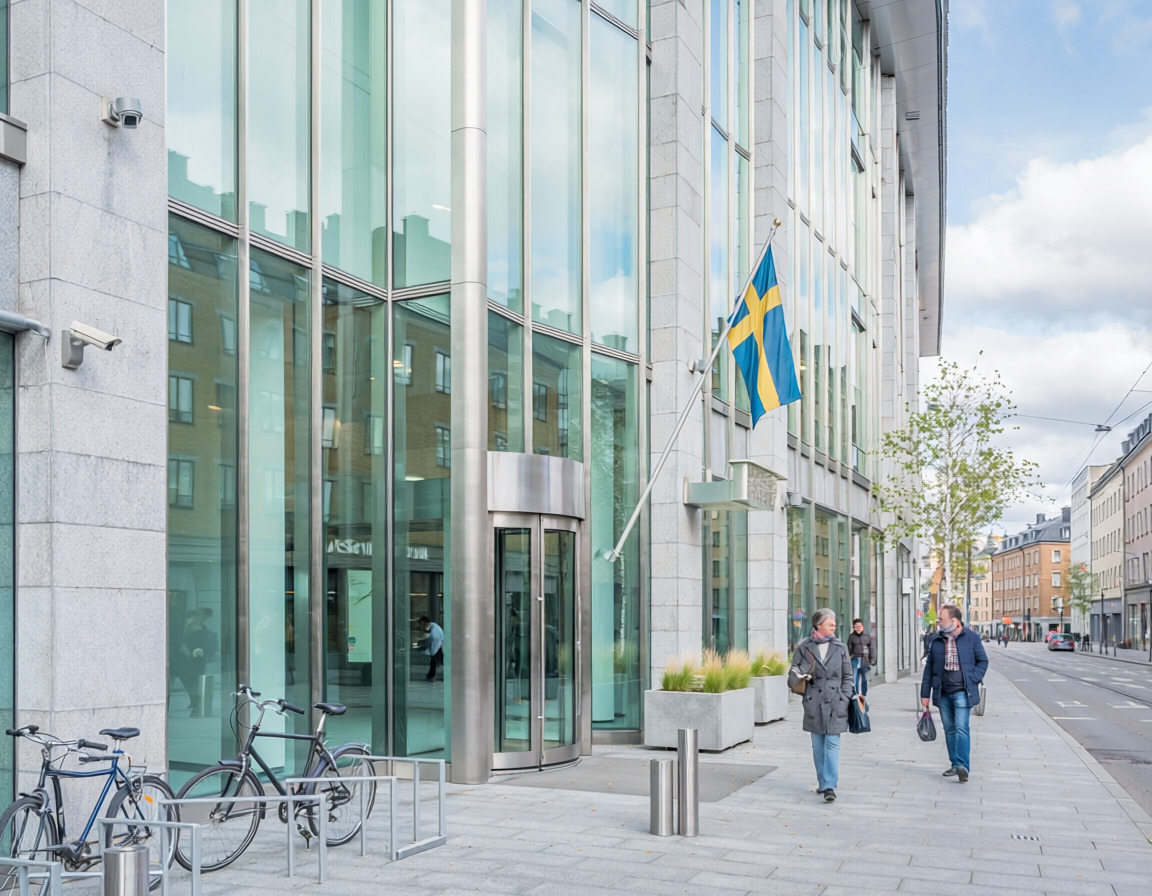
In an earnings season dominated by provisioning anxiety, geopolitical disruption, and the spectre of rising loan losses, Handelsbanken’s first-quarter 2026 results offer something increasingly rare among major European banks: a clean beat, delivered with the quiet competence that has characterised this Swedish lender for most of its 150-year history.
Handelsbanken reported net profit of SEK 6.358 billion for the January to March 2026 quarter — above market expectations — on the back of better-than-forecast interest income, cost discipline that came in ahead of analyst estimates, and credit quality that the bank described as good against a backdrop of heightened macroeconomic and geopolitical uncertainty. Revenue for the period was SEK 14.778 billion. The results were published on the morning of Wednesday, April 22, led by Chief Executive Officer Michael Green, who has steered the bank through a sustained period of restructuring and strategic refocus that appears, in Q1 2026, to be bearing measurable fruit.
The Numbers Behind the Beat
The headline profit figure — SEK 6.358 billion against SEK 6.322 billion in the same period a year earlier — reflects a year-on-year improvement at a bank that has spent much of the past two years managing the transition from a higher-rate environment that had previously boosted net interest income. EPS came in at SEK 3.21, up from SEK 3.19 a year earlier.
Two factors drove the beat above consensus expectations. The first was net interest income, which came in ahead of analyst forecasts — a meaningful positive given that Handelsbanken’s NII has faced persistent headwinds in recent quarters from the Riksbank’s rate-cutting cycle. The Swedish central bank has been reducing interest rates as the domestic economy navigated a protracted slowdown, and lower short-term rates squeeze the spread between what banks earn on their lending and what they pay on deposits. That Handelsbanken managed to beat NII expectations against that backdrop reflects both the repricing dynamics in its mortgage book and the benefit of the bank’s conservative lending model, which concentrates on high-quality, long-duration customer relationships rather than volume-driven origination.
The second driver of the beat was costs — a line item that has been a recurring pressure point for Handelsbanken in recent years. The bank has historically carried a cost-to-income ratio that sits at the higher end of its Nordic peer group, a consequence of its famously decentralised branch-led model, which requires more staff per unit of revenue than the more centralised structures of competitors. Cost control came in better than forecast in Q1 2026, reflecting both the bank’s ongoing efforts to improve operating efficiency and a moderation in some of the investment expenditure that had weighed on margins in prior quarters.
The quarter also included the recognition of a SEK 1.1 billion VAT refund as other income — a one-off positive item that had been pre-disclosed to the market in advance of the results and which contributed to the headline profit figure. The pre-announcement of this item, made several weeks before the results, exemplifies the transparency that has been a consistent feature of Handelsbanken’s investor communications.
Credit Quality: The Defining Strength
In the current banking environment — where US consumer lenders are building reserves against rising macro uncertainty, European banks are watching their property-adjacent loan books carefully, and the Iran war’s energy shock is feeding into inflation and interest rate expectations — Handelsbanken’s credit performance stands out.
The bank’s credit quality remained benign in Q1 2026. Net credit loss ratios have been at or near zero — frequently in net reversal territory — for an extended period. This is consistent with a pattern that stretches back years: Handelsbanken has consistently managed one of the cleanest credit books in European banking, a reflection of its selective underwriting standards and its focus on relationship banking with customers whose financial positions it understands deeply through its branch-based model.
This credit quality profile is not accidental. Handelsbanken operates on a model in which individual branches bear direct accountability for the lending decisions they make — a structural incentive for conservative underwriting that differs fundamentally from the centralised credit scoring approaches used by most major banks. The result, historically, has been lower losses through cycles, a less volatile earnings profile, and the trust of institutional investors who value predictability above growth.
The Q4 2025 annual results provided the baseline context: for the full year 2025, Handelsbanken’s credit loss ratio on a net basis was -0.01% — effectively a small net reversal, meaning the bank recovered more from previously provisioned loans than it set aside for new ones. The common equity tier 1 ratio ended 2025 at 17.6%, well above regulatory requirements. The bank’s return on equity was 13.0% for the full year 2025, modestly below the 14.6% achieved in 2024 as net interest income declined with falling rates, but demonstrating sustained profitability without the credit cost spikes that are surfacing elsewhere in the industry.
The Macro Context That Makes the Beat More Significant
The Q1 2026 results arrive against a global economic backdrop that is, by most measures, the most challenging for financial institutions since 2022. The Iran war, which began on February 28 with joint US-Israeli strikes on Iranian military and government targets, has driven oil prices sharply higher, disrupted energy supply chains across Asia and Europe, and introduced a geopolitical uncertainty premium into virtually every economic forecast.
For European banks, the energy shock creates a dual pressure: the inflationary impact of higher oil prices complicates the Riksbank’s rate-cutting path, potentially delaying the interest rate reductions that many Nordic borrowers are counting on to ease mortgage affordability; and the broader uncertainty about corporate earnings and household finances increases the forward-looking credit risk that prudent banks must manage in their provisions.
That Handelsbanken beat forecasts in this environment — on both the revenue and cost lines, with clean credit metrics — is a statement about the resilience of its business model as much as it is a quarterly earnings report. Swedish households are expected to see increased disposable income in 2026, as Handelsbanken’s own economics team has noted, with real wages continuing to rise and government spending providing support ahead of upcoming elections. But those tailwinds are being tested by the energy shock and the geopolitical uncertainty that the Iran conflict has created.
Michael Green, CEO of Handelsbanken since 2024, has been executing a strategic refocus of the bank that has involved exiting certain markets — including the completion of the sale of Finnish operations and the Danish business in prior years — and redirecting resources toward markets where Handelsbanken has durable competitive positions. The UK, where the bank holds approximately 19% of its income, and Norway (9.6%), complement the dominant Swedish franchise (63.4%).
What the Results Say About the Model
Handelsbanken has never been the fastest-growing bank in its peer group, nor the most aggressively expanding. Its model is built on a different proposition: conservative lending, strong relationships, deep customer knowledge, and the kind of low volatility that institutional investors who own the stock for its dividend and stability characteristics find genuinely valuable.
The Q1 2026 beat — delivered in a quarter when markets were rattled by the Iran war, the Riksbank’s rate path remained uncertain, and the Swedish economy was navigating a protracted slowdown — validates that proposition one more time. The bank’s credit ratings have remained the highest overall among peer banks globally, as noted in its most recent half-year report. Its CET1 ratio of 17.6% provides a substantial buffer above regulatory requirements. The dividend — SEK 17.50 per share for full year 2025, up from SEK 15.00 the prior year — reflects management’s confidence in the sustainability of returns.
In the context of a European banking sector that is broadly navigating the same macro headwinds with considerably more credit anxiety, Handelsbanken’s first-quarter results are a reminder that conservative banking, executed well over a long period, produces a different kind of resilience — one that does not require exceptional tailwinds to deliver, and does not collapse when those tailwinds reverse.
Written by Shalin Soni, CMA specializing in financial analysis, global markets, and corporate strategy, with hands-on experience in financial planning and analytical decision-making.
ALSO READ
• Alternative Asset Managers Face Investor Test as AI Risks and Redemptions Mount
• Delta Warns of $2 Billion Fuel Hit as CEO Signals Cautious Outlook
• Wealthy Investors Exit Private Credit as $14 Billion Redemption Wave Hits Markets
Source: Based on Handelsbanken Interim Reports, Q4 2025 Annual Report, and publicly available information.