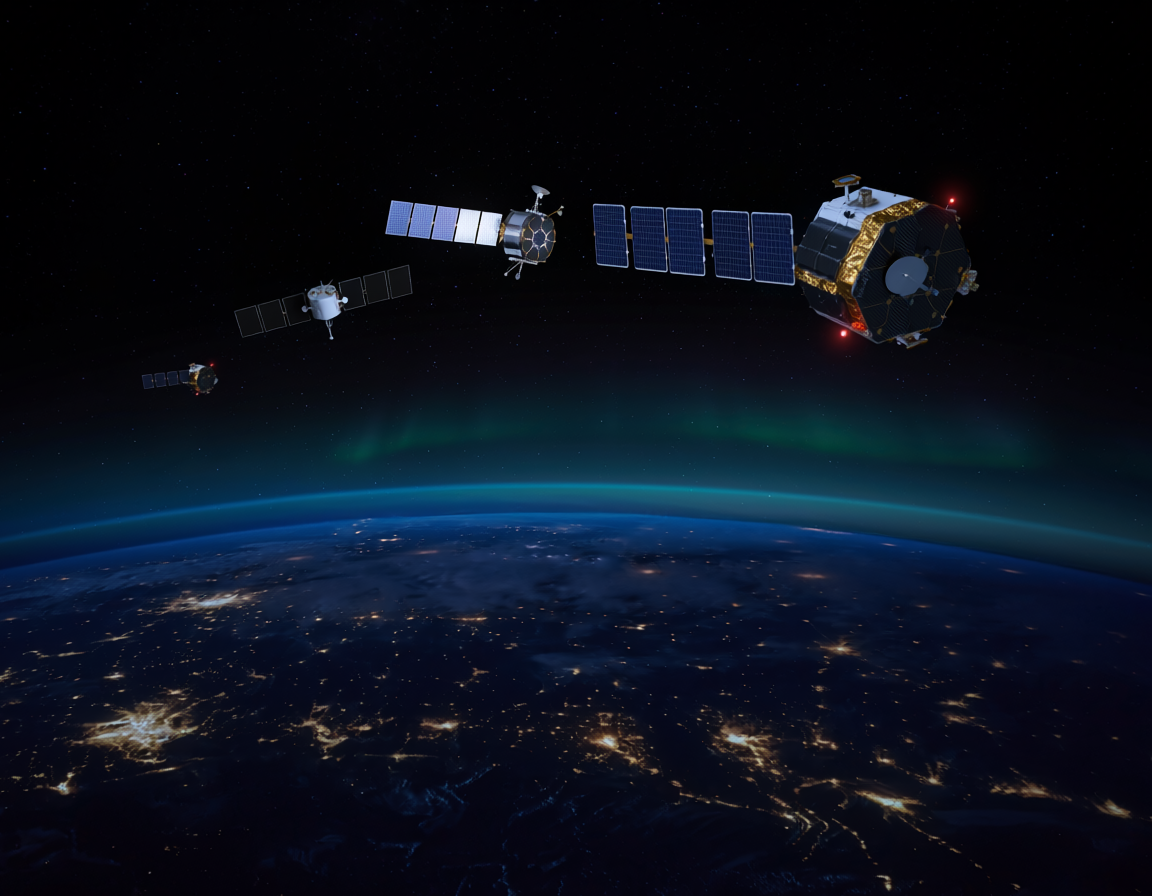
There is a version of the SpaceX story that is easy to tell and impressive on its own terms. The world’s dominant commercial launch provider. The maker of the Falcon 9, the most frequently flown orbital rocket in history. The architect of Starlink, a satellite broadband network that serves more than ten million subscribers across 150 countries, generates $11.4 billion in annual revenue, earns a 63% EBITDA margin, and doubled its operating income last year to $4.42 billion. A company that has fundamentally reshaped the economics of space access and is preparing what may be the largest initial public offering in history, targeting a $75 billion raise at a $1.75 trillion valuation.
That story is accurate. It is also, according to the IPO registration excerpts reviewed by Reuters and published on Thursday, April 24, incomplete. Because the more complete story is this: Elon Musk is spending Starlink’s cash — and then some — on an artificial intelligence bet so large it has transformed SpaceX’s financial profile from a profitable aerospace company into something that looks more like a trillion-dollar venture capital experiment with a broadband business attached.
The Numbers That Define the Transformation
The Reuters analysis of SpaceX’s IPO registration documents reveals the financial architecture of the transformation with unusual clarity, because an S-1 filing requires a level of disclosure that private company communications never do.
In 2025, SpaceX’s AI division — which following the $1.25 trillion all-stock merger with xAI in February 2026 is the home of the Grok large language model, the Colossus supercomputer in Memphis, and the orbital data centre ambition — accounted for 61% of the consolidated company’s $20.74 billion in total capital spending. In absolute terms: the AI division consumed approximately $12.65 billion in capital expenditure in a single year. At the same time, rising costs pushed the unit to an operating loss of $6.4 billion.
The arithmetic of SpaceX’s financial position flows directly from those figures. Total capital spending of $20.74 billion exceeded total revenue — estimated at $15 to $16 billion for 2025 — by approximately $2 billion. The company is spending significantly more than it earns in a given year, with the gap financed by the extraordinary profitability of Starlink and by private capital markets. Starlink’s $4.42 billion operating income, impressive as it is in isolation, does not cover the AI division’s $6.4 billion operating loss, let alone fund the capital spending required to build orbital data centres and launch one million satellites.
“The financial overhang matters but it is manageable if the AI revenue ramp arrives on the timeline management is implying,” said Shay Boloor, chief market strategist at Futurum Equities. “It becomes much riskier once Starlink subscriber growth matures or if AI spend keeps scaling faster than monetisation.”
That conditional framing — manageable if, much riskier once — captures precisely the analytical challenge that IPO investors face when evaluating SpaceX at $1.75 trillion.
The xAI Merger and What It Added
The February 2026 merger of SpaceX and xAI fundamentally altered the investment case that the company presents to prospective shareholders. Prior to the merger, SpaceX was the world’s most valuable private aerospace company, with an estimated $350 billion valuation in late 2025. After the merger, valued at $1.25 trillion for the combined entity, SpaceX became the world’s most valuable private company in any sector — a position it held for less than three months before filing its S-1 and targeting $1.75 trillion at IPO.
The xAI merger adds to SpaceX’s portfolio the Grok family of large language models, the Memphis supercomputing facility targeting one million or more GPUs, and the strategic vision of orbital AI computing — the idea that processing AI workloads in space, powered by near-constant solar energy and cooled by radiation rather than water, represents a fundamentally different approach to the data centre economics that currently constrain terrestrial AI infrastructure.
It also adds approximately $1 billion in monthly cash burn. Industry estimates place xAI’s infrastructure spending at roughly $12 billion annually — the same order of magnitude as the AI division’s reported $12.65 billion capital expenditure figure from the IPO registration. The merger gave xAI access to SpaceX’s cash-generating capabilities to fund that infrastructure buildout; Futurum’s analysis of the deal noted plainly that the financial rationale was clear: “xAI is reportedly burning approximately $1 billion per month competing with OpenAI, Google, Microsoft, Anthropic, and others. Meanwhile, SpaceX generated an estimated $8 billion profit on $15-16 billion revenue in 2025.”
The deal was, in this reading, xAI acquiring a funding mechanism as much as SpaceX acquiring an AI capability. Whether the combined entity’s IPO investors will value the transaction the same way is a separate question.
What Investors Are Actually Buying
Shay Boloor of Futurum Equities offered the most precise statement of the IPO valuation challenge: “The company’s financials are closer to the rocket and satellite company it is than the AI infrastructure giant it wants to become. That doesn’t make the story broken but it does mean IPO buyers would be paying upfront for a transformation that still needs to show up more clearly in the numbers.”
This is the central tension in the SpaceX IPO narrative. The $1.75 trillion valuation implies approximately 87 to 109 times revenue depending on which revenue base is used — a multiple that has no direct comparable in the public markets at this scale. Tesla, Palantir, and other growth-at-a-premium technology companies have traded at high multiples, but none at this scale and none while simultaneously burning cash at the rate SpaceX is currently burning it.
The investment case for that multiple rests on a sequence of outcomes that must each materialise for the valuation to be justified. Starlink must continue growing subscribers and average revenue per user even as the constellation matures and competitors — primarily Amazon’s Project Kuiper, which must deploy 1,618 satellites by July 2026 under its FCC licence — begin to close the scale gap. Starship must achieve full reusability and the cadence of launches that Starlink’s constellation expansion and orbital data centre deployment require. The xAI AI division must generate meaningful revenue within the timeframe implied by current spending levels — xAI burned $9.5 billion in the first three quarters of 2025 while generating only $210 million in revenue in that period. And the orbital data centre thesis — which requires launching up to one million satellites carrying computing hardware — must prove technically and economically viable at a cost that analysts currently put in the trillions of dollars.
Melissa Otto, head of research at S&P Global Visible Alpha, identified the specific question that investors will bring to the roadshow: “What investors will be looking for is clear visibility on how the business model evolves with this financing and whether it can make the economics of compute work at scale.”
The IPO Timeline and the Cursor Complication
SpaceX filed its confidential S-1 with the SEC on April 1, 2026. The public S-1 must be released at least 15 days before the roadshow begins, meaning a June IPO — the target according to multiple sources — requires the public filing in May. A successful Starship V3 Flight 12 test launch, targeting late April, would provide a meaningful positive signal before the roadshow begins.
The Reuters analysis also flagged a newly revealed deal with AI code-generation startup Cursor, adding further uncertainty to the financial picture at a moment when the company’s capital allocation is already under scrutiny. Like the xAI merger itself, the Cursor deal reflects Musk’s appetite for deploying capital into AI adjacencies before the revenue base that would justify them has been demonstrated.
The question of whether that appetite represents visionary resource allocation or premature overextension is one that the IPO market will answer with the price at which shares clear — if they clear in June, or later, or not at all.
SpaceX asked to raise $75 billion. The gap between what Starlink earns and what AI costs suggests it may need to come back for more.
Written by Shalin Soni, CMA specializing in financial analysis, global markets, and corporate strategy, with hands-on experience in financial planning and analytical decision-making.
ALSO READ
• Lululemon Names Former Nike Executive Heidi O’Neill as Next CEO
• LG Display to Invest $745 Million in OLED Infrastructure to Boost Competitiveness
• U.S. Ship Seizure Deepens Rift as Iran Signals Reluctance for Peace Talks
Source: Based on Reuters and publicly available information.