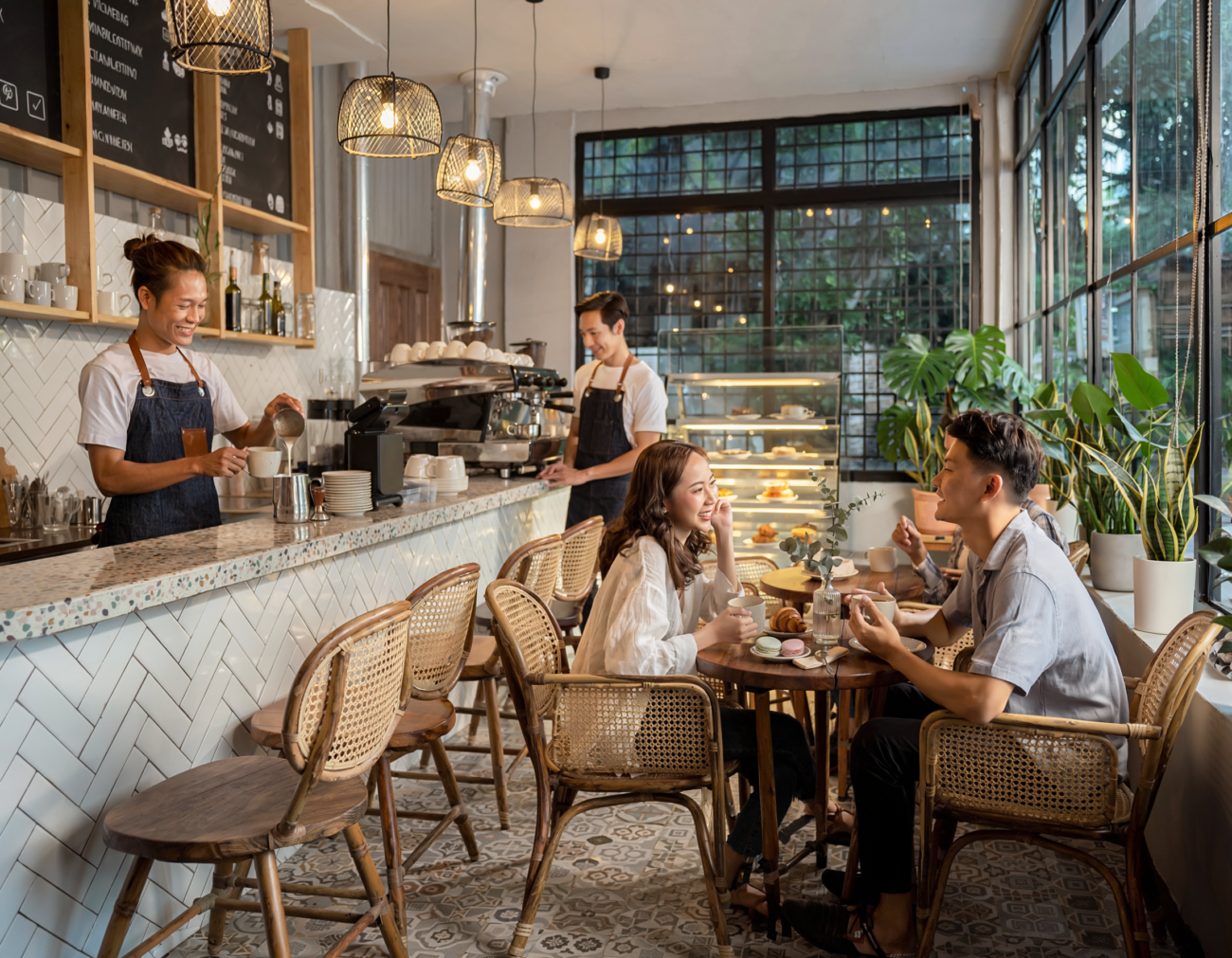
On the face of it, a grab-and-go coffee stand in South Jakarta with $15,000 in startup capital and no seating sounds like an unlikely candidate to become Southeast Asia’s hottest consumer brand. But in 2017, when Edward Tirtanata and his co-founder James Prananto opened the first Kopi Kenangan outlet at the Standard Chartered tower in Jakarta’s Setiabudi district, they weren’t just selling coffee. They were exploiting a gap in the market that one of the most powerful brands in the world had, perhaps unwittingly, left wide open.
That brand was Starbucks — and the gap was affordability.
“Indonesia is the ninth-most unaffordable tall latte in the world,” Tirtanata has said, referring to the informal economic measure known as the Starbucks Latte Index that charts the purchasing power of currencies against the price of a local Starbucks drink. While a tall latte costs approximately 2% of the median daily income of an American, that same drink costs more than 30% of the median daily income of an Indonesian. For a nation that is the world’s fifth-largest coffee producer, with a deeply rooted coffee culture and rapidly growing urban middle class, that price mismatch was not just a market inefficiency. It was a business opportunity of enormous scale.
The Idea Behind the Cup
Before founding Kopi Kenangan, Tirtanata had run a premium tea chain called Lewis & Carroll. It performed reasonably well, but a conversation with Prananto during a quiet afternoon at one of the tea shops crystallised what he had been sensing for some time: the Indonesian coffee market was missing an entire category. At one end sat international chains like Starbucks — premium, expensive, accessible mainly to upper-middle-class Indonesians on occasion. At the other sat cheap sachet coffee sold through roadside stalls and convenience stores. Nothing of quality existed in between at a price the average Indonesian could spend daily.
Tirtanata’s insight, rooted in his finance background from Northeastern University in Boston, was that this middle category could be built without sacrificing quality — as long as you ruthlessly eliminated the costs that weren’t going into the cup. Instead of investing in comfortable sofas, high-speed Wi-Fi, and large sit-down spaces, Kopi Kenangan opened small grab-and-go storefronts. Instead of hiring interior designers, it invested in La Marzocco espresso machines, premium Greenfields fresh milk, and export-grade Indonesian beans. “Instead of focusing on the sofa or fast Wi-Fi, we focused on a good, high-quality cup of coffee,” Tirtanata said.
The menu reflected the target audience with unusual self-awareness. The company’s best-selling drink — the Kopi Kenangan Mantan, which translates loosely as “Coffee in Memory of My Ex-Girlfriend” — became a viral sensation. Melancholic names like “Kenangan Masa Lalu” (Memories of the Old Days) and “Lupakan Dia” (Let Them Go) created a brand identity entirely unlike any international chain, rooted in Indonesian vernacular culture and the kind of bittersweet nostalgia that resonated instantly with young urban consumers. “The key to branding is to be different, and nobody was using Indonesian names for their coffee,” Tirtanata said.
From Stall to Unicorn
What followed was one of the fastest growth stories in Southeast Asian consumer retail. Within its first year, Kopi Kenangan had 50 stores. Within two years, over 200 locations across 10 cities. By 2021, the company had become Southeast Asia’s first food and beverage new retail unicorn, crossing a $1 billion valuation. At its peak growth, Kopi Kenangan was opening new stores at a rate of one per day.
The company’s $240 million in funding over five rounds attracted a striking combination of investors: Sequoia Capital’s India arm, Eduardo Saverin’s B Capital, Serena Williams’ Serena Ventures, and Jay-Z’s Arrive, among others. The investor roster reflected what global venture capital had begun to recognise — that Indonesia’s 270 million-person consumer market, its young demographic profile, and its rapidly increasing per capita coffee consumption made this not just a local success story, but a template for a new kind of consumer brand in emerging markets.
Now operating under the name Kenangan Coffee internationally, the chain has moved beyond Indonesia into Malaysia, Singapore, the Philippines, and Australia, with India added in 2025. It now has more than 1,100 stores total — comfortably surpassing Starbucks Indonesia’s roughly 500 outlets. Annual revenues exceeded $119 million in 2024 and the company projected $180 million for 2025, with a path to its first net profit.
The Broader Coffee Battlefield
Kopi Kenangan is not alone. Indonesia has produced a generation of domestic coffee chains all operating on variations of the same “affordable premium” thesis. Tomoro Coffee now operates over 650 stores; Fore Coffee, which completed Indonesia’s first coffee chain IPO in April 2025, raised $22 million and saw its shares jump 34% on debut, reporting 44% revenue growth and 55% profit growth in the year following its listing. Janji Jiwa has approximately 900 locations. Together, these chains have collectively outpaced Starbucks in store count and are making aggressive moves into regional markets.
The competitive dynamics are intense. Luckin Coffee, China’s app-driven behemoth, has moved aggressively into Singapore with its kiosk-based, technology-heavy model and sharp pricing. Malaysia’s Zus Coffee and Thailand’s Cafe Amazon are deeply entrenched in their home markets. Indonesian chains are not always the cheapest in foreign markets — local competitors often undercut them. What they are betting on instead is a combination of product differentiation through local Indonesian flavours, technology-driven loyalty programs and personalisation, and a brand identity that feels genuinely different from both Western chains and cheaper local alternatives.
“We have grown quite quickly across countries, not because we are the cheapest; often local competitors are cheaper than us. However, we have localised the offering and used technology to increase sales per store,” Tirtanata said.
That technology element is central to the model. Kopi Kenangan’s app drives loyalty points, pre-orders, and promotional mechanics in a way that mirrors Luckin’s playbook — turning each store visit into a data point that feeds back into personalisation. The company’s hyperlocal approach extends even to flavour: a Kenangan latte in Singapore is tuned differently from one in Jakarta, calibrated using purchase data and customer feedback. “This is where we really shaped our strategy for global expansion — we want to make sure that the sweetness and robustness of the coffee really suits the market that we are operating in, using a data-driven approach,” Tirtanata explained.
What Makes This More Than a Coffee Story
Indonesia’s annual per capita coffee consumption is now the highest in Southeast Asia, almost on par with larger markets like Australia and the United States, according to Euromonitor data. What’s particularly notable is that this growth has been driven not by export but by domestic formalisation — the shift from roadside stalls and instant sachets to modern outlets offering consistency, convenience, and what analysts describe as an “affordable treat” positioning.
Roshan Raj Behera, partner at Redseer Strategy Consultants, describes the structural drivers clearly: “Consumption has been formalised, from roadside stalls and instant sachets to modern outlets, which offer consistency, convenience, and an affordable treat positioning.” This shift is still early-stage in many respects. World Coffee Portal forecasts that Indonesia’s branded coffee shop market will surpass 10,400 outlets by the end of 2030, compared to a fraction of that today. There is substantial territory still to be built.
For Tirtanata, the ambition is explicitly global. He wants Kopi Kenangan to become the next Starbucks — or rather, the Starbucks it built to replace. “I do not code, and I do not make coffee,” he has said of himself. What he has clearly been very good at is identifying a structural market gap, building a brand that fills it with genuine cultural authenticity, and scaling that model at speed. The company started with $15,000 and a bet that quality and affordability do not have to be opposites. Eight years later, with a billion-dollar valuation, the bet looks prescient.
Written by Shalin Soni, CMA specializing in financial analysis, global markets, and corporate strategy, with hands-on experience in financial planning and analytical decision-making.
ALSO READ
• The Final Countdown to Tax Day 2026: New Breaks, Big Changes, and an IRS Under Pressure
• U.S. Bank Profits Rise on Deal Activity as Iran War Clouds Outlook
• How Big Tech Is Reinventing Itself Around AI in 2026
Source: Based on Forbes and publicly available information.