
U.S. Treasury markets are showing early signs of strain as government debt auctions draw weaker demand at a time when the federal government must refinance approximately $10 trillion in maturing debt over the next 12 months. The shift comes amid rising geopolitical tensions linked to the Iran war, which is increasing borrowing costs and testing investor appetite for U.S. government securities.
According to a report by Fortune, this development marks a notable change in market dynamics, where Treasuries traditionally seen as safe-haven assets are facing growing resistance from investors.
Auction Weakness: Demand Softens Across Key Tenors
Recent auctions for two-year, five-year, and seven-year Treasury notes have all recorded weaker-than-expected demand, forcing yields to rise above market expectations. This contrasts sharply with prior months, when long-term Treasury auctions had seen some of the strongest demand on record.
The weaker reception suggests that investors are becoming more selective, demanding higher compensation to absorb increasing supply.
Yield Surge: Rising Costs Reflect Inflation and War Risk
The impact of softer demand is already visible in bond markets. The 2-year Treasury yield has moved above 4.0%, while the 10-year yield has climbed above 4.4%, reflecting rising inflation expectations and heightened risk premiums.
Geopolitical tensions particularly disruptions to energy markets are driving inflation concerns, forcing investors to reassess the outlook for interest rates and monetary policy.
Fiscal Pressure: War Spending Adds to Debt Burden
The financing challenge is being compounded by increased fiscal demands. Reports indicate that the Pentagon is seeking around $200 billion in additional funding related to the Iran conflict, adding further pressure to an already expanding deficit.
At the same time, the U.S. budget deficit is projected to approach $2 trillion, increasing the volume of debt that must be issued into the market.
Market Competition: Record Supply of Fixed Income Assets
Treasuries are also facing competition from a surge in corporate bond issuance. Total corporate bond supply is expected to reach around $2 trillion in 2026, contributing to an overall $14 trillion in investment-grade fixed income supply entering the market.
This flood of supply is putting upward pressure on yields and credit spreads, as investors have more options for deploying capital.
Volatility Signals: Bond Market Stress Intensifies
Market volatility indicators are reinforcing concerns about instability. The MOVE index, which tracks Treasury market volatility, has risen to levels associated with pricing instability and policy uncertainty.
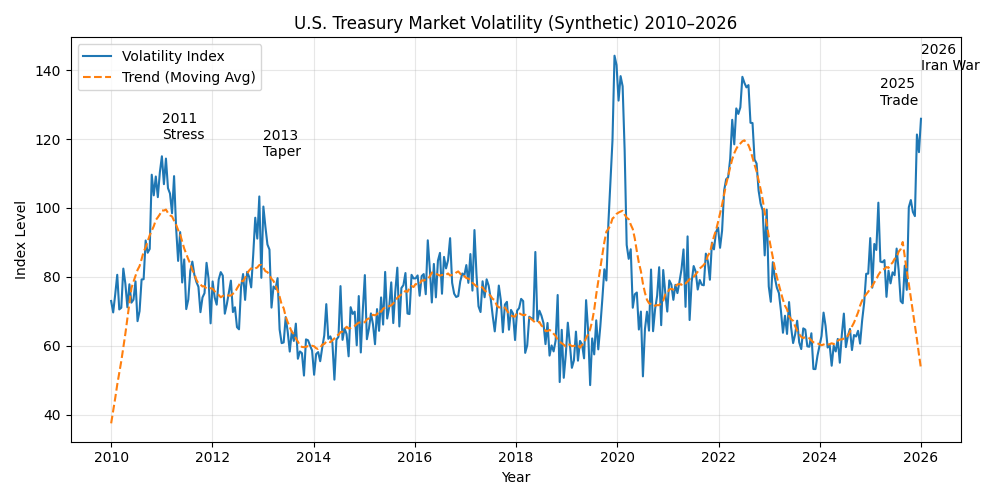
Synthetic representation of U.S. Treasury market volatility trends (2010–2026), highlighting macroeconomic shocks; for illustrative and analytical purposes only.
Analysts warn that this reflects a broader shift in investor behavior, with increased sensitivity to fiscal sustainability, inflation risk, and geopolitical developments.
Structural Risk: Emergence of ‘Bond Vigilantes’
The current environment has revived concerns about the return of “bond vigilantes” as investors who push yields higher by selling government debt in response to rising deficits and inflation risks.
Historically, such dynamics have forced policymakers to adjust fiscal and economic strategies, highlighting the power of bond markets in shaping government policy.
Market Implications: Borrowing Costs Set to Rise
If weak demand persists, the implications for the broader economy could be significant. Higher Treasury yields would translate into increased borrowing costs across the economy, including mortgages, corporate debt, and consumer credit.
Recent data already shows that rising yields are feeding into higher financing costs, reinforcing concerns about tightening financial conditions.
Forward Outlook: Critical Test for Treasury Markets
Looking ahead, the U.S. Treasury market faces a critical test as it attempts to absorb a large volume of issuance amid uncertain macroeconomic conditions. Key variables include:
- Duration and cost of the Iran war
- Trajectory of inflation and energy prices
- Federal Reserve policy response
- Investor demand for long-duration assets
Any sustained weakness in demand could trigger broader instability across financial markets.
Expert Insight
The weakening demand at U.S. debt auctions signals more than a temporary market imbalance as it reflects a structural shift in how investors are pricing risk in sovereign debt.
For decades, U.S. Treasuries benefited from near-unquestioned demand, particularly during periods of crisis. Today, that assumption is being challenged.
In a nutshell, the bond market is beginning to reassert discipline on fiscal policy. In an environment defined by rising debt, geopolitical conflict, and inflation uncertainty, investors are no longer willing to absorb supply without demanding higher compensation.
That shift has profound implications and not just for interest rates, but for the broader stability of the global financial system.
Written by Shalin Soni, CMA specializing in financial analysis, global markets, and corporate strategy, with hands-on experience in financial planning and analytical decision-making.
ALSO READ
• FIFA Faces Pressure Over Iran Matches as World Cup 2026 Collides With Geopolitics
• McDonald’s CEO Responds to Viral Big Arch Backlash, Highlights Marketing Risks
• JPMorgan’s $80 Billion Small Business Lending Push Signals Banking Shift
Disclaimer
This article is based on publicly available information, market developments, and credible media reports. The content is intended for informational and analytical purposes only and should not be considered financial, investment, or legal advice.