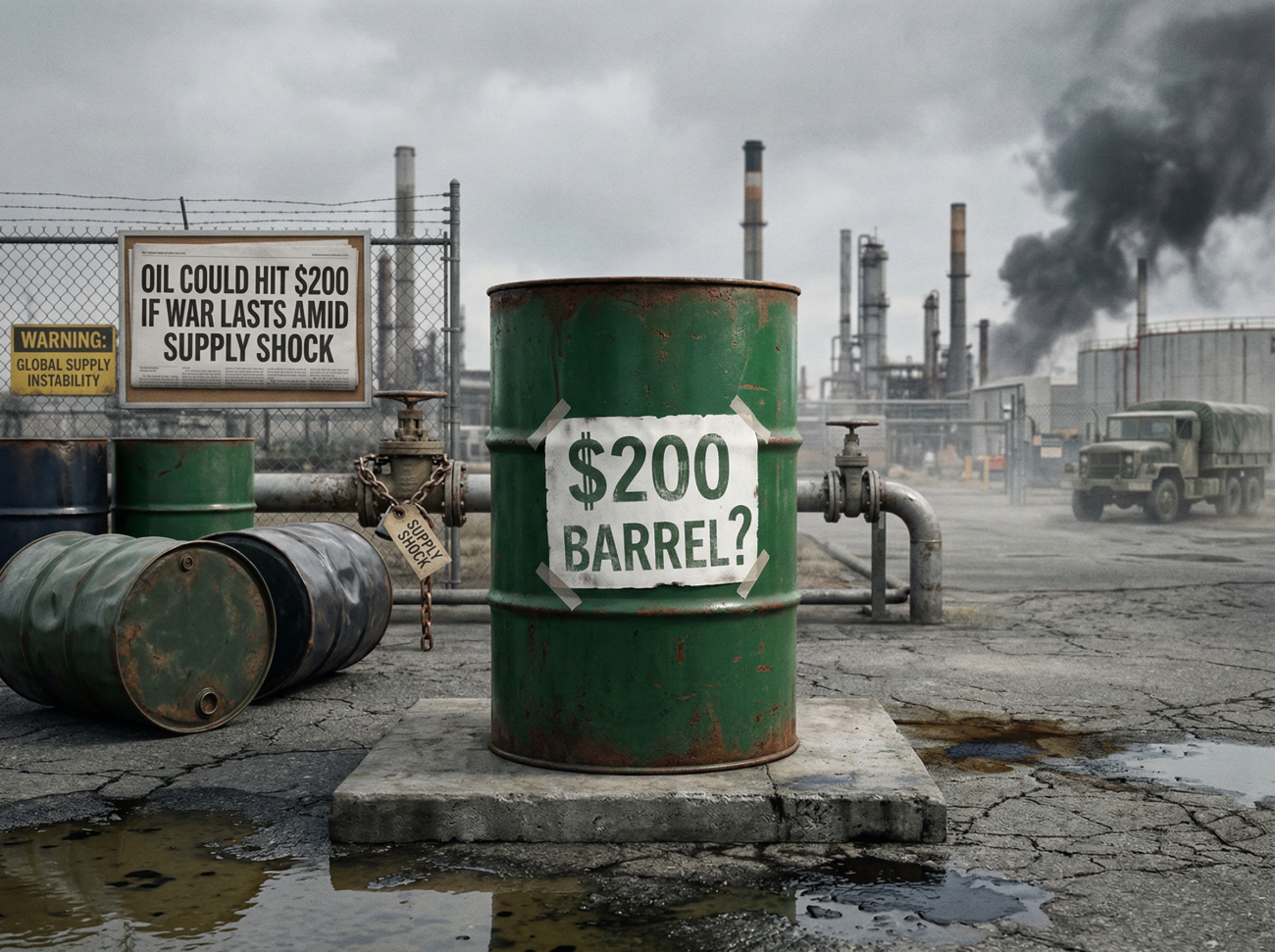
Global oil markets are facing the risk of an extreme price surge, with analysts warning that crude could climb as high as $200 per barrel if the ongoing Middle East conflict continues into mid-year, underscoring the growing severity of supply disruptions.
The warning comes from Macquarie Group, which outlined a worst-case scenario in which prolonged conflict and continued disruption to key shipping routes push oil prices to unprecedented levels. According to Bloomberg, the projection is tied to the duration of the war, with sustained disruptions potentially driving a significant imbalance between global supply and demand.
Market Reaction: Oil Prices Already Surge Above $100 Amid Conflict
Oil prices have already risen sharply since the conflict began, with Brent crude trading around $105–$108 per barrel after briefly touching a crisis high of nearly $119.50 earlier in March, reflecting the immediate impact of supply fears.
The rally represents a significant increase from pre-conflict levels, with prices rising more than 40% since tensions escalated, highlighting the strong geopolitical risk premium now embedded in energy markets.
Supply Shock: Strait of Hormuz Disruption Drives Risk Scenario
At the center of the bullish oil outlook is the disruption of the Strait of Hormuz, one of the world’s most critical energy chokepoints.
The waterway typically handles around 15 million barrels of crude oil per day along with approximately 5 million barrels of refined products, making it essential to global energy flows.
Current disruptions have already removed more than 10–11 million barrels per day from global supply, tightening the market significantly and increasing the likelihood of further price spikes if the situation persists.
Macquarie Scenario: $200 Oil Depends on War Duration
Macquarie’s forecast is based on the duration of the conflict, with analysts assigning roughly a 40% probability to a scenario where the war continues into June, potentially pushing oil prices toward $200 per barrel.
In contrast, a shorter conflict ending within weeks would likely see prices retreat, though still remaining above pre-war levels due to lingering supply constraints and elevated geopolitical risk.
The analysis highlights that prices would need to rise sharply to “destroy demand”—a condition where high costs force a reduction in global consumption to rebalance the market.
Inflation Impact: Energy Prices Threaten Global Economy
A surge toward $200 oil would have significant implications for inflation and economic stability worldwide.
Even at current levels near $100 per barrel, fuel prices have already risen sharply, with U.S. gasoline prices increasing by roughly 30% since the conflict began, reflecting the direct pass-through of energy costs to consumers.
Higher oil prices typically feed into:
- transportation costs
- manufacturing expenses
- food prices
This creates broad-based inflationary pressure across economies.
Market Dynamics: Short-Term Volatility vs Structural Constraints
Oil markets are currently balancing two opposing forces.
On one hand, geopolitical tensions and supply disruptions are pushing prices higher. On the other, expectations of demand destruction and potential diplomatic resolutions are limiting further upside in the short term.
Analysts note that while prices could spike rapidly under extreme scenarios, they may also fall quickly if tensions ease and supply routes reopen.
Industry Outlook: Energy Markets Enter High-Risk Phase
The current situation marks a shift into a high-risk environment for global energy markets, where prices are increasingly driven by geopolitical developments rather than traditional supply-demand fundamentals.
Major institutions have already revised forecasts upward, with some scenarios projecting oil prices reaching $130 or higher under extended disruptions, even without a full-scale escalation.
The possibility of $200 oil represents an extreme but plausible outcome if multiple risk factors—prolonged conflict, infrastructure damage and continued supply blockages—materialize simultaneously.
Outlook: Key Trigger Remains Duration of Conflict
Looking ahead, the trajectory of oil prices will depend largely on:
- duration of the Middle East conflict
- status of the Strait of Hormuz
- global supply response
- policy actions by major economies
If disruptions persist into the second quarter, markets could move toward the upper end of extreme scenarios.
However, a resolution in the near term could stabilize prices, though likely at levels higher than those seen before the conflict.
Conclusion
Macquarie’s warning of $200 oil highlights the growing vulnerability of global energy markets to geopolitical shocks.
While current prices near $100 already reflect significant disruption, the risk of further escalation remains tied to the duration of the conflict and the stability of critical supply routes.
The situation underscores a broader reality for investors and policymakers alike: in today’s environment, oil prices are increasingly driven by geopolitical uncertainty, with potentially far-reaching consequences for inflation and economic growth.
ALSO READ
• Google AI Breakthrough Hits Micron, Samsung Stocks – What It Means for Memory Demand
• Barclays Pulls Back Asset-Based Lending After MFS, Tricolor Collapse
• SEC Proposal to End Quarterly Earnings Could Disrupt Finance Jobs
Disclaimer
This article is based on publicly available information, market developments, and credible media reports. The content is intended for informational and analytical purposes only and should not be considered financial, investment, or legal advice.