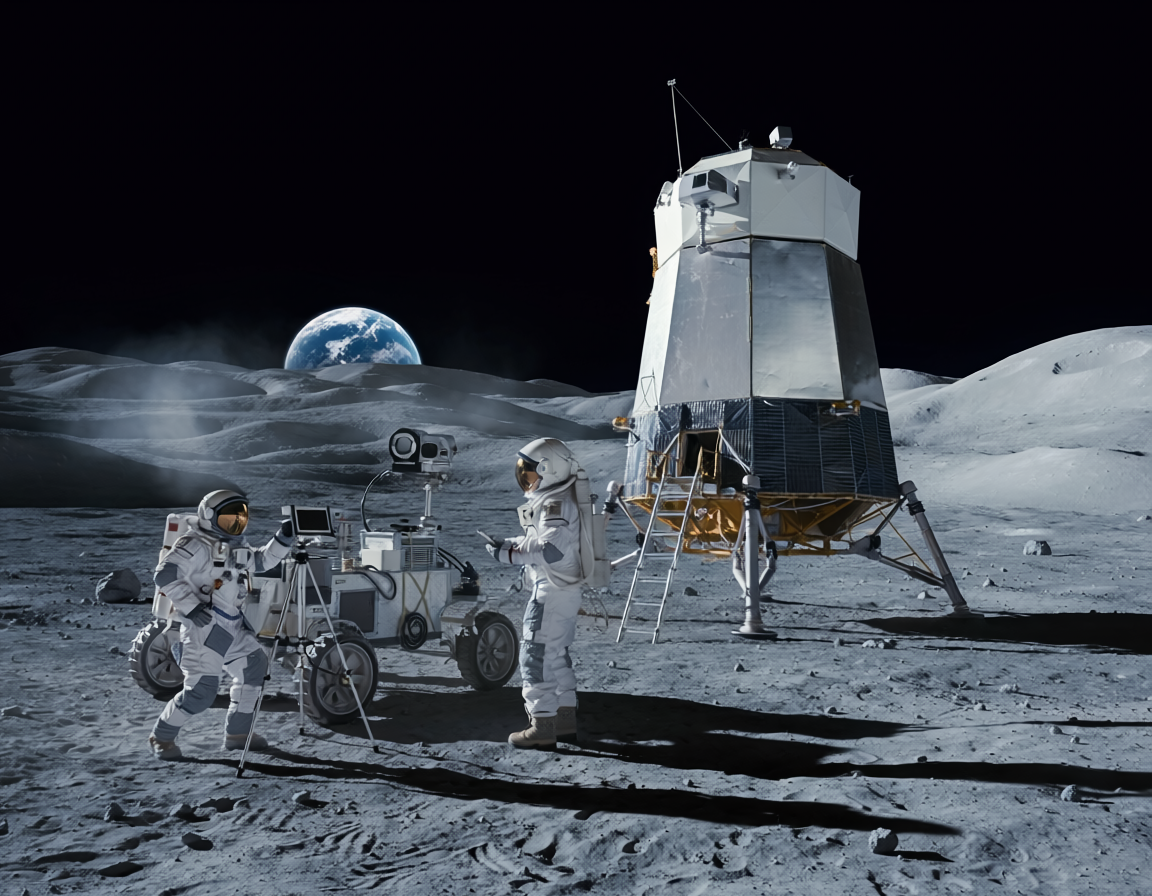
Just days after the Artemis II crew completed a landmark flyby of the Moon — the first humans to travel that far from Earth in over fifty years — NASA is quietly rewriting the rules for what comes next. The agency’s path back to the lunar surface has been officially restructured, and for the first time, the actual moment of a historic Moon landing depends entirely on which private company can get there first: Elon Musk’s SpaceX or Jeff Bezos’s Blue Origin.
It’s a fascinating pivot — part pragmatic engineering decision, part recognition that the old plan simply wasn’t holding together. Either way, it marks a new era in how America goes to the Moon.
What Changed and Why
For years, the plan was straightforward — or at least it looked that way on paper. Artemis III was supposed to be NASA’s triumphant return to the lunar surface, picking up where Apollo 17 left off in 1972. SpaceX had been contracted since 2021 to provide its Starship Human Landing System (HLS) to ferry astronauts down from lunar orbit to the Moon’s south pole. The mission was eagerly anticipated. The dates kept slipping.
NASA’s previous plan called for following up on Artemis II with a crewed lunar landing for Artemis III. However, the development of the SpaceX Starship lander for that mission proceeded more slowly than expected. Delays piled up. Schedules stretched. And going directly from a lunar flyby to a full Moon landing — without ever testing a crewed lander in orbit — was beginning to look like a gamble that NASA simply wasn’t willing to take.
On February 27, 2026, NASA Administrator Jared Isaacman announced the schedule shift, saying: “This is going to be our pathway back to the moon.”
On March 3, NASA revealed a revision in the Artemis program. Artemis III has now been re-classified as a test mission during which the Orion spacecraft will rendezvous and dock in low Earth orbit with commercial lunar landers — the SpaceX Starship Human Landing System and Blue Origin’s Blue Moon. It is scheduled for launch in mid-2027.
In other words, the Moon landing itself has been pushed to Artemis IV — now tentatively scheduled for early 2028. Two crew members will descend to the surface and spend about a week near the Moon’s south pole before returning to lunar orbit to join their crew for the journey back to Earth.
A Race Between Billionaires — With NASA as Judge
Here’s where it gets genuinely compelling. It’s effectively now a straight race between SpaceX and Blue Origin, with NASA intending to test whichever lander is ready for its Artemis III crew. If both companies get a lander ready in time, an Elon Musk vs. Jeff Bezos face-off in space — with NASA as the judge — is sure to keep interest in Artemis alive.
This competitive dynamic didn’t emerge by accident. Interim NASA Administrator Sean Duffy was unusually blunt about the situation. “SpaceX had the contract for Artemis 3. By the way, I love SpaceX. They’re an amazing company. The problem is they’re behind. They pushed their timelines out and we’re in a race against China,” Duffy said. “The President and I want to get to the Moon in this President’s term.”
He added: “I’m going to open up the contract. I’m going to let other space companies compete with SpaceX, like Blue Origin. And whatever one can get us there first, to the Moon, we’re gonna take. And if SpaceX is behind and Blue Origin can do it before them, good on Blue Origin.”
New NASA Administrator Jared Isaacman has similarly endorsed competition as a feature, not a flaw. At a Senate hearing, he said: “I think the best thing for SpaceX is a Blue Origin right on their heels and vice versa.”
Where Each Company Stands
SpaceX brings scale and ambition. Its Starship rocket — upon which the HLS variant is based — stands over 50 meters tall and has completed multiple integrated test flights, demonstrating key milestones including the reuse of its Super Heavy booster. But the critical challenge remains: Starship will need to stop at an orbital depot to refuel before heading to lunar orbit. An unspecified number of Starship tanker variants will be used to stock it. The orbital propellant transfer demonstration, originally planned for 2025, is now not expected until sometime in early- to mid-2026 at the earliest. That’s a fundamental technical hurdle yet to be cleared.
Blue Origin, on the other hand, brings a different kind of momentum. Blue Origin is already accelerating its Blue Moon development program and put its suborbital New Shepard program on hold for at least two years to shift resources to lunar projects. An uncrewed, cargo-carrying version of the Blue Moon lander is targeting a launch to the Moon this year. Blue Origin CEO Dave Limp’s response to the revised Artemis plan was simply: “We’re all in!”
The two landers are strikingly different machines. Starship HLS is a behemoth — built for heavy payload delivery and capable of carrying enormous amounts of cargo. Blue Moon Mark 2, built around the smaller and more heritage-based BE-7 engine, is designed to carry up to four astronauts for stays of up to 30 days on the lunar surface.
The China Factor
It would be incomplete to discuss any of this without acknowledging the race happening beyond U.S. borders. China has made no secret of its ambitions to land taikonauts on the Moon before the end of the decade. That pressure is real, even if NASA’s leadership has been careful not to let it dictate every decision.
Isaacman acknowledged the competition with China but downplayed its role in schedule discussions. “I think competition is good,” he told reporters. “We’re here talking about what is a common-sense approach to achieve the objective, whether we had a great rival in the running or not.”
Behind the scenes, though, the urgency is unmistakable. Budget pressure is adding to it. The White House published its FY2027 discretionary budget request soon after the Artemis II launch, including a $5.6 billion cut to NASA’s discretionary budget — a 23 percent decrease from 2026. That kind of financial headwind makes the reliance on commercial partners not just a strategy, but a necessity.
What It All Means
NASA’s revised Artemis architecture is, in many ways, a return to basics. By inserting a crewed orbital test between the Moon flyby and the actual landing, the agency is applying the same logical sequencing that made Apollo successful: test in orbit before you trust the hardware with a surface landing.
As NASA Associate Administrator Amit Kshatriya put it, the new plan “reflects the adjustments that we need to keep our schedule credible and our teams focused on what matters most, which is safe and achievable missions.”
What’s different now is that the pivotal question — who actually lands on the Moon for Artemis IV — may not be answered by engineers at NASA headquarters. It may be answered by whichever company moves faster, builds smarter, and proves their hardware ready first.
Fifty years after Apollo, America’s return to the Moon is being written not by a single government program, but by a competition between two private visionaries. History will note who won.
Written by Shalin Soni, CMA specializing in financial analysis, global markets, and corporate strategy, with hands-on experience in financial planning and analytical decision-making.
ALSO READ
• AI Backlash Grows as Workers Quietly Resist Adoption Amid FOBO Fears
• IMF Warns “Hot Money” Now Dominates Emerging Market Financing
• Weak U.S. Debt Demand Raises Risks as $10 Trillion Refinancing Looms
Source: Based on Forbes and publicly available information.