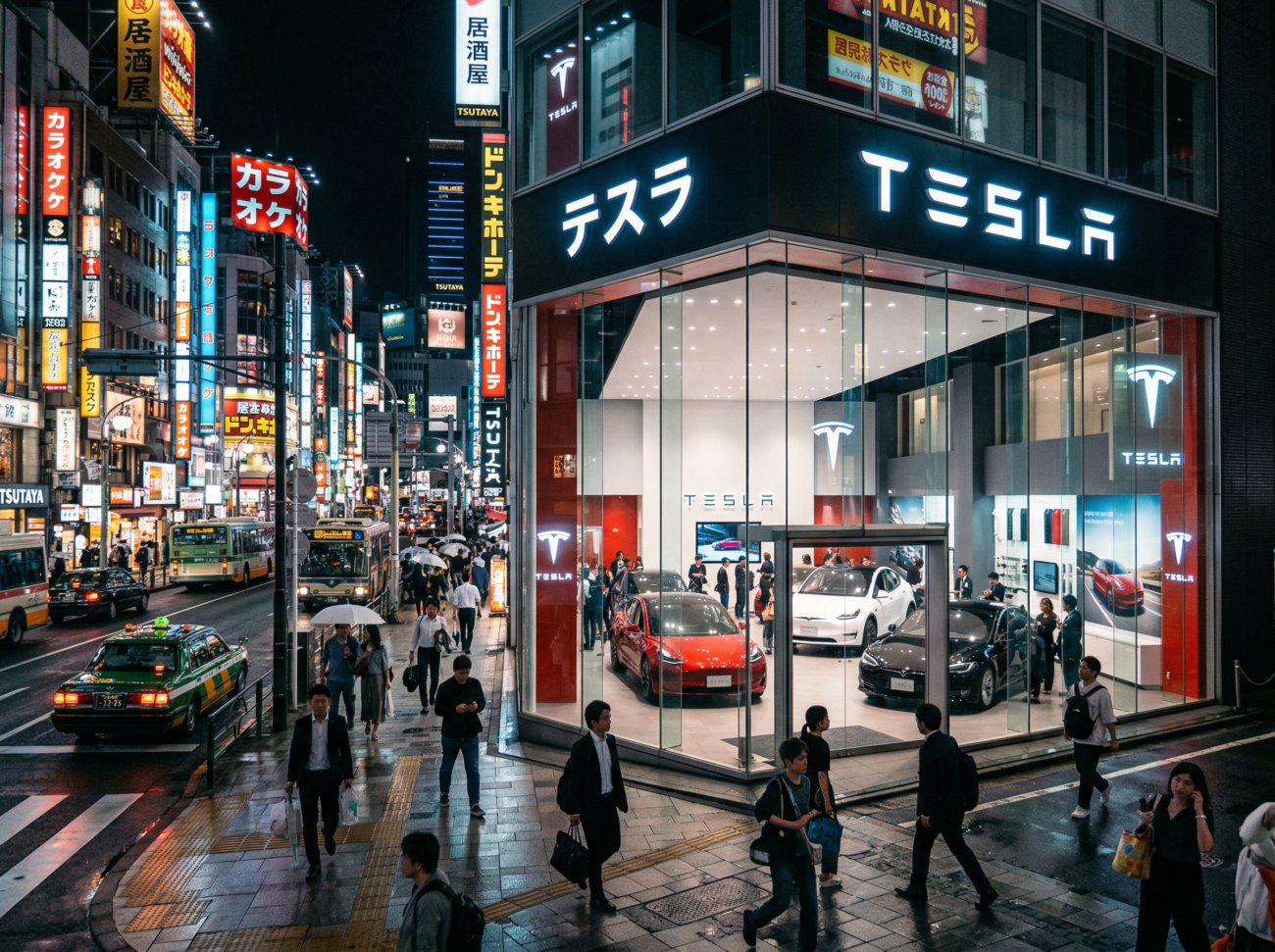
Tesla is accelerating its expansion strategy in Japan, aiming to become the country’s top imported car brand as early as 2027, as it strengthens its retail and service infrastructure in a market traditionally dominated by European automakers. This ambition reflects a calculated shift toward long-term market positioning rather than short-term volume gains. According to Reuters, the push comes at a time when global electric vehicle (EV) demand is slowing in key regions such as the U.S. and parts of Europe, prompting Tesla to focus on underpenetrated markets like Japan, where EV adoption remains relatively low but structurally promising.
Expansion Strategy: Store and Service Network Scaling Up
Tesla plans to expand its footprint to at least 60 stores across Japan, up from its current 35 stores, significantly increasing its physical presence and geographic reach across key urban and suburban regions.
At the same time, the company intends to more than double its service infrastructure, increasing service centers from 14 to around 30 locations. This expansion directly addresses one of the most critical barriers to EV adoption after-sales support and maintenance accessibility, which remains a major concern among Japanese consumers.
This dual expansion strategy reflects Tesla’s direct-sales model, where physical locations serve not only as sales points but also as experiential hubs. These locations play a critical role in customer education, brand positioning, and long-term service engagement, reinforcing trust in a relatively new technology category.
Sales Performance: Growth Momentum Builds in Japan
Tesla sold just over 10,000 vehicles in Japan in 2025, and early 2026 performance indicates accelerating demand, with first-quarter sales already reaching roughly half of last year’s total volume. This suggests a potential inflection point in consumer adoption trends.
The company is also expanding its product lineup with the launch of a six-seater Model Y L, aimed at attracting family-oriented buyers and broadening appeal beyond early adopters. This move signals Tesla’s intent to transition from a niche premium EV player to a more mainstream automotive brand in Japan.
Market Context: Challenging EV Adoption Environment
Japan remains one of the slowest major markets to adopt fully electric vehicles, with consumers showing a strong preference for hybrid models, largely driven by domestic automakers’ long-standing dominance in hybrid technology.
Foreign car sales in the country have historically been dominated by German brands, with Mercedes-Benz selling nearly 51,000 vehicles in 2025, followed by BMW, Volkswagen, and Audi. These brands benefit from strong brand equity, established dealer networks, and consumer trust built over decades.
This entrenched competition underscores the scale of Tesla’s ambition to become the leading imported car brand, requiring not just product competitiveness but a fundamental shift in consumer perception.
Consumer Strategy: Test Drives and Experience-Led Sales
Tesla is leveraging its retail network not just for sales, but for customer conversion and behavioral change. Stores are strategically designed to facilitate test drives, allowing potential buyers to directly experience EV performance, acceleration, and ease of use.
Management notes that customer hesitation often diminishes significantly after firsthand driving experience, highlighting the importance of physical engagement in overcoming psychological barriers associated with transitioning from internal combustion engine vehicles to EVs.
Macro Tailwinds: Energy Prices Could Support EV Demand
Rising fuel prices which is partly driven by geopolitical tensions and supply disruptions are emerging as a potential catalyst for EV adoption in Japan. Analysts suggest that higher gasoline costs could gradually shift consumer economics in favor of electric vehicles, improving Tesla’s growth prospects in the region.
This dynamic positions Japan as a strategically important market, particularly as Tesla seeks diversification amid broader uncertainty in global EV demand and pricing pressures in more mature markets.
Market Implications: Infrastructure as Competitive Advantage
Tesla’s expansion highlights a key competitive differentiator in the EV market: infrastructure. By scaling both retail and service networks, the company is proactively addressing critical adoption barriers, including range anxiety, maintenance accessibility, and customer education.
This infrastructure-led strategy is becoming increasingly important as EV markets mature and competition intensifies, shifting the focus from product differentiation to ecosystem strength and ownership experience.
Forward Outlook: Japan as a Growth Lever for Tesla
Looking ahead, Tesla’s success in Japan will depend on its ability to convert infrastructure investment into sustained sales growth and market share gains. Key factors include increasing consumer acceptance of EVs, continued expansion of service and charging networks, and effective competitive positioning against established foreign brands.
If successful, Japan could emerge as a key growth driver for Tesla, helping offset slowing demand in more mature EV markets and contributing to long-term global expansion.
Expert Insight
Tesla’s push into Japan reflects a broader structural shift in the EV industry from product-driven growth to infrastructure-driven expansion. In early adoption markets, demand is often fueled by innovation and early adopters. However, in more conservative and mature markets like Japan, growth depends on trust, accessibility, and convenience.
By investing heavily in stores and service centers, Tesla is effectively lowering the friction associated with EV ownership and addressing the practical concerns that influence consumer decision-making. The strategy suggests that the next phase of EV competition will not be won solely through technological superiority, but through ecosystem development, service reliability, and customer experience.
In that sense, Tesla’s Japan expansion is not just a regional strategy but it represents a broader blueprint for how EV companies must scale in markets where adoption is gradual and consumer expectations are deeply rooted.
Written by Shalin Soni, CMA specializing in financial analysis, global markets, and corporate strategy, with hands-on experience in financial planning and analytical decision-making.
ALSO READ
• Global Companies Delay IPOs and Cut Dividends as Middle East Conflict Shakes Markets
• Banks Tighten Lending as AI Risks Pressure $2 Trillion Private Credit Market
• Exxon–QatarEnergy Golden Pass LNG Startup Reshapes Global Energy Supply
Disclaimer
This article is based on publicly available information, market developments, and credible media reports. The content is intended for informational and analytical purposes only and should not be considered financial, investment, or legal advice.