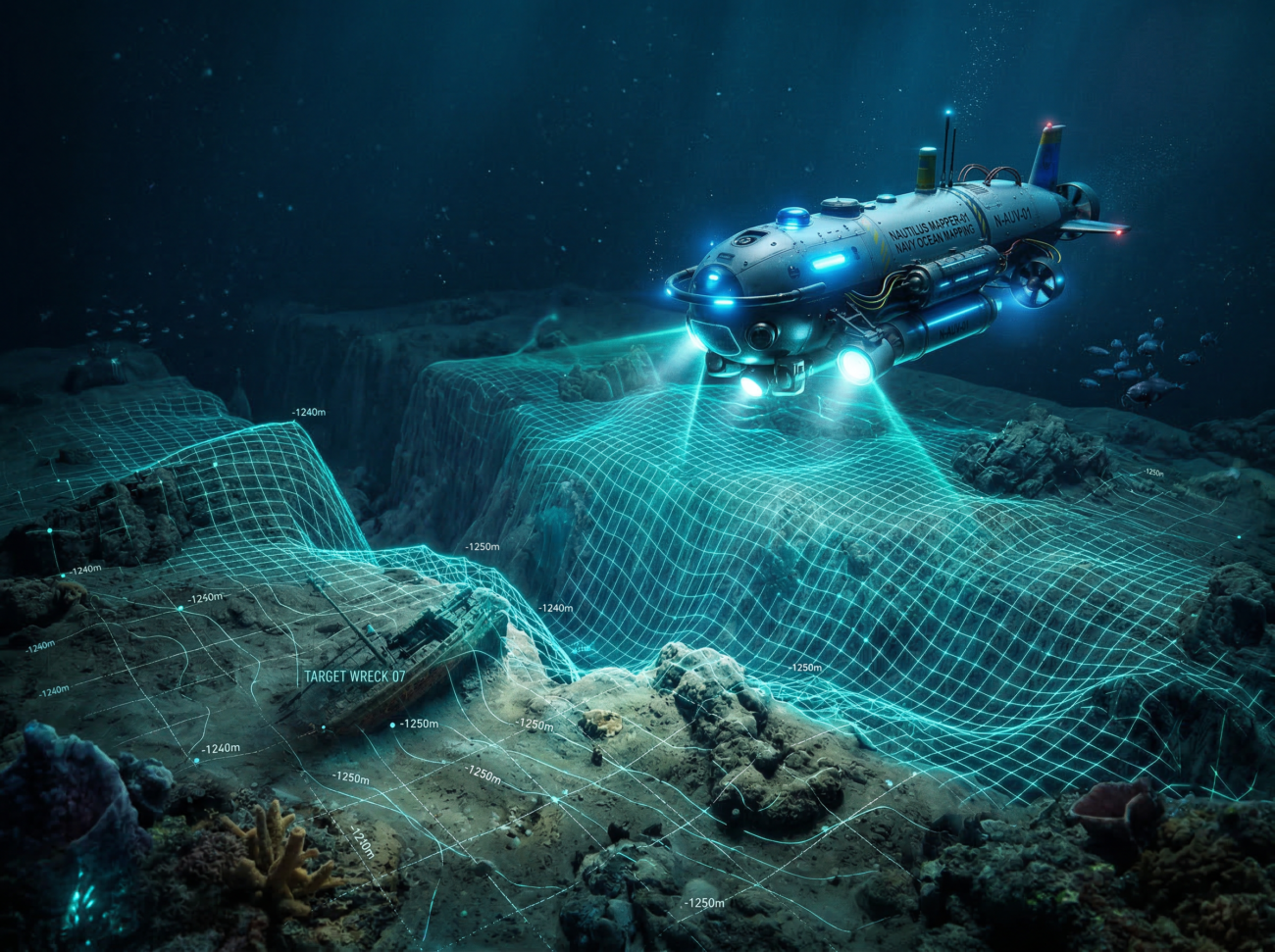
China is conducting an extensive campaign to map the ocean floor across key global regions, a move that analysts say could significantly enhance its submarine warfare capabilities and reshape the strategic balance beneath the seas.
The large-scale effort spans the Pacific, Indian and Arctic oceans, reflecting Beijing’s growing focus on undersea dominance as competition with the United States intensifies.
According to a report by Reuters, dozens of Chinese research vessels are actively surveying the seabed in strategically important areas, collecting data that could be critical for future submarine operations and maritime conflict scenarios.
Massive mapping operation across key regions
China’s activities are not limited to isolated missions but represent a coordinated, multi-year effort involving dozens of vessels and hundreds of underwater sensors.
Ship-tracking data reviewed in the report shows research vessels operating near sensitive areas such as:
- waters around Taiwan
- the U.S. military hub in Guam
- parts of the Indian Ocean
- approaches to the Malacca Strait
These regions are among the most strategically important maritime corridors in the world, both for military positioning and global trade.
One vessel, the Dong Fang Hong 3, repeatedly traversed these waters over 2024 and 2025, conducting detailed seabed mapping and monitoring operations.
Dual-use science with military implications
While China presents much of its ocean research as scientific—covering areas such as climate studies, fisheries and mineral exploration—experts say the data has clear military applications.
Seabed mapping provides detailed information about:
- underwater terrain
- ocean currents
- temperature and salinity
- acoustic conditions
This information is essential for submarine warfare.
Naval experts note that such data allows submarines to:
- navigate safely without collision
- hide more effectively from detection
- optimize sonar performance
- detect adversary submarines
The same data can also support the placement of underwater sensors and potentially even weapons systems, giving a significant advantage in undersea battles.
Building a “transparent ocean”
China’s long-term objective appears to go beyond mapping alone.
The effort aligns with a broader vision described by Chinese researchers as creating a “transparent ocean”—a system in which underwater conditions and movements can be continuously monitored.
This involves deploying networks of sensors across the seabed to track:
- submarine movements
- environmental conditions
- acoustic signals
U.S. intelligence officials have warned that such capabilities could enable persistent surveillance of submarines moving through key waterways, significantly reducing their stealth advantage.
Strategic concern for the United States
The scale and scope of China’s activities have raised alarms among U.S. and allied defense analysts.
Rear Admiral Mike Brookes of the U.S. Office of Naval Intelligence described the data collection as a strategic concern, noting that it could enable China to better track and counter foreign submarines.
For decades, the United States maintained a significant advantage in undersea warfare, partly due to superior knowledge of ocean environments.
China’s expanding mapping efforts could erode that advantage by giving its navy a detailed understanding of the maritime “battlespace.”
“This is preparation of the battlespace,” one expert noted, emphasizing that such data would be invaluable in a conflict scenario.
Shift toward blue-water naval capability
The mapping campaign reflects China’s broader ambition to transform its navy into a global force capable of operating far from its shores.
Historically focused on coastal defense, China is increasingly investing in:
- long-range naval operations
- advanced submarines
- undersea surveillance networks
The ability to operate effectively in distant waters requires detailed environmental knowledge, which China is now systematically building.
Analysts say this marks a shift toward a “blue-water navy” strategy, where undersea capabilities play a central role in power projection.
Key role of ocean data in warfare
Undersea warfare is fundamentally dependent on environmental conditions.
Sound waves—used in sonar detection—behave differently depending on:
- water temperature
- salinity
- ocean depth
- seabed composition
By mapping these variables, militaries can predict how sonar signals will travel, improving both detection and evasion capabilities.
This makes oceanographic data as important as traditional intelligence in submarine operations.
The concept is closely tied to modern naval strategy, where control of the seabed and underwater domain is becoming as critical as control of airspace or land.
Civil-military fusion strategy
China’s approach also reflects its broader “civil-military fusion” policy, which integrates civilian research and commercial activities with military objectives.
Universities, research institutes and government agencies are all involved in oceanographic projects that contribute data usable by the military.
This allows China to expand its capabilities while maintaining a civilian narrative around scientific exploration.
However, it also makes it more difficult for other countries to distinguish between purely scientific missions and those with strategic intent.
Global implications and rising competition
China’s mapping efforts are part of a wider global competition for undersea dominance.
Other major powers, including the United States, are also investing in:
- seabed surveillance systems
- advanced submarines
- underwater drones
The growing focus on undersea warfare reflects the increasing importance of protecting:
- communication cables
- energy infrastructure
- shipping routes
These assets are critical to global economic stability, making the seabed a new frontier of strategic competition.
Outlook
China’s extensive ocean mapping campaign underscores the evolving nature of modern warfare, where control of the underwater domain is becoming increasingly important.
As Beijing continues to expand its capabilities, the balance of power beneath the oceans may shift, with implications for regional security and global stability.
For now, the effort highlights a broader trend: the deep sea is no longer just a scientific frontier—it is rapidly becoming a key arena in geopolitical competition.
ALSO READ
• Janus Living shares surged 18% in their debut after raising $840 million in an IPO
• Bridgepoint, Triton Withdraw From Spire Healthcare Buyout Talks
• BOJ Holds Rates Steady as Iran Conflict Clouds Inflation Outlook
Disclaimer
This article is based on publicly available information, market developments, and credible media reports. The content is intended for informational and analytical purposes only and should not be considered financial, investment, or legal advice.