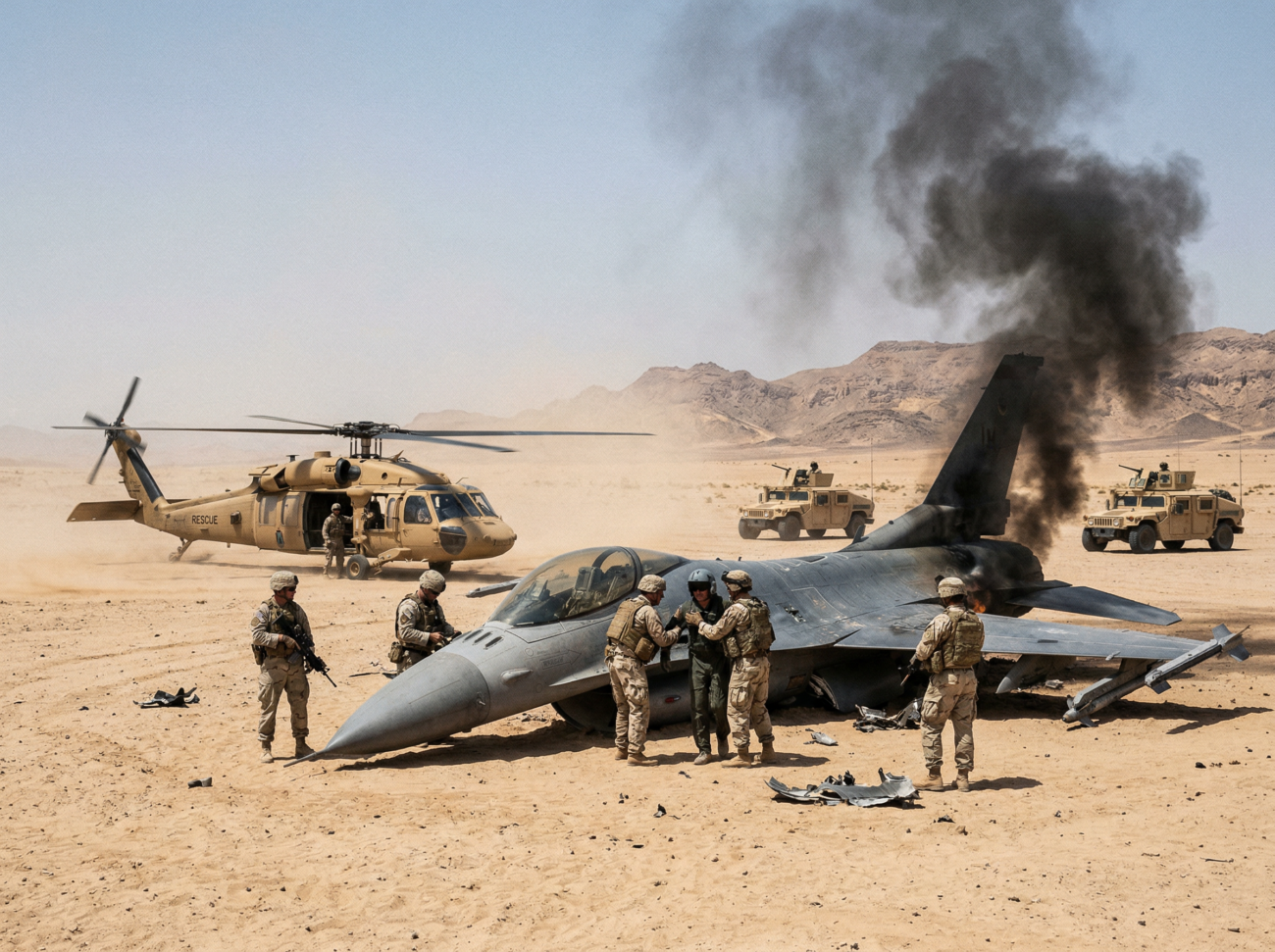
The United States is intensifying search-and-rescue operations for a missing airman after an F-15E fighter jet was shot down by Iranian forces, marking a significant escalation in the ongoing conflict. According to Bloomberg, the search comes amid continued Iranian strikes across Gulf states, highlighting the widening geographic scope of the war and increasing operational risks for U.S. forces in the region.
The incident underscores a critical turning point, as direct engagement between U.S. and Iranian forces deepens, with aerial combat now extending into contested airspace.
Incident Overview: Fighter Jet Downed, One Airman Still Missing
The F-15E aircraft, carrying two crew members, was shot down during operations over Iran. One airman has been successfully rescued, while the second remains missing, prompting an ongoing high-risk recovery mission.
The search effort is being conducted under hostile conditions, with reports indicating that rescue operations have come under fire, further complicating recovery attempts.
Escalation Signal: Multiple Aircraft Incidents Raise Stakes
The downing of the F-15E is not an isolated event. A second U.S. aircraft — an A-10 also went down in the Gulf region during related operations, although its pilot was safely rescued.
These incidents mark one of the most serious escalations in the conflict to date, signaling that Iran’s air defense capabilities are actively challenging U.S. air operations.
Search Operations: High-Risk Recovery Under Combat Conditions
The U.S. military has deployed advanced search-and-rescue teams to locate the missing airman, operating in contested territory with elevated threat levels. The mission involves coordinated air and ground efforts, supported by surveillance and reconnaissance systems.
Iranian state media has further intensified the situation by broadcasting calls for civilians to assist in locating the missing airman, even offering rewards, raising the risk of capture.
Geopolitical Context: Conflict Expands Across Gulf States
The search operation is unfolding as Iran continues to launch strikes across Gulf states, targeting both military and infrastructure assets. The broader conflict, now in its sixth week, has already triggered a global energy shock and heightened geopolitical instability.
The closure and disruption of key routes such as the Strait of Hormuz are further amplifying the economic and strategic consequences of the conflict.
Policy Response: Trump Issues 48-Hour Ultimatum
U.S. President Donald Trump has escalated rhetoric, issuing a 48-hour ultimatum to Iran to agree to a deal or face intensified military action.
This signals a potential shift toward more aggressive military engagement if diplomatic progress fails, increasing the probability of further escalation.
Military Dynamics: Air Superiority Under Challenge
The downing of U.S. aircraft raises questions about air superiority in the region. Iran’s deployment of advanced air defense systems suggests an evolving capability to counter high-end U.S. military assets.
This development complicates operational planning and increases the cost and risk associated with continued air operations over Iranian territory.
Market Implications: Geopolitical Risk Premium Intensifies
The escalation is likely to reinforce geopolitical risk premiums across global markets, particularly in:
- Energy markets (oil supply concerns)
- Defense sectors
- Global shipping and logistics
Investors are increasingly factoring in prolonged instability and potential disruption to critical trade routes.
Forward Outlook: Rescue Mission and Conflict Trajectory in Focus
The immediate focus remains on locating and safely recovering the missing airman. However, the broader trajectory of the conflict will depend on:
- Diplomatic developments within the 48-hour window
- Iran’s continued military posture
- U.S. escalation strategy
Until clarity emerges, the situation is expected to remain highly volatile.
Expert Insight
The search for the downed airman represents more than a tactical military operation as it reflects a broader shift in the conflict’s intensity and risk profile. The downing of advanced U.S. aircraft signals that the conflict is entering a phase where capability parity at least regionally is becoming a factor. This changes the strategic calculus significantly.
In a nutshell, modern conflicts are no longer defined solely by technological superiority, but by operational adaptability and asymmetric counter-capabilities. In this environment, even limited engagements can rapidly escalate into broader systemic risks impacting not just military outcomes, but global markets, energy flows, and geopolitical stability.
Written by Shalin Soni, CMA specializing in financial analysis, global markets, and corporate strategy, with hands-on experience in financial planning and analytical decision-making.
ALSO READ
• Microsoft Defends Copilot Growth as AI Monetization Concerns Rise
• Markets Rally as Trump Signals Iran War May End Within Weeks
• Microsoft Faces UK Antitrust Probe as Cloud Dominance Comes Under Scrutiny
Disclaimer
This article is based on publicly available information, market developments, and credible media reports. The content is intended for informational and analytical purposes only and should not be considered financial, investment, or legal advice.