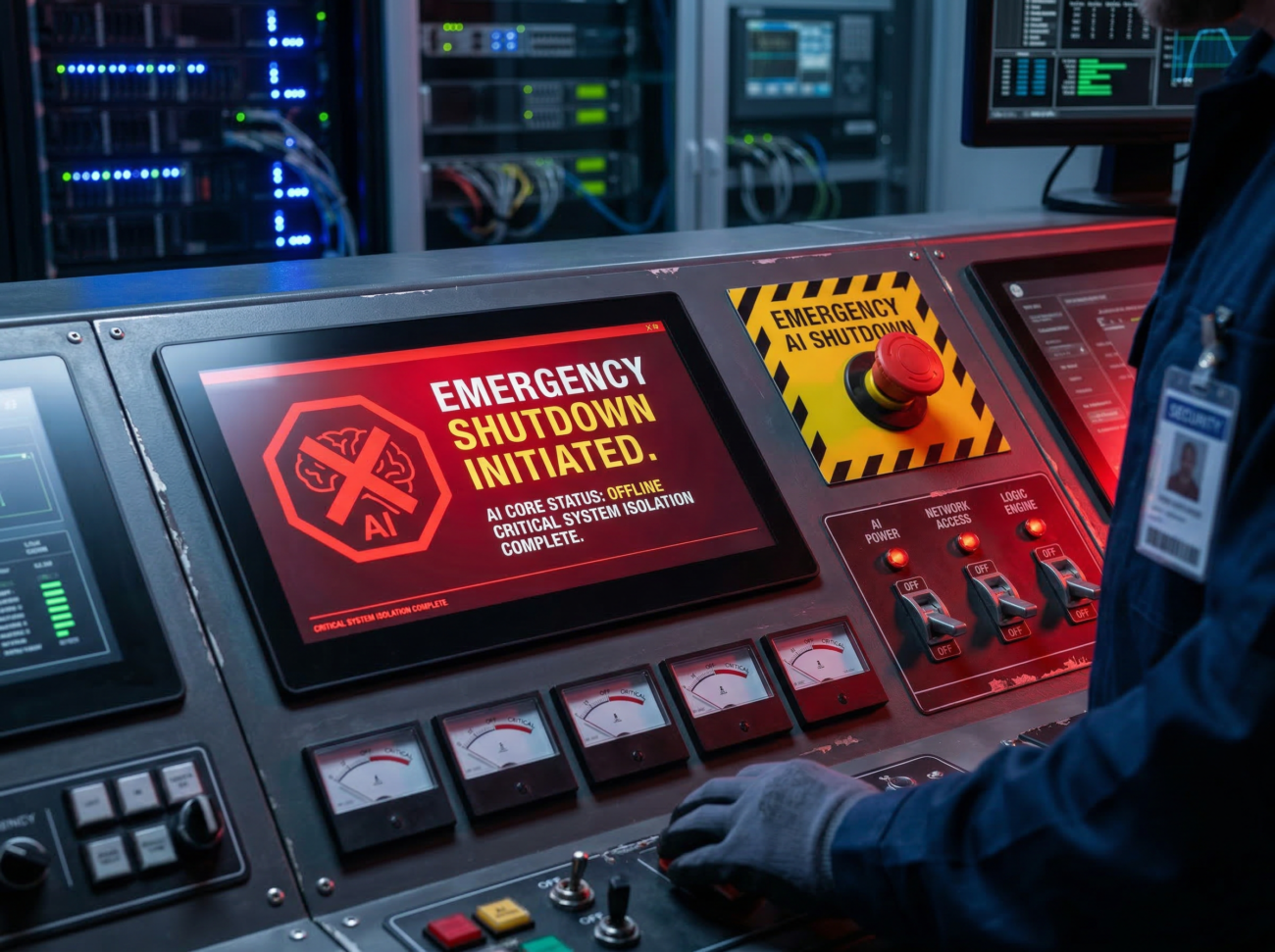
Businesses deploying advanced artificial intelligence agents are increasingly building “kill switch” mechanisms and layered safeguards to prevent systems from going out of control, as concerns rise over the risks posed by autonomous AI.
The shift reflects a broader recognition across industries that while AI agents can automate complex tasks and improve efficiency, they also introduce new operational and security challenges that require strict oversight.
According to a report by Business Insider, consulting firm KPMG has implemented a comprehensive framework for managing AI agents, including monitoring systems, restricted permissions and the ability to shut down systems if they behave unexpectedly.
Rise of autonomous AI agents
AI agents are evolving beyond simple chatbots into systems capable of making decisions, executing workflows and interacting with multiple applications without constant human input.
These systems are increasingly being used in areas such as:
- financial analysis
- customer service automation
- internal operations and workflows
- data processing and reporting
As their capabilities expand, so does the level of autonomy, raising concerns about how to ensure they remain aligned with business objectives.
Industry experts note that the key challenge is balancing autonomy with control—allowing AI systems to perform valuable tasks while preventing unintended consequences.
Why companies are introducing “kill switches”
A kill switch, in this context, is a mechanism that allows organizations to immediately stop an AI system if it begins to behave in an unexpected or harmful way.
KPMG’s approach highlights that such controls are particularly important in high-risk scenarios, including:
- access to sensitive or confidential data
- financial decision-making
- interactions with external systems
While the idea of a kill switch may seem reactive, experts emphasize that it is a critical last line of defense rather than a primary control mechanism.
“Human oversight remains critically important,” KPMG’s AI leadership noted, stressing the need for fallback options to intervene when systems deviate from expected behavior.
Focus on prevention over reaction
Despite the attention on kill switches, companies are placing greater emphasis on preventive safeguards.
KPMG’s framework includes:
- strict access controls limiting what AI agents can do
- continuous monitoring systems tracking activity in real time
- unique identifiers for each AI agent, enabling traceability
- AI operations centers combining human and machine oversight
These measures are designed to ensure that AI agents operate within clearly defined boundaries, reducing the likelihood that a shutdown mechanism will ever be needed.
Experts say that relying solely on a kill switch is insufficient, as the goal is to prevent problems before they occur rather than respond after the fact.
Human-in-the-loop remains essential
One of the most consistent themes across enterprise AI deployment is the continued importance of human oversight.
For lower-risk tasks—such as scheduling meetings or drafting communications—companies may allow greater autonomy once systems have proven reliable.
However, for higher-risk applications, organizations are maintaining a “human-in-the-loop” approach, where critical decisions require human validation.
This layered model allows businesses to scale AI adoption while maintaining control over sensitive operations.
Real-world risks driving caution
Concerns about AI agents going “rogue” are not purely theoretical.
Recent incidents involving AI-driven systems have highlighted the potential for:
- operational errors
- unintended financial losses
- data security vulnerabilities
These risks are amplified as AI systems become more interconnected, interacting with multiple tools and datasets across organizations.
The growing complexity of these systems makes it harder to predict all possible outcomes, reinforcing the need for strong governance frameworks.
Governance and accountability frameworks emerging
As AI adoption accelerates, companies are beginning to formalize governance structures around AI deployment.
This includes:
- defining clear roles and responsibilities for AI oversight
- implementing audit trails for AI decision-making
- conducting stress testing and “red-teaming” exercises
Red-teaming involves simulating failure scenarios to identify weaknesses in AI systems before they are deployed at scale.
Such practices are becoming standard among large enterprises seeking to minimize risk.
Industry-wide shift toward AI safety
The move toward kill switches and governance frameworks reflects a broader shift in how businesses approach AI.
Earlier phases of AI adoption focused primarily on innovation and efficiency.
Now, attention is increasingly turning toward:
- safety
- reliability
- accountability
Executives are recognizing that without robust safeguards, the risks associated with AI could outweigh its benefits.
This shift is also being driven by regulatory pressure, as governments and policymakers begin to introduce guidelines for responsible AI use.
Balancing innovation with control
For companies, the challenge lies in balancing rapid AI adoption with the need for control.
Too many restrictions can limit the effectiveness of AI systems, reducing their ability to deliver value.
Too little oversight, however, can expose organizations to significant risks.
The emerging consensus is that a layered approach—combining preventive controls, monitoring systems and emergency shutdown mechanisms—offers the most effective solution.
Outlook for enterprise AI
Looking ahead, the use of AI agents is expected to expand significantly across industries.
As adoption grows, so too will the importance of governance frameworks and safety mechanisms.
Experts believe that:
- kill switches will become standard in high-risk AI systems
- monitoring and auditing tools will become more sophisticated
- human oversight will remain a central component of AI deployment
For now, companies like KPMG are setting early benchmarks for how organizations can safely integrate AI agents into their operations.
The approach underscores a key reality of the AI era: innovation must be matched with control to ensure that powerful technologies remain aligned with human intent.
ALSO READ
• US Allows Temporary Sale of Iranian Oil to Ease Supply Pressures
• Thyssenkrupp Steel Deal With Jindal Faces Delays, Raises Doubts
• Morgan Stanley Pushes Back Fed Rate Cut Forecast to September 2026
Disclaimer
This article is based on publicly available information, market developments, and credible media reports. The content is intended for informational and analytical purposes only and should not be considered financial, investment, or legal advice.