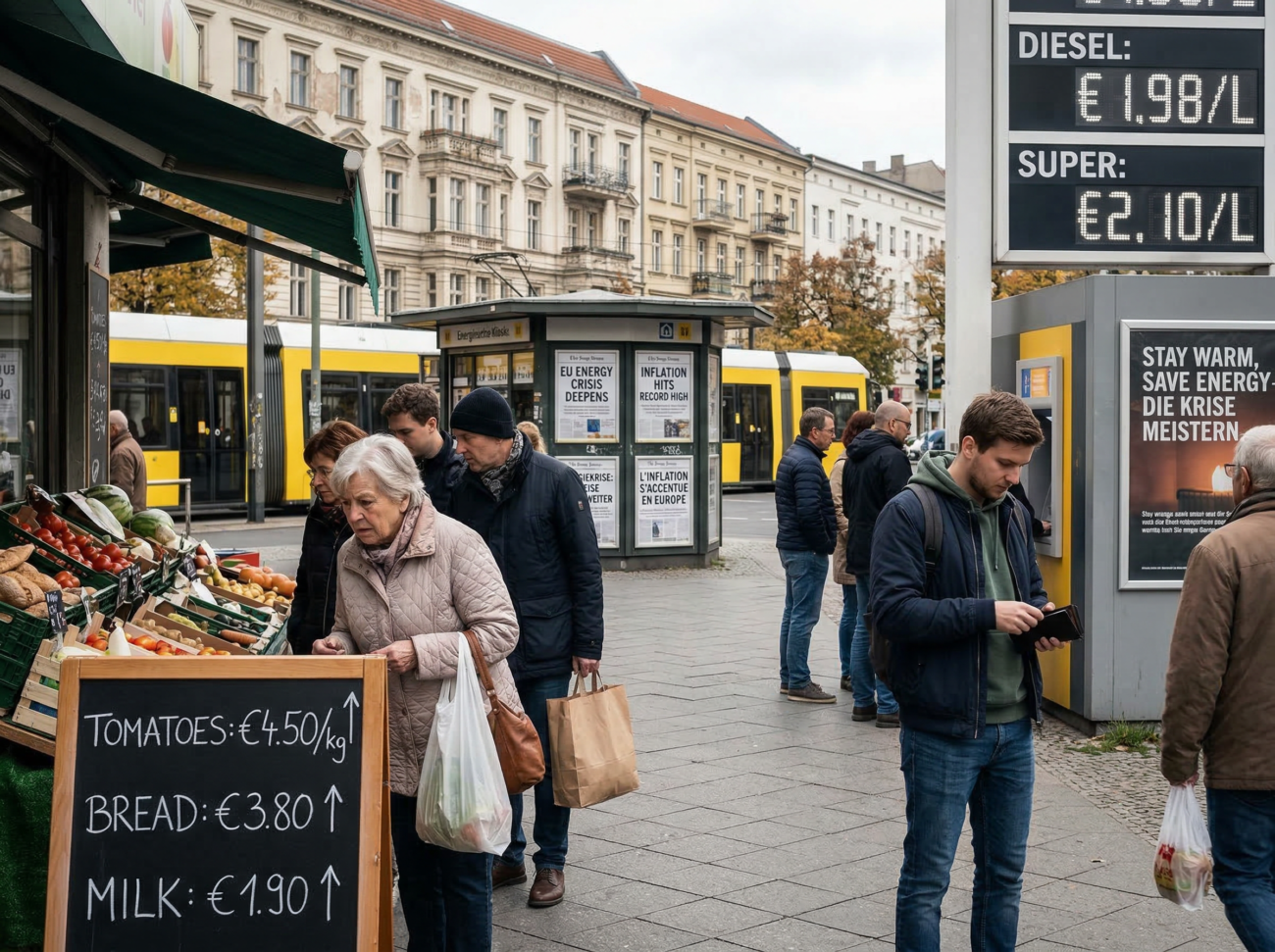
European Union officials have warned that escalating tensions in the Middle East could push inflation across the euro area above 3% this year, raising concerns about economic stability and monetary policy across the region.
The warning comes as oil and gas prices rise sharply following the conflict involving Iran, which has disrupted global energy markets and revived fears of another energy-driven inflation surge in Europe.
According to a report by Bloomberg, EU policymakers said inflation in the bloc could exceed 3% if the conflict keeps oil prices near $100 per barrel and natural gas prices elevated for a prolonged period.
The warning highlights the continued vulnerability of Europe’s economy to energy price shocks, particularly after the region experienced severe inflation pressures during the energy crisis following Russia’s invasion of Ukraine in 2022.
Energy markets driving inflation concerns
Energy costs remain one of the most significant drivers of inflation across Europe.
When oil and gas prices increase, the effects quickly spread across the broader economy. Transportation, manufacturing, and electricity generation all rely heavily on energy inputs, meaning that rising fuel costs often lead to higher prices for goods and services.
The current geopolitical crisis has already caused significant volatility in global energy markets.
The war involving Iran has disrupted oil flows and increased uncertainty around shipping routes in the Middle East, particularly in the Strait of Hormuz — a critical chokepoint for global oil transportation.
Roughly one-fifth of the world’s seaborne oil supply passes through this narrow waterway, making any disruption there a major concern for global energy markets.
As a result, crude oil prices have climbed significantly in recent weeks, raising fears that Europe could face renewed inflationary pressures.
Potential impact on Europe’s economic outlook
European policymakers worry that another surge in energy prices could slow economic growth while pushing consumer prices higher — a combination that economists often describe as stagflation.
Higher fuel prices increase production costs for businesses and reduce consumers’ purchasing power.
Industries such as transportation, chemicals, steel manufacturing, and agriculture are particularly sensitive to energy costs.
For households, rising energy bills can quickly translate into higher living expenses, especially during periods of volatile global energy markets.
Analysts warn that if oil prices remain elevated for several months, the eurozone could experience a noticeable increase in inflation rates during the second half of the year.
Some economic projections suggest inflation could briefly exceed the 3% level if energy prices remain near or above $100 per barrel.
European Central Bank monitoring risks
The European Central Bank (ECB) is closely monitoring the situation as it evaluates its monetary policy strategy.
After several years of aggressive interest-rate increases aimed at controlling inflation, the ECB had recently begun signaling a more cautious stance as price pressures gradually stabilized.
However, the conflict involving Iran has introduced new uncertainty into the economic outlook.
ECB policymakers have warned that prolonged geopolitical tensions could drive inflation higher again and complicate the central bank’s policy decisions.
If energy prices continue to rise, central bankers may face pressure to maintain tighter monetary policy for longer than previously expected.
This could slow economic growth across the eurozone, particularly in energy-dependent sectors.
Europe’s continued dependence on energy imports
One of the reasons the EU remains vulnerable to global energy shocks is its reliance on imported fossil fuels.
Although the bloc has made significant progress in expanding renewable energy capacity, oil and natural gas still play a crucial role in powering European industries and households.
Many EU countries rely on imported energy supplies from the Middle East and other regions.
This dependence means that geopolitical developments outside Europe can quickly affect domestic economic conditions.
The conflict involving Iran has once again highlighted the strategic importance of secure energy supply chains.
European policymakers have been working to diversify energy sources since the Russia-Ukraine conflict disrupted gas supplies in 2022.
However, building new energy infrastructure and expanding renewable energy capacity takes time.
In the short term, global oil and gas prices remain a major factor shaping Europe’s inflation outlook.
Global economic ripple effects
The economic impact of the Iran conflict is not limited to Europe.
Energy price spikes triggered by geopolitical tensions can affect economies around the world.
When oil prices rise, transportation costs increase and production expenses rise across many industries.
These effects can push inflation higher across multiple countries simultaneously.
The ongoing conflict has already caused oil prices to climb above $100 per barrel in some markets, raising concerns among economists about the risk of global inflationary pressure.
Financial markets have also experienced volatility as investors react to the uncertainty surrounding energy supply disruptions.
Lessons from past energy crises
European policymakers are particularly cautious because of the experience of the recent energy crisis.
After Russia’s invasion of Ukraine in 2022, energy prices surged dramatically, pushing inflation across the eurozone to multi-decade highs.
That period forced central banks to raise interest rates aggressively and triggered significant economic strain across many European countries.
Although inflation has since moderated, the memory of that crisis remains fresh for policymakers.
Many officials fear that another prolonged energy shock could undo the progress made in bringing inflation back under control.
Outlook for inflation and growth
For now, the future trajectory of inflation in Europe will depend heavily on developments in global energy markets.
If the geopolitical tensions ease and oil prices stabilize, the inflation impact could remain limited.
However, a prolonged conflict that keeps energy prices elevated could create a new inflation wave across the eurozone.
Economists warn that such a scenario would force policymakers to balance two competing priorities: controlling inflation while protecting economic growth.
As global energy markets continue to respond to geopolitical developments, European officials will be closely monitoring both oil prices and supply disruptions in the coming months.
ALSO READ
• CVC Capital Partners Posts Annual Profit Slightly Above Expectations
• US Core Inflation Slows Ahead of Iran War as Price Pressures Ease
• Oil Prices Surge Amid Iran Conflict Before Pulling Back from Multi-Year Highs
Disclaimer
This article is based on publicly available information, market developments, and credible media reports. The content is intended for informational and analytical purposes only and should not be considered financial, investment, or legal advice.